
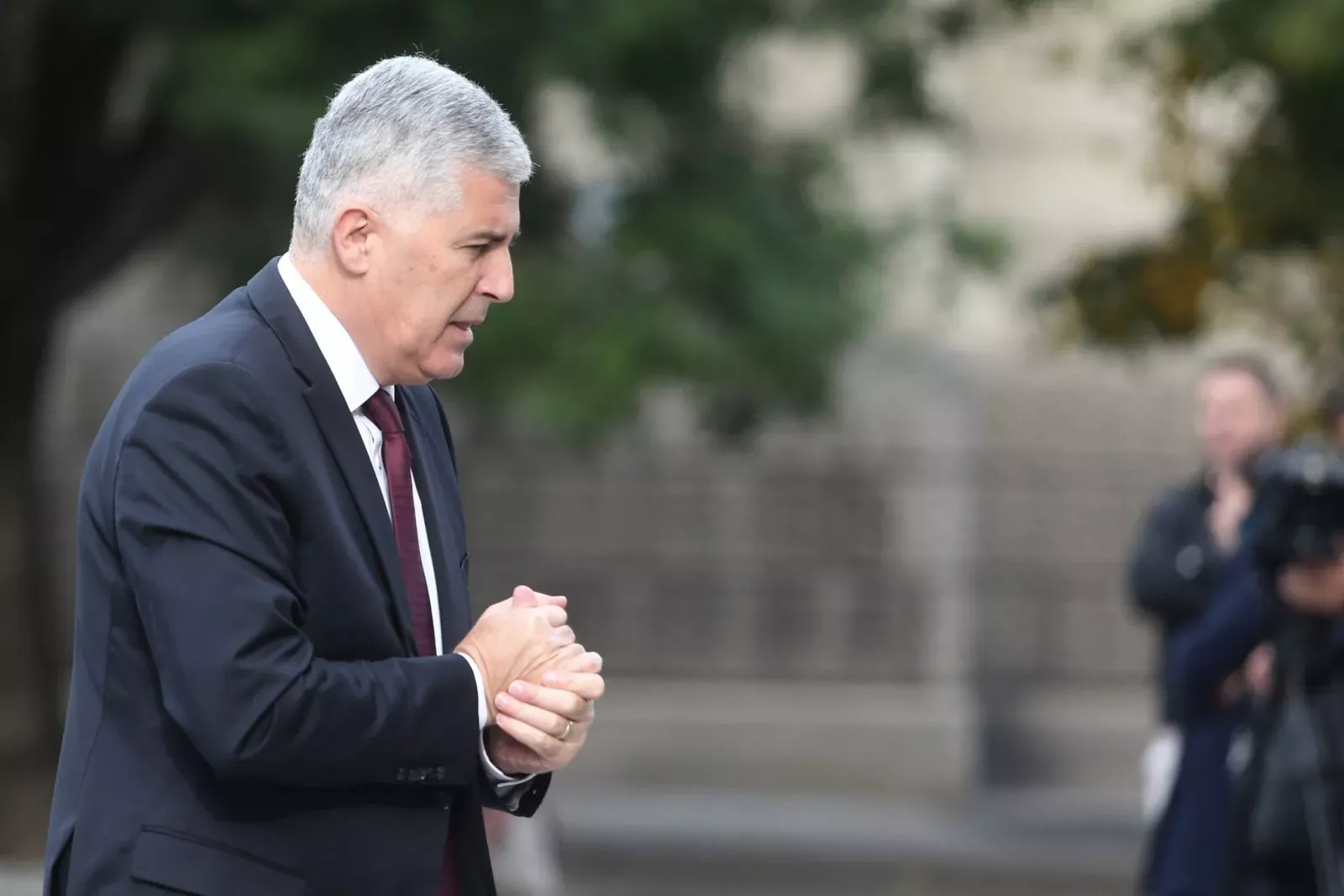
In a political environment that has been functioning on the brink of institutional stability for years, symbols are never just symbols. They are messages, tests of strength, and often a prelude to broader political processes.
Not so long ago, amid discussions about the verdict in the "Kovačević vs. Bosnia and Herzegovina" case, Dragan Čović's politics threatened "unrest in the south." This was not merely a thoughtless statement, but a form of political pressure that has too often proven to be an effective tool in BiH.
However, such methods are used exclusively by opponents of the state of Bosnia and Herzegovina, while pro-Bosnian forces resort to the method of compromise, but almost always to the detriment of the most numerous people.
Thus, after the 'threats of unrest in the south,' political agreements followed, international negotiations, and, ultimately, solutions that largely fit into the well-known HDZ matrix of ethno-territorial reorganization of the state.
Čović and his political circle emerged from that process further strengthened, firmly positioned in power, and with a clear sense that political capital in BiH is not lost; it is merely redistributed through crisis cycles.
Now, a period of political dynamics traditionally used to open up "big questions" is approaching again.
In this context, one increasingly gets the impression that international actors, under the guise of "preserving stability," are entering into processes that long-term cement existing ethnic political divisions, rather than overcoming them.
Such a policy, already seen in earlier phases of European verdicts and negotiations, leaves room for new internal tensions.
However, political pressures today do not only come through formal negotiations. They are increasingly manifested through local incidents and symbolic moves that raise tensions in the public sphere.
The latest such incident was recorded in Čapljina. Flags of BiH were removed, and apart from the Democratic Front, no one reacted. I particularly note that the Troika is silent.
We will also recall the case in Široki Brijeg, where the actions of Sanin Musa and his public performance were presented as a fight for religious rights, even though it took place in an environment that is demographically almost completely homogeneous.
According to official data from the 2013 census, only a symbolic number of Muslims live in that town, which further raises the question of the real purpose and political context of such activities.
When such events are placed in a broader regional framework, they easily fit into narratives that already exist in political discourse, including those that attempt to portray Bosniaks through the prism of a security problem, which is often reflected in Milorad Dodik's rhetoric about "radicalization."
The Islamic Community reacted measuredly in this case and called for calming tensions, thereby, at least institutionally, lowering the level of potential political escalation.
But, after some relaxation of relations began to be advocated more strongly, pressures from the HDZ have intensified.
This was illustrated precisely in the removal of the flags of Bosnia and Herzegovina in Čapljina. That act, regardless of how local actors justify it, was perceived in the public as a strong political message.
In a country where the state flag is itself a subject of political interpretations, its removal cannot be viewed as an administrative detail, but as a symbolic act with clear implications.
In combination with other incidents, such moves contribute to an atmosphere in which the state is not built as a common space, but its visibility and presence on the ground are constantly challenged anew. It is precisely here that space opens up for political actors who do not perceive crises as a problem, but as an instrument.
Therefore, the upcoming political months should not be viewed as a routine cycle of negotiations and waiting for elections. They are a potential framework for a new phase of institutional re-examination of BiH, in which it will again be decided who defines the rules of the game and who merely reacts to them.
If such processes are again met unprepared, the result will not be a political surprise, but a repetition of a well-known pattern in which decisions are made outside the country, and the consequences remain within it.
And that, in political terms, is not an oversight. It is continuity.
Komentari (0)
Prijavite se za komentiranje
PrijavaJos nema komentara. Budite prvi!
Minuta
Sve →Iz drugih kategorija

High Representative Not Elected: Germans, French and British Sabotaged Americans, New Attempt at End of June

ČOVIĆ WITHOUT MERCY: How Those Who Brought Ademović to Office Created a Political Hell for Him



Sunny Saturday, quite warm



Tragedy in Albanian resort: Two minors drown












