

By Avdo Avdić/Istraga.ba
The current situation in BiH requires caution before making a decision that could be interpreted as delegitimizing the constitutional framework of BiH as a whole, writes in a letter that, within the case "Slaven Kovačević v. BiH", the British law firm Blackstone Chamber on behalf of the High Representative Christian Schmidt submitted to the European Court of Human Rights in Strasbourg.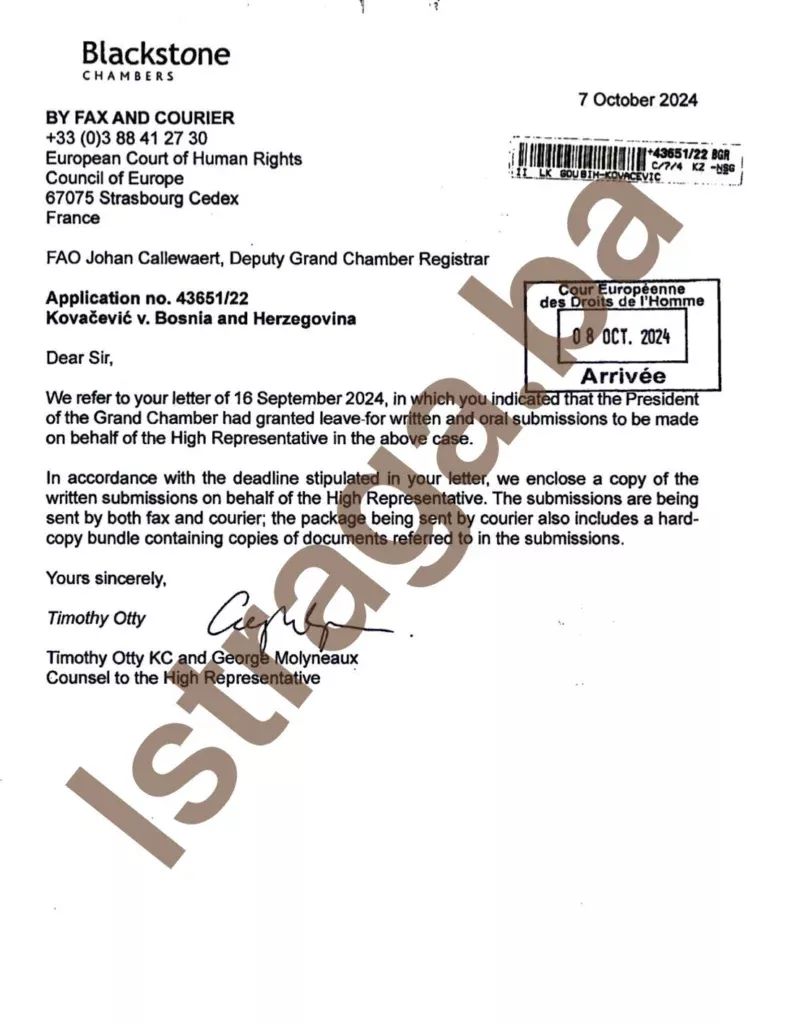
Although the President of the European Court of Human Rights allowed Schmidt to address the Court as a third party, on the condition that he did not speak about the facts and merits of the case itself, the High Representative violated this. Schmidt, in the letter which you can read at this link, entered into the merits of the "Slaven Kovačević v. BiH" case several times.
"If it is concluded that this framework can only be reconciled with the convention to the detriment of the power-sharing mechanisms, this could further undermine the already fragile foundations of BiH," Schmidt wrote.
In the letter itself, Schmidt refers several times to the dissenting opinion of Austrian judge Gabriele Kucsko-Stadlmayer, who was the only one to vote against the decision to accept Slaven Kovačević's application. Furthermore, Schmidt states that Judge Kucsko "correctly noted" that "proportionality" should be adapted to contexts.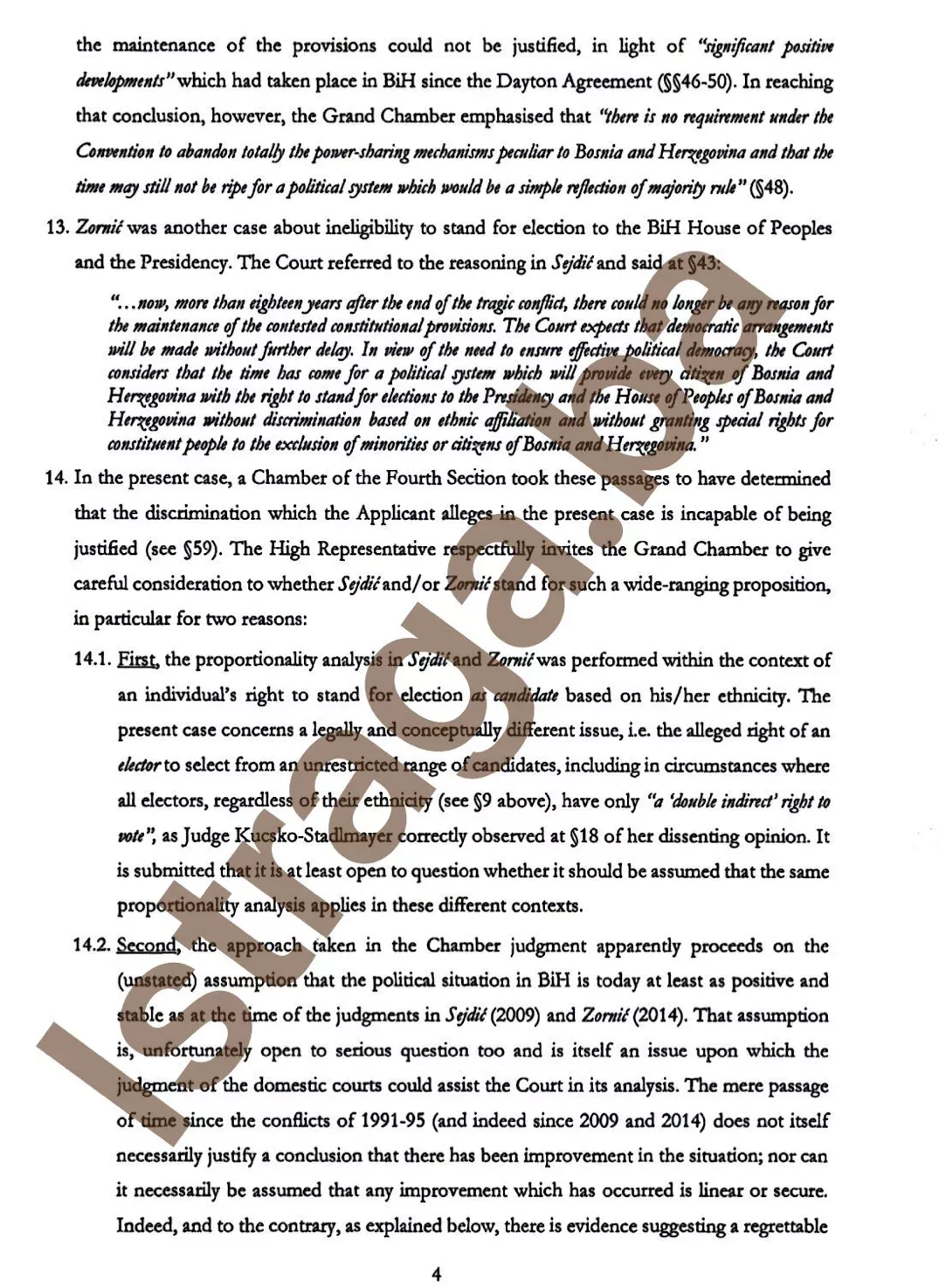
"This case concerns a legally and conceptually different issue, i.e., the alleged right of an elector to choose from an unlimited range of candidates, including cases where all voters, regardless of their ethnic affiliation, have only a 'doubly indirect' right to vote", as Judge Kucsko-Stadlmayer correctly noted on page 18 of her dissenting opinion.
"It is at least open to debate whether the same proportionality analysis should be assumed to apply in these different contexts," stated Schmidt, addressing the European Court of Human Rights through a law firm from London.
At the same time, Schmidt is also reviewing the positions of the judges of the European Court who voted to accept Kovačević's application. This is the position which concluded that Slaven Kovačević could not seek legal protection from the Constitutional Court of BiH, because their position is known through the cases Sejdić-Finci and Zornić.
"The Chamber of the Fourth Section considered that an appeal to the Constitutional Court would be 'bound to fail', in light of certain decisions of the Constitutional Court cited in the judgment. The High Representative respectfully considers that the Chamber's reasoning in this regard is at least open to serious question, and calls on the Grand Chamber to carefully review Judge Kucsko-Stadlmayer's analysis on this issue," stated Schmidt.
As an argument, Schmidt again quotes Judge Kucsko-Stadlmayer, stating that she correctly determined that the "Constitutional Court of BiH is a very specific institution, different from all other constitutional communities in Europe".
Therefore, Christian Schmidt is asking the European Court of Human Rights not to rule on the Kovačević case, but to refer the applicant to the Constitutional Court of BiH.
"The High Representative considers that it would be premature to definitively conclude that an appeal to the Constitutional Court would not be an effective remedy," wrote Schmidt.
Christian Schmidt, first and foremost, warns the judges in Strasbourg that the Kovačević ruling could destabilize BiH.
"If and to the extent that it is necessary to assess whether any interference with the applicant's rights under Article 14 and/or A1P12 was proportionate, the High Representative calls on the Grand Chamber to take into account his assessment of the current political situation in BiH, as stated in his periodic reports to the Secretary-General of the United Nations.
As briefly summarized here, the reports show that there have been unprecedented attacks on the Dayton Agreement and the territorial integrity, sovereignty, and multi-ethnic character of BiH and its institutions. The High Representative draws the Court's attention to his last four reports covering the period from the elections that are the subject of the applicant's complaint," stated Schmidt.
Let us recall, the European Court of Human Rights in Strasbourg ruled that Slaven Kovačević was discriminated against on both ethnic and territorial grounds because he could not elect members of the BiH Presidency from RS and delegates from RS to the House of Peoples of the BiH Parliament.
After that, BiH agents close to HDZ requested a review of the proceedings from the European Court, referring to the dissenting opinion of Austrian Gabriele Kucsko-Stadlmayer.
The Court accepted to re-examine the judgment before the Grand Chamber. Christian Schmidt then intervened in the case, asking to present his opinion. He did not have the consent of the Peace Implementation Council.
The Court allowed Schmidt to address it, but not to enter into the merits of the case. However, the High Representative, as you can see, directly cited the dissenting opinion of the judge from Austria as a relevant position on certain issues of the case.
Komentari (0)
Prijavite se za komentiranje
PrijavaJos nema komentara. Budite prvi!
Minuta
Sve →Iz drugih kategorija

High Representative Not Elected: Germans, French and British Against Americans, New Attempt at End of June

ČOVIĆ WITHOUT MERCY: How Those Who Brought Ademović to Office Created a Political Hell for Him



Sunny Saturday, quite warm



Tragedy in Albanian resort: Two minors drown












