
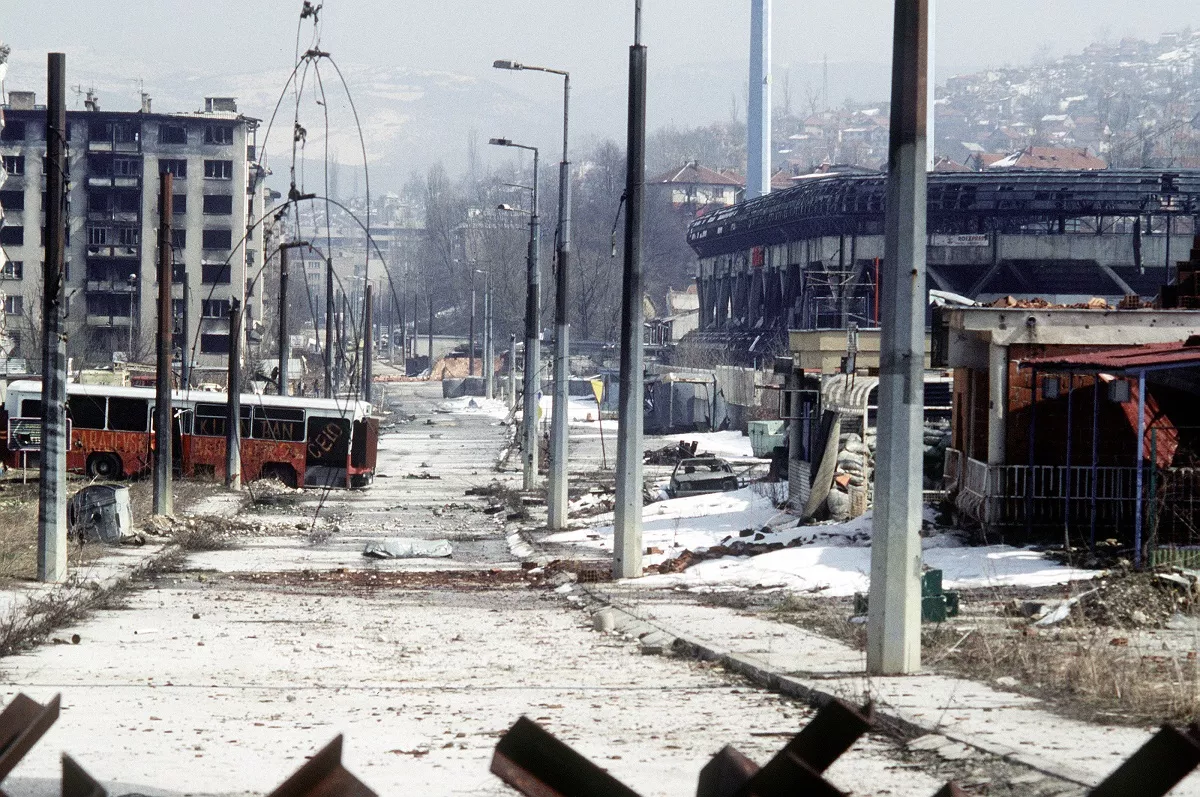
(Patria) - On this day - April 5, 1992, the siege of Sarajevo began, and it ended on February 29, 1996. It lasted 1,425 days.
During that time, about 350,000 residents were exposed to daily fire from members of the former JNA and paramilitary formations, and later members of the then Army of Republika Srpska, from almost all types of weapons, from positions located on the surrounding hills.
11,541 citizens killed
They did not manage to take the city only thanks to the immense will, desire, and efforts of the defenders, mostly citizens who responded to the call for defense and, initially almost unarmed, in sneakers and jeans, with minimal weaponry, stood on the city's ramparts.
During the siege, 11,541 citizens of Sarajevo were killed, including 1,601 children. According to post-war research, most residents, almost four-fifths of the total number of killed, died in the first two years of the war.
The first civilian victims of the siege of Sarajevo were Suada Dilberović and Olga Sučić. They were killed on April 5 at the Vrbanja Bridge, not far from the building of the then Assembly of the Socialist Republic of Bosnia and Herzegovina, in front of which demonstrations of citizens demanding peace were taking place, and fire was opened on them.
The former Vrbanja Bridge today bears the names of these two brave women, and a plaque in its center, facing east, where the sun rises every day, reminds and warns intentional and accidental passers-by of the city's difficult past.
The last victim of the siege of Sarajevo was Mirsada Durić, who was killed in an attack on a tram on January 9, 1996, near the National Museum, also near the BiH parliament building.
The perpetrators of the attack, which occurred on the first day the tram ran after the signing of the Peace Agreement for Bosnia and Herzegovina, were never discovered.
According to eyewitness accounts, the mortar shell that hit the tram was most likely fired from the direction of the settlements of Grbavica and Vraca, then still under the control of Serb units, and passengers fleeing the tram were shot at with sniper fire.
Thirty-three years later, many who survived hell in this city still get goosebumps at the mere thought of what happened from 1992 to 1996. A target was "drawn" on the back of every Sarajevan for all 44 months of the siege.
City districts, neighborhoods, streets, squares, all important and less important buildings, apartment buildings, private houses were targeted with various weapons. Many buildings - the city maternity hospital at Jezero, the central Post Office, the City Hall with tens of thousands of valuable books, the Olympic Museum, the building of the daily newspaper "Oslobođenje", numerous factories, schools, cultural institutions... - were burned to the ground after being hit by mortar and other types of projectiles.
Some buildings, such as the building of the Radio Television of Bosnia and Herzegovina, were also hit by so-called modified aerial bombs weighing up to 250 kilograms, for which there is testimony and reports from ballistics experts from the trials for crimes committed during the war in Bosnia and Herzegovina before the International Criminal Tribunal for the former Yugoslavia.
On July 12, 1993, 14 civilians were killed and 16 wounded in the explosion of a shell in Dobrinja, quadrant 5. The shell was fired at a place in a private yard where there was a well and a pump, and people waited for 10-12 hours to get water.
Citizens were also killed by artillery shells in bread lines. The distribution point, where bread was brought from Velepekara, was located on Vase Miskina Street (now Ferhadija), across from the City Market. The explosion that morning, May 27, 1992, shook the surrounding neighborhoods.
The market and the covered market Markale in the old part of Sarajevo were shelled on two occasions. The first time, on February 5, 1994, 68 civilians were killed and 144 wounded by the explosion of a shell at the Markale market. In the massacre at the very end of the war, on August 28, 1995, 43 civilians were killed and 84 wounded near the Markale City Market.
Children in schools were not spared either. In the settlement of Alipašino Polje, on ZAVNOBIH Square, were the premises of the Primary School "Prvi maj" (today OŠ "Fatima Gunić"), which was shelled on November 9, 1993. Shrapnel that entered the classroom through small openings in the protective concrete partition killed teacher Fatima Gunić and three students, and 21 civilians were wounded.
Children were also targeted
In the explosions of shells fired at the city, children who went out to get fresh air and socialize with their peers after days and nights spent in basements and shelters were killed.
The International Criminal Tribunal for the former Yugoslavia sentenced Stanislav Galić, former commander of the Sarajevo-Romanija Corps of the Army of Republika Srpska, to life imprisonment for terrorizing the citizens of Sarajevo. Galić's successor as head of the Sarajevo-Romanija Corps of the VRS, Dragomir Milošević, was sentenced to 29 years in prison.
For terrorizing civilians in Sarajevo with sniper and artillery attacks, among other things, the former president of Republika Srpska and military leader of the VRS, Radovan Karadžić, was sentenced to life imprisonment.
To the same life sentence at the Hague Tribunal, among other things, for terrorizing civilians in Sarajevo with sniper and artillery attacks, the commander of the VRS, Ratko Mladić, was also sentenced.
The ICTY judgments established that the units of the Sarajevo-Romanija Corps of the VRS intentionally targeted civilians, carrying out a campaign of terror aimed at pressuring the authorities in Sarajevo.
Komentari (0)
Prijavite se za komentiranje
PrijavaJos nema komentara. Budite prvi!
Minuta
Sve →Iz drugih kategorija

High Representative Not Elected: Germans, French and British Against Americans, New Attempt at End of June

ČOVIĆ WITHOUT MERCY: How Those Who Brought Ademović to Office Created a Political Hell for Him



Sunny Saturday, quite warm



Tragedy in Albanian resort: Two minors drown












