
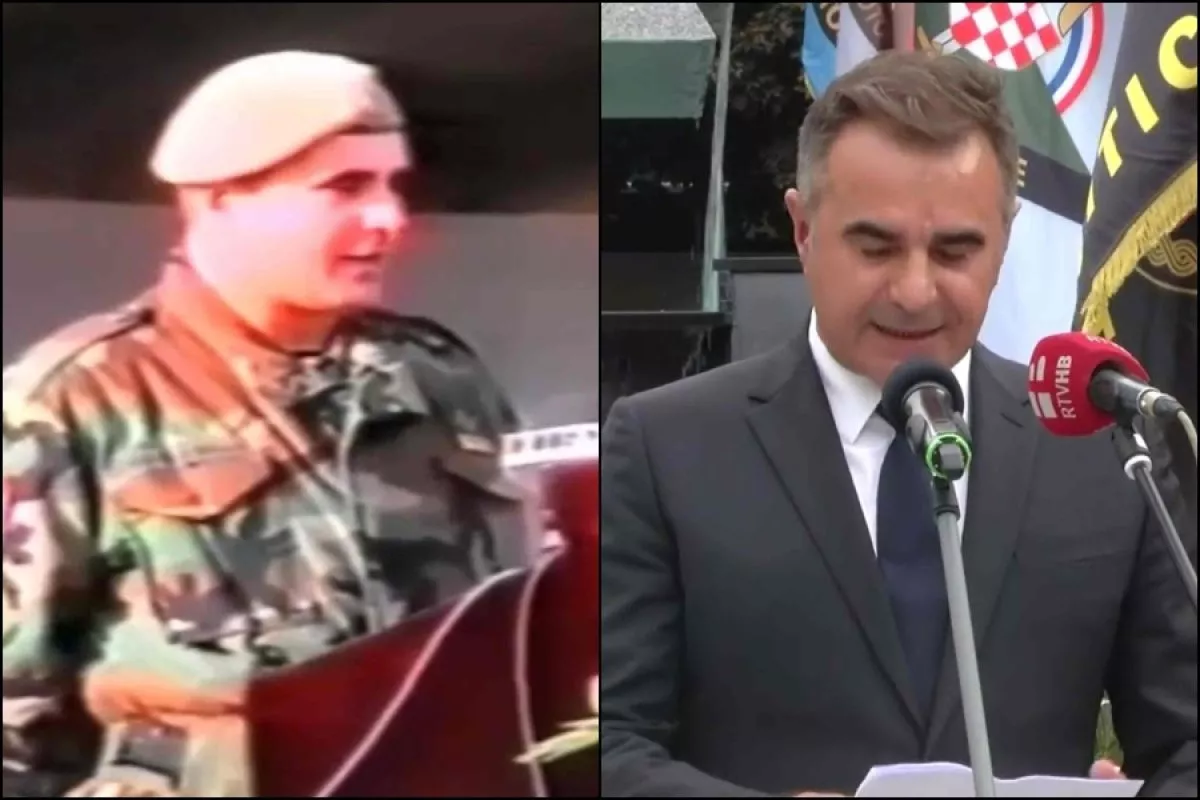
By: Samir Begović/Slobodna Bosna
With thousands of likes and hundreds of thousands of views on social networks, the speech by HVO General Stanko Sopta yesterday was accompanied by a pause in the middle of the speech due to the adhan from the Jajce mosque.
Social media users, many of them Bosniaks, enthusiastically commented on this act by General Sopta, stating that it is an example of honor and humanity.
Sarajevo media would have followed Sopta's act in the same way, uncritically treating his wartime and post-war biography.
Who is General Stanko Sopta?
Known by the nickname “Stari” during the war, Sopta was, according to Hague documentation, the deputy of the infamous Mladen Naletelić Tuta at the beginning of the war, commander of the criminal HVO Široki Brijeg Punishment Battalion, who was sentenced to 20 years in prison for the ethnic cleansing of Bosniaks in the Mostar and Jablanica areas.
After that, he served as commander of the 3rd HVO Brigade until December 1993, when he took command of the newly formed 2nd HVO Guards Brigade “Knez Domagoj”. The brigade was formed by order of the president of HR HB Mate Boban on December 29, 1993, and its composition included units of the “Punishment Battalion” and the VP Light Assault Battalion “Jure i Boban”, and by the end of 1995, the 60th Guards Battalion “Ludvig Pavlović” and PPN “Gavran 2” were included. Its headquarters was in the Stanislav Baja Kraljević barracks in Rodoč, a southern suburb of Mostar.
Shortly after its formation, the brigade had its first clashes with the Army of RBiH in the Gornji Vakuf area. In the last major offensive on this municipality in Central Bosnia, with massive use of artillery and armored vehicles, in February 1994, the brigade commanded by Sopta had the task of breaking through the Army of RBiH positions around the city, but in battles that lasted several days, the brigade achieved only modest results in terms of shifting the lines forward, but the final goal was not achieved. Gornji Vakuf was successfully defended. Due to massive shelling of civilian facilities, several civilians were killed in Gornji Vakuf.
After the signing of the Washington Agreement, the brigade commanded by Sopta was deployed to the fronts against the Serbian aggressor.
Sopta's name was very important for the Prosecutors of the Hague Tribunal in proving the international character of the conflict in BiH. Namely, the Trial Chamber of the Hague Tribunal stated in the verdict against the “Croatian Six” in 2013 that several senior HVO officers were simultaneously members of the Croatian Army.
“For example, Željko Šiljeg, commander of the HVO Northwest Herzegovina Operational Zone, was a colonel in the HV. Vladimir Primorac, from the 145th HV Brigade, served as deputy commander of the 3rd Battalion of the HVO Military Police,1135 and Nedjeljko Obradović, who was the commander of the 1st HVO Brigade “Knez Domagoj” on January 21, 1993, was assigned to the 116th HV Brigade on the same date. Stanko Sopta, a colonel in the HV, held the position of deputy commander of the HVO “Punishment Battalion” and commander of the 3rd HVO Brigade,” the Hague Court verdict states.
The Hague Tribunal also concluded in the verdict against the “Croatian Six” that Sopta was one of the officers who had operational jurisdiction over the control of the Heliodrom camp, where Bosniak civilians were forcibly held, mistreated, and killed.
In the early 2000s, the media often wrote that the Hague Court would indict Sopta along with other high-ranking HVO officers who would later be convicted in the case known as the “Croatian Six”:
Sopta's name was often mentioned in conjunction with the infamous manager of the Heliodrom camp, Zlatan Mijo Jelić. However, while the BiH Prosecutor's Office indicted Jelić, who then immediately fled to Croatia, there is no known indictment against Sopta, although investigations were certainly conducted. Sopta, therefore, as we saw yesterday in Jajce, moves freely in our country.
Perhaps that is why Sopta, before making the move that caused positive reactions in our public, made a very ugly gesture that the media did not pay attention to. Namely, at the beginning of his address, he conveyed greetings from General Zlatan Mijo Jelić, a war criminal and fugitive from BiH justice, to the people of Jajce.
Even after the war ended, Sopta clearly indicated through his behavior which ideas he followed and fought for. For example, at the formation of the 2nd HVO Guards Brigade on January 9, 1996, he sang the infamous Ustasha song “Evo zore, evo dana” which glorifies Ustasha crimes from World War II.
After the war, in 2003, Sopta was also placed on the US blacklist due to suspicions of war crimes.
However, all of this, Sopta's interruption of his speech due to the adhan and his conveying greetings from a war criminal, is less important compared to what Croatian Prime Minister Andrej Plenković said.
Plenković openly called Jajce a “Croatian royal city” although there is no historical evidence that Jajce was ever under the control of Croatian rulers from the Middle Ages to the present day. Moreover, Jajce was the capital of Bosnian medieval rulers.
Even with all these historical falsifications and scandals, none of the Bosniak political representatives have issued any reaction yesterday or today. They have turned a deaf ear to historical falsifications and greetings from criminals, perhaps due to “good neighborly relations”.
Komentari (0)
Prijavite se za komentiranje
PrijavaJos nema komentara. Budite prvi!
Minuta
Sve →Iz drugih kategorija

High Representative Not Elected: Germans, French and British Against Americans, New Attempt at End of June

ČOVIĆ WITHOUT MERCY: How Those Who Brought Ademović to Office Created a Political Hell for Him



Sunny Saturday, quite warm



Tragedy in Albanian resort: Two minors drown












