
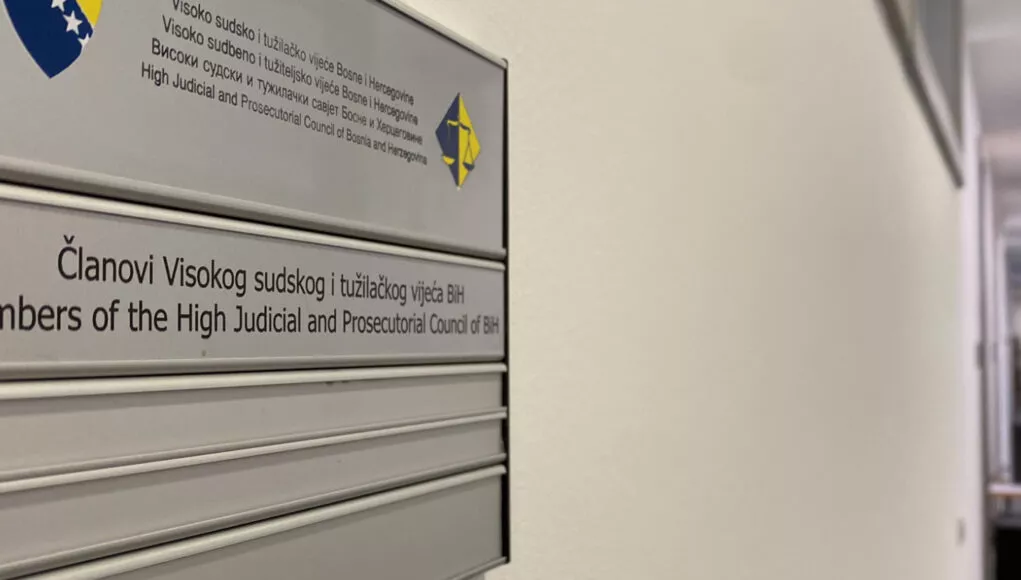
(Patria) - The BiH Ministry of Justice has drafted a new Law on the High Judicial and Prosecutorial Council (HJPC), the content of which the public only got insight into through the opinion of the Venice Commission, which was recently published.
Transparency International in BiH (TI BiH) warns that, in addition to the non-transparent drafting process itself, for which a working group with dominant participation of the executive branch and insufficient involvement of the judiciary itself was responsible, the content also does not meet relevant recommendations regarding strengthening the independence and integrity of judicial office holders.
The identified shortcomings, which were also confirmed by the opinion of the Venice Commission, primarily relate to the undefined disciplinary responsibility of the Council members, insufficiently precise provisions on preventing conflicts of interest, then asset declarations, the composition of the Council and the jurisdiction of auxiliary bodies, but also insufficient transparency and exclusion of the public from the law drafting process itself.
Commenting on the draft of the new HJPC Law, the Venice Commission reiterated many comments that TI BiH had made on previous amendments to this key reform law, with warnings that judicial reform is being implemented in an inadequate, partial manner, which does not lead to meeting the key criteria set for BiH on the path to EU membership.
In its Opinion, the Venice Commission stated that when selecting judicial office holders, priority should be given to competence over the ethnic affiliation of candidates, and that when selecting for key judicial positions, reliance should primarily be placed on objective criteria based on measurable competencies.
The need for clear provisions regulating the independence of the HJPC from the executive branch was further emphasized, both through the role defined by the Constitution, and through the clear exclusion of the HJPC from the application of the Law on Administration and the Law on Ministries and Other Administrative Bodies of BiH, which was removed from the proposed text without explanation.
In addition, TI BiH emphasizes that the draft Law on the HJPC does not define the method of appointing members of commissions that conduct interviews, score and test candidates for judicial positions, nor does it define the mechanisms for conducting qualification and written tests. This increases the risk of undue influence and irregularities, leaving room for manipulation of the process through influence on the composition of commissions, which have a key role in the selection of judges and prosecutors, especially considering the large share of subjective assessment.
The draft also neglects certain mechanisms that were introduced by the latest amendments to the current Law on the HJPC, which relate to the disciplinary responsibility of HJPC members, while the provisions on conflict of interest have not been improved. The provisions on conflict of interest were highlighted as problematic in the EC Opinion, as the definition is not clearly specified, which TI BiH warned about during the last amendments to the Law. In addition, TI BiH still stands by its previous recommendations that when submitting reports on assets and interests of judges, prosecutors and Council members, it is necessary to include all close relatives, including those who do not live in the same household, in order to reduce the possibility of avoiding asset declaration in this way, which is not foreseen in the draft either.
When it comes to verifying assets, the submitted text still does not clearly regulate the obligations of all institutions in the process of submitting data and verification, which TI BiH pointed out during the last amendments, as a potential mechanism for blocking the verification of asset statements.
Furthermore, in line with TI BiH's comments, the Venice Commission also states that the HJPC should have an odd number of members to facilitate decision-making, with recommendations to include more independent members who are not judicial office holders in the Council's composition. The opinion reiterated TI BiH's proposals for a clearer definition of disciplinary responsibility in order to differentiate between more serious and less serious offenses, and thus sanctions.
Finally, pointing out that representatives of civil society and other interested stakeholders were not informed about the content of the draft, nor involved in the drafting process of this and other reform laws in the field of justice, the Venice Commission notes that transparency and an open law-making process are necessary and essential prerequisites for the quality completion of the process.
TI BiH reminds that this is one of the most important laws for BiH, which will direct the course of action of the entire judicial system, and that the opportunity must be seized to ensure that the proposed law provides the basic foundations of independence and accountability. TI BiH therefore appeals to the Council of Ministers and the BiH Ministry of Justice as the proposer to ensure broad consultations on this important law, include the opinions of all relevant stakeholders, especially the judicial community and the professional public, which is insufficiently represented in the law-making process.
Komentari (0)
Prijavite se za komentiranje
PrijavaJos nema komentara. Budite prvi!
Minuta
Sve →Iz drugih kategorija

High Representative Not Elected: Germans, French and British Against Americans, New Attempt at End of June

ČOVIĆ WITHOUT MERCY: How Those Who Brought Ademović to Office Created a Political Hell for Him



Sunny Saturday, quite warm



Tragedy in Albanian resort: Two minors drown












