
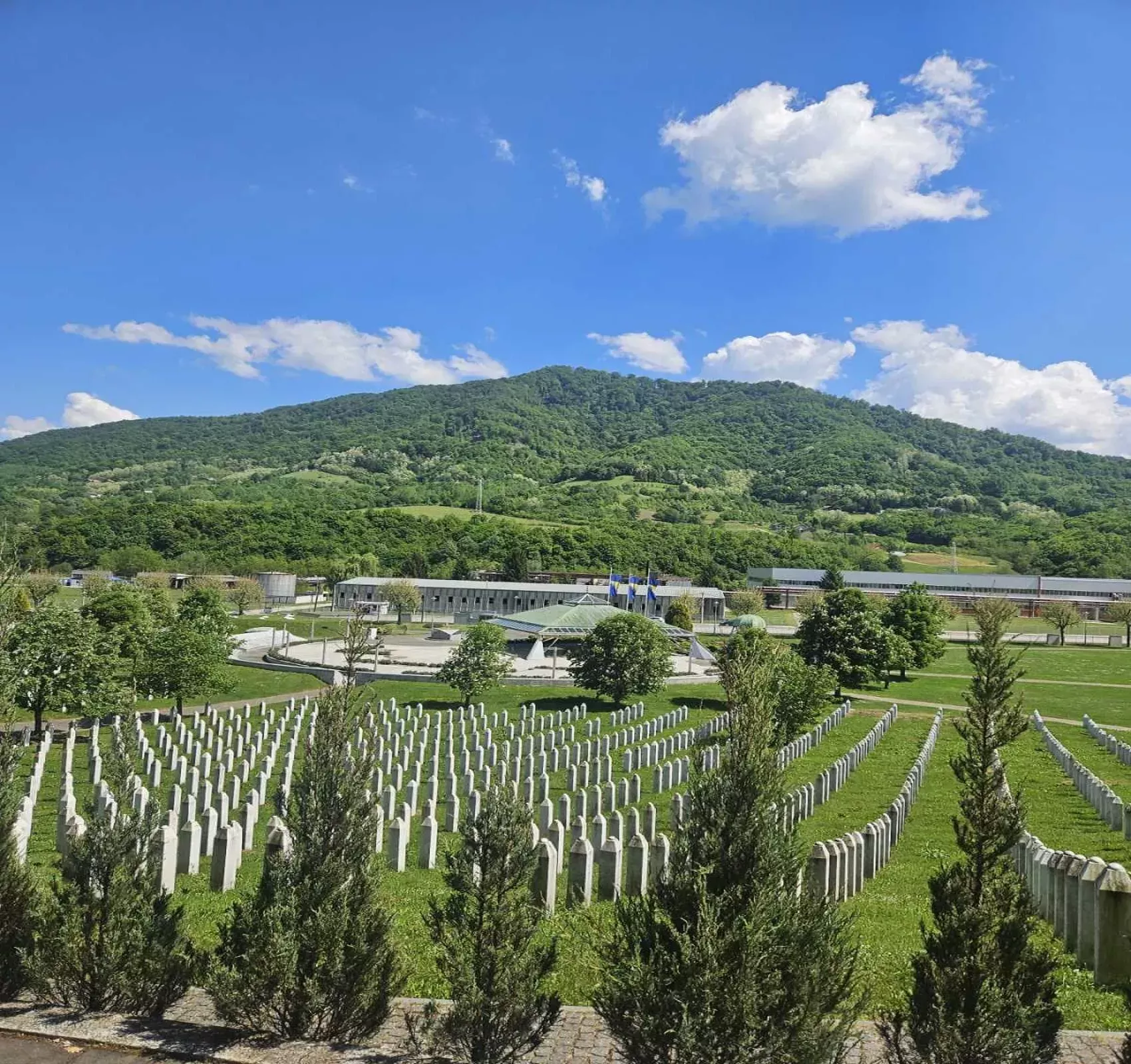
(Patria) - Families of six victims of the genocide committed in July 1995 in Srebrenica have so far given consent for the burial of the remains of their loved ones at the collective funeral on July 11 at the Srebrenica-Potočari Memorial Center.
The incompleteness of the remains remains a problem, making it difficult for families to decide on burial. In most cases, only a few bones are involved.
“When it comes to Srebrenica, we do not have a large number of identified complete remains. Six victims are ready, but that number may increase by July. There is still time; we are waiting for some more DNA results and matches. However, we have 12 identified individuals for whom families have not given consent for burial, as they believe only a small number of bones have been identified. Also, we have 53 DNA identity matches, but only from one or two bones,” said Saliha Ðuderija, a member of the board of directors of the Institute for Missing Persons in Bosnia and Herzegovina (INO).
She stated that these are fairly complete bodies. After the collective funeral on July 11 each year, re-exhumations are carried out, and this will be the case this year as well.
“We have found another part of the remains of victims who were buried earlier. Around 65 individuals will receive an additional part of their remains, which we will add to those previously buried in the cemetery of the Memorial Center,” Ðuderija explained.
She also pointed to the problem of a lack of relevant information for finding new graves.
“As for field searches, they are carried out continuously, but relevant information is lacking. It is not easy for us because the time has come when we cannot obtain relevant information. We have a lot of information that leads us to some locations; we do the entire job, but we do not find remains. We have some indications, but we do not know if they will be accurate. We know that there are certainly more places where the remaining victims from Srebrenica are located. There are fewer and fewer witnesses or people willing to provide accurate information that would lead us to the locations of missing persons. Around 800 people are still being sought. These are individuals whose identities have been verified,” Ðuderija explained.
She emphasized that information received in recent months from police agencies has mostly not yielded results.
“This means it is difficult to reach the locations where the remains of the remaining number of killed are located. We know that there are certainly some more mass graves. We will try, with the help of our international colleagues, to narrow down the area in terms of observing changes on the ground. We are trying to obtain some more modern tools, such as ground-penetrating radar,” Ðuderija stressed.
Regarding the Krajina region, which includes Prijedor, Banja Luka, and Kotor Varoš, she stated that more than 1,200 missing persons have been verified in that area.
“The largest number is related to Prijedor and Kotor Varoš. These are truly the most difficult areas for us, where we need information to find the locations of the remaining missing persons from Prijedor. We have indications that some of them may be in common and mass graves. However, it is the same as with Srebrenica when it comes to access to data,” Ðuderija said.
She reminded that 7,608 people are still being sought in Bosnia and Herzegovina.
“These are individuals whose names have been verified and checked, but unfortunately we do not know their burial locations. We are also working on a revision of mortuaries. We already have some cases where there has been a swap of identities because they were identified using the classical method, not through DNA. This is an opportunity to tell families, those who have already identified their loved ones using the classical method, to also provide samples so we can see if there has been a swap of identities,” Ðuderija explained.
She stated that this is a complex and complicated process that requires a high level of cooperation.
“It is also difficult for us to obtain official information from the competent authorities of that time, such as headquarters, civil protection, military units, local authorities, and those who were involved in the sanitation of the terrain, to help us and exchange information with us,” Ðuderija said.
For years, bags containing the remains of exhumed individuals have been stored in mortuaries and identification centers in Bosnia and Herzegovina, but their identity could not be determined.
“We have more than 1,400 such cases. These are unknown identities. We know they are individuals from our mandate, but we cannot get a match in terms of a blood sample. This is related to these classical identifications. We work on these cases continuously. We are moving in the direction of asking families who identified their loved ones using the classical method to also give blood so we can determine the identity with 100 percent certainty,” Ðuderija added.
The Potočari Memorial Center was officially opened on September 20, 2003, by former President of the United States Bill Clinton. At the Srebrenica-Potočari Memorial Center, 6,751 genocide victims have been buried so far, while 250 victims have been buried in local cemeteries by decision of surviving family members.
The victims come from various municipalities, with the largest numbers from the areas of Srebrenica, Bratunac, Vlasenica, Zvornik, and Milići. Genocide victims have been found at 150 different locations, including 77 mass graves. The youngest victim buried so far in Potočari was a newborn baby girl, Fatima Muhić, and the oldest was grandmother Šaha Izmirlić, born in 1901.
Komentari (0)
Prijavite se za komentiranje
PrijavaJos nema komentara. Budite prvi!
Minuta
Sve →Iz drugih kategorija

High Representative Not Elected: Germans, French and British Against Americans, New Attempt at End of June

ČOVIĆ WITHOUT MERCY: How Those Who Brought Ademović to Office Created a Political Hell for Him



Sunny Saturday, quite warm



Tragedy in Albanian resort: Two minors drown












