
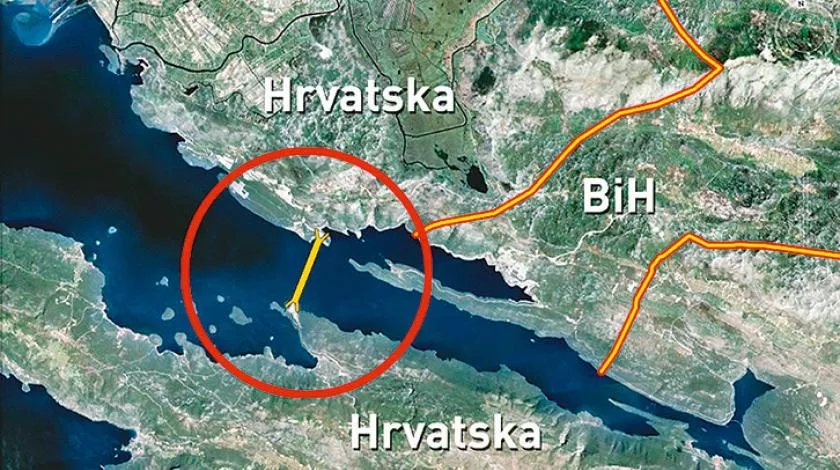
(Patria) - The Maritime Society in Bosnia and Herzegovina today sent a letter to all parliamentary clubs of the National Assembly of the RS, regarding tomorrow's session and initiative. On this topic, the Maritime Society can answer all questions and offers its presence at the scheduled session of the National Assembly of the Republika Srpska. We transmit the letter in its entirety.
The Association Maritime Society in Bosnia and Herzegovina was founded in 2007 with the aim of preserving the sovereignty and territorial integrity of Bosnia and Herzegovina, and achieving all its rights in the Adriatic Sea and maritime affairs in general, which belong to it. The immediate reason for the founding of the Maritime Society is the fact that the Republic of Croatia, by its law, appropriated the maritime territory of Bosnia and Herzegovina and the coast.
The sovereignty of the Republic of Croatia over the maritime territory of Bosnia and Herzegovina. The Republic of Croatia, by adopting the Maritime Code, declared its state sovereignty over the maritime territory of Bosnia and Herzegovina and the coast, in such a way that the key provisions of the Code for the said situation were copied from the laws of the SFRY, and thus the Republic of Croatia identified itself as the sole successor in this part of the Adriatic Sea, completely excluding Bosnia and Herzegovina. The coast of the Republic of Croatia is here established with continuity, without respecting and excluding the 24 km of the coast of Bosnia and Herzegovina and the maritime territory of Bosnia and Herzegovina, which is clearly wrapped in the legally established sovereignty of the Republic of Croatia over internal sea waters and the territorial sea, which partly belong to Bosnia and Herzegovina.
Consequently, the Republic of Croatia, for 20 years, has refused to ratify the Agreement on the State Border between Bosnia and Herzegovina and the Republic of Croatia, signed by the President of the Republic of Croatia Franjo Tuđman and the Chairman of the Presidency of Bosnia and Herzegovina Alija Izetbegović (Sarajevo, July 30, 1999), because it is contrary to the provisions of the Maritime Code. In contrast, the publicly stated explanation of the authorities of the Republic of Croatia for non-ratification of the Agreement is a fabricated dispute over two small islands: Mali and Veliki Školj, in the sense that they belong to Croatia, not Bosnia and Herzegovina. Representatives of the Croatian authorities refer to this Agreement before international officials, although they ignore and do not recognize it. The retrospective and attitudes of Croatian officials are best seen in the text published under the title „Rhythm of an Imperfect Crime” of November 9, 2018.
In the context of this structure, it is necessary to mention the judgment of the Appeals Chamber of the Hague Tribunal (www.icty.org) of November 29, 2017, where the goals of the intent of aggression and the joint criminal enterprise in terms of annexing parts of Bosnia and Herzegovina to the Republic of Croatia are clearly described.
Construction of the Pelješac Bridge, needs and goals
The construction of the Pelješac Bridge is closely related to the intentions and goals of the Republic of Croatia, which are described in detail and established by the aforementioned judgment. The stated connection of Croatian territory in the south, in addition to other more economical, rational, more serviceable and acceptable solutions for citizens (three times shorter and four times cheaper connection), through the construction of the Pelješac Bridge is only a necessary excuse for the realization of the described strategic intentions and goals. It is clear to everyone that the built Pelješac Bridge would be a maritime asset of the Republic of Croatia with full national sovereignty in the sea, surface and air. This would, in addition to the above, be the final stamp for a permanent change of legal facts and acquired rights, in this part of the Adriatic Sea to the detriment of: sovereignty, territorial integrity and international rights of Bosnia and Herzegovina.
Information submitted to international officials
The mentioned information in a broader and more detailed form was submitted to: the European Commission, the EU Parliament, the EU Council, the UN Secretary General..., and then to the Parliamentarians of the Republic of Croatia in the EU Parliament (11 MPs), the President of the Sabor and his deputies, the Prime Minister of the Republic of Croatia, the President of the Republic of Croatia...
Bridge on the Sava near Gradiška
This bridge is located on the road/corridor R2a, i.e. E-661, according to the UNECE agreement of 1972 and its construction is not and cannot be conditioned or blackmailed by anything, because it is an obligation of Bosnia and Herzegovina as well as the Republic of Croatia. The President of the Society was the President of the Commission for the preparation and construction of this bridge in cooperation with the Republic of Croatia according to the Agreement of the two states, which was ratified in the Sabor and the Parliament of BiH, and can confirm that all conditions (main project and building permit) for the tender for the selection of the contractor were ready at the beginning of 2013. Instead of a tender, the Croatian Minister of Transport Siniša Hajdaš Dončić appeared in Sarajevo, who met with Minister Damir Hadžić. Although it was earlier announced that construction would begin in 2013, it was postponed because the problem of the high price was highlighted.
It was agreed to form a working body to resolve the problem regarding the difference in the price of the construction of the bridge near Gradiška. Minister Čubrilović, Minister of Transport and Communications of the RS (today President of the National Assembly of the Republika Srpska), who was at the meeting, expressed doubt about this high price, so he called on Croatia to check in detail how the original price of the construction of the bridge on the Sava near Gradiška increased from 27 to 42 million euros.
The bridge on the Sava near Gradiška was never and in no way connected with the construction of the Pelješac Bridge, and the real reason why Croatia was not efficient regarding this bridge in Gradiška is the expected loss of revenue (tolls) between Sl. Brod and Okučani (74 km) on the existing highway ZG-BG (E-70), after the construction and opening of this bridge on the Sava near Gradiška. This position of theirs is still not completely concluded and some new variants are possible, regardless of the fact that they will pay less for the construction of the bridge than Bosnia and Herzegovina, because the new technical solution has a lower price because the bridge has been shortened on the BiH side for the entire inundation (flood) area, which, as was previously visible, will be paid by the BiH side. This position of the Republic of Croatia towards BiH is equal to the position of Slovenia towards the Republic of Croatia.
Better connoisseurs of the situation know that Croatian Motorways could not repay the used loans for the construction of highways, so after the failed monetization of highways, they took new loans to repay the old loans, of course with double interest.
Komentari (0)
Prijavite se za komentiranje
PrijavaJos nema komentara. Budite prvi!
Minuta
Sve →Iz drugih kategorija

High Representative Not Elected: Germans, French and British Against Americans, New Attempt at End of June

ČOVIĆ WITHOUT MERCY: How Those Who Brought Ademović to Office Created a Political Hell for Him



Sunny Saturday, quite warm



Tragedy in Albanian resort: Two minors drown












