
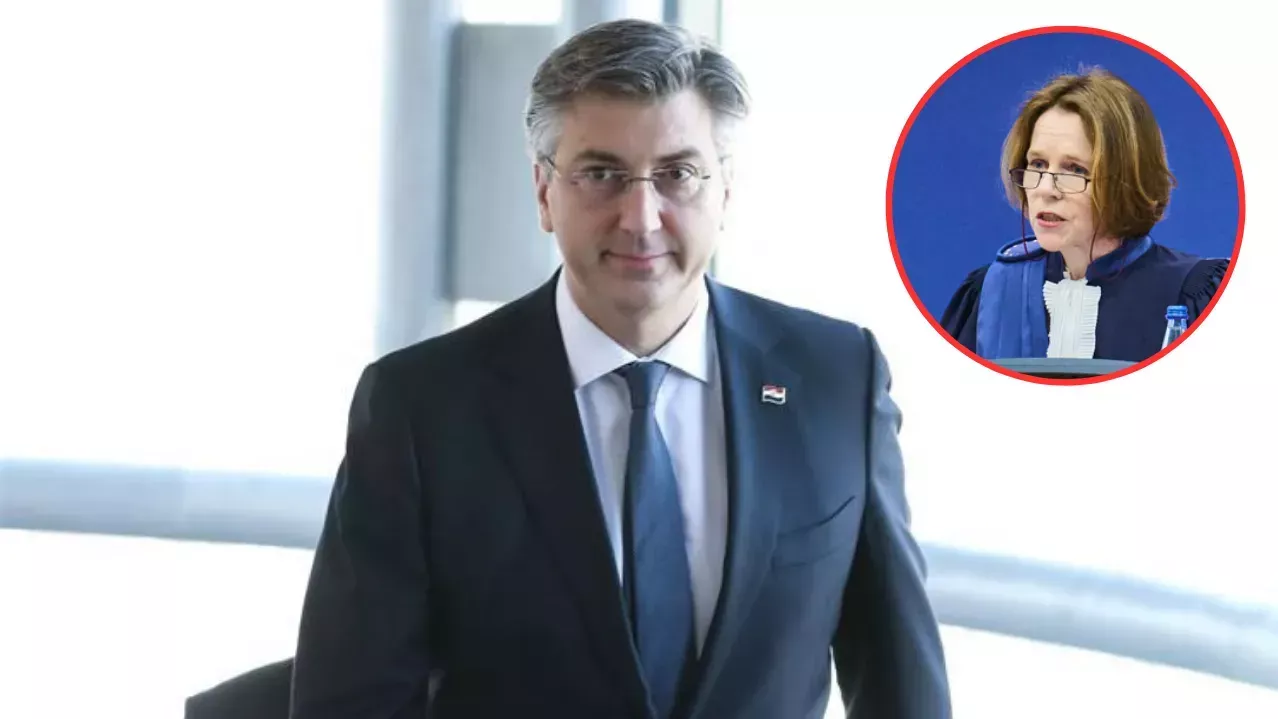
By Rasim Belko
We announced that official Zagreb would launch an absolute offensive in an attempt to discredit the judgment in the case of Kovačević against Bosnia and Herzegovina shortly after the information was published that the Strasbourg Court had ruled in favor of the appellant Slaven Kovačević.
And they have started, primarily by securing the possibility for the self-proclaimed agents of Bosnia and Herzegovina to submit a request to the Grand Chamber, considering the dissenting opinion in the “first-instance” procedure by Austrian judge Gabriele Kucsko-Stadlmayer. The inertia of those responsible in the Council of Ministers has led to Monika Mijić and Jelena Cvijetić submitting a request, despite the fact that they are not legitimate agents of Bosnia and Herzegovina.
The Minister for Human Rights and Refugees of Bosnia and Herzegovina, Sevlid Hurtić, although he tried, did not fully fulfill his obligation to bring this issue to the Council of Ministers, given the fact that the agents' mandates had expired, where Monika Mijić's mandate was even illegally extended three times, as was Harisa Bavčić's, while Jelena Cvijetić was elected as the legal representative of Bosnia and Herzegovina on September 7, and the request to the Grand Chamber was signed on September 19, 2023. Very strange, isn't it?
Borjana Krišto sent a letter to Strasbourg on her own behalf and for reasons known only to her, and then the Minister of Defense (Deputy Chairman of the Council of Ministers and member of the Collegium) Zukan Helez did the same, emphasizing that Krišto could not write on behalf of the Council of Ministers, but also pointed out that the Council of Ministers as the government of the defendant had never made a decision to submit a request to the Grand Chamber, nor had it decided on the status of agents of Bosnia and Herzegovina, probably some new ones, as the mandates of the old ones had irreversibly expired. But it had to.
It was already clear then that Croatian politics led by Andrej Plenković was trying to influence the Strasbourg Court to involve the Grand Chamber. Because Croatian politics and its debtors like Christian Schmidt had been lobbying for months to influence both the President of the ECHR and other judges.
From the Council of Europe meeting in Iceland to secret meetings in Brussels and the rest of the EU, everything was done to fulfill the basic goal of the Republic of Croatia in this case. Croatia, Plenković, and HDZ as a whole do not want to overturn the judgment but rather keep the entire case trapped in procedural stages to free up space for HDZ BiH, i.e., Dragan Čović and partners, and Christian Schmidt to create and “push through” an Election Law that would introduce legitimate representation into the constitutional system. And legitimate representation is the exact opposite of the ECHR decision in the case “Kovačević v. Bosnia and Herzegovina”.
In the whole story, a serious role is played by the Secretary-General of the Council of Europe, Marija Pejčinović Burić, who, according to Plenković's instructions, lobbies with ECHR judges!
According to our information, Pejčinović Burić, following Plenković's instructions, is offering positions in European Union institutions to at least two judges who would support the “Croatian cause” in the European Court of Human Rights.
In other words, in exchange for the already prepared positions, the lobbied judges are required to vote to stall the “Kovačević v. BiH” case somewhere in the procedure until other debtors of Croatian politics complete their tasks.
Thus, the “Kovačević v. BiH” case has become a matter that goes beyond the scope of human rights violations against the citizens of Bosnia and Herzegovina. The vortex of the entire story involves actors who, if our information is accurate, could be criminally prosecuted.
The European Union, or its institutions, should monitor and investigate the background processes in such and similar cases. If the protection of human rights and freedoms depends on lobbying for positions in the EU system, then that system is fundamentally undermined.
Multiple sources have confirmed to us that official Zagreb, through Pejčinović Burić and other actors, has established contact with at least two judges and made promises to secure the positions they seek.
In such a development, any talk about the illegitimacy of Bosnia and Herzegovina's agents and the absence of a unified stance from the country that lost the case of Slaven Kovačević becomes irrelevant, as lobbying attempts seek to discredit both the European Court and any notion of the European Convention on Human Rights.
The continuous struggle of several journalists from Bosnia and Herzegovina and the European Union, who ultimately failed to obtain even basic information about the direction in which the President of the Court, Síofra O'Leary, will act, raises concerns. Particularly, whether she will accept an inadmissible request from illegitimate agents and thus create a kind of scandal within the Court, establishing a dangerous precedent for its future work. The only response we received was a request not to “send questions directly to the president because that is not the practice.”
What we have learned, and what has been confirmed by more credible sources, is that O'Leary is the person promised a position in EU institutions. This could be a reason why the Court's Press Service ignores media inquiries and only responds to certain ones.
The fact that the European Court of Human Rights has been placed in a position of doubt regarding its objectivity in protecting these rights is already damaging to the Council of Europe and its credibility. If the protection of human rights in a member state of the EU and Bosnia and Herzegovina does not carry equal weight, then the Court, the Council of Europe, and even the European Union lose their meaning and credibility to a considerable extent.
This could happen precisely in the case of “Kovačević v. BiH,” as Croatia's heavy diplomatic, political, and lobbying machinery seeks to misuse its position to lobby for votes in favor of its cause. Their cause is the preservation of the possibility of ultimately realizing hegemonic aspirations over Bosnia and Herzegovina, for which they need legitimate representation in the constitutional and electoral order of Bosnia and Herzegovina.
If this text reaches those who oversee the ECHR, its credibility, and the credibility of the Council of Europe or the European Union, we hope it will prevent the institutional submergence of European institutions in the Balkan system of contamination and bribery!
Komentari (0)
Prijavite se za komentiranje
PrijavaJos nema komentara. Budite prvi!
Minuta
Sve →Iz drugih kategorija

High Representative Not Elected: Germans, French and British Against Americans, New Attempt at End of June

ČOVIĆ WITHOUT MERCY: How Those Who Brought Ademović to Office Created a Political Hell for Him



Sunny Saturday, quite warm



Tragedy in Albanian resort: Two minors drown












