
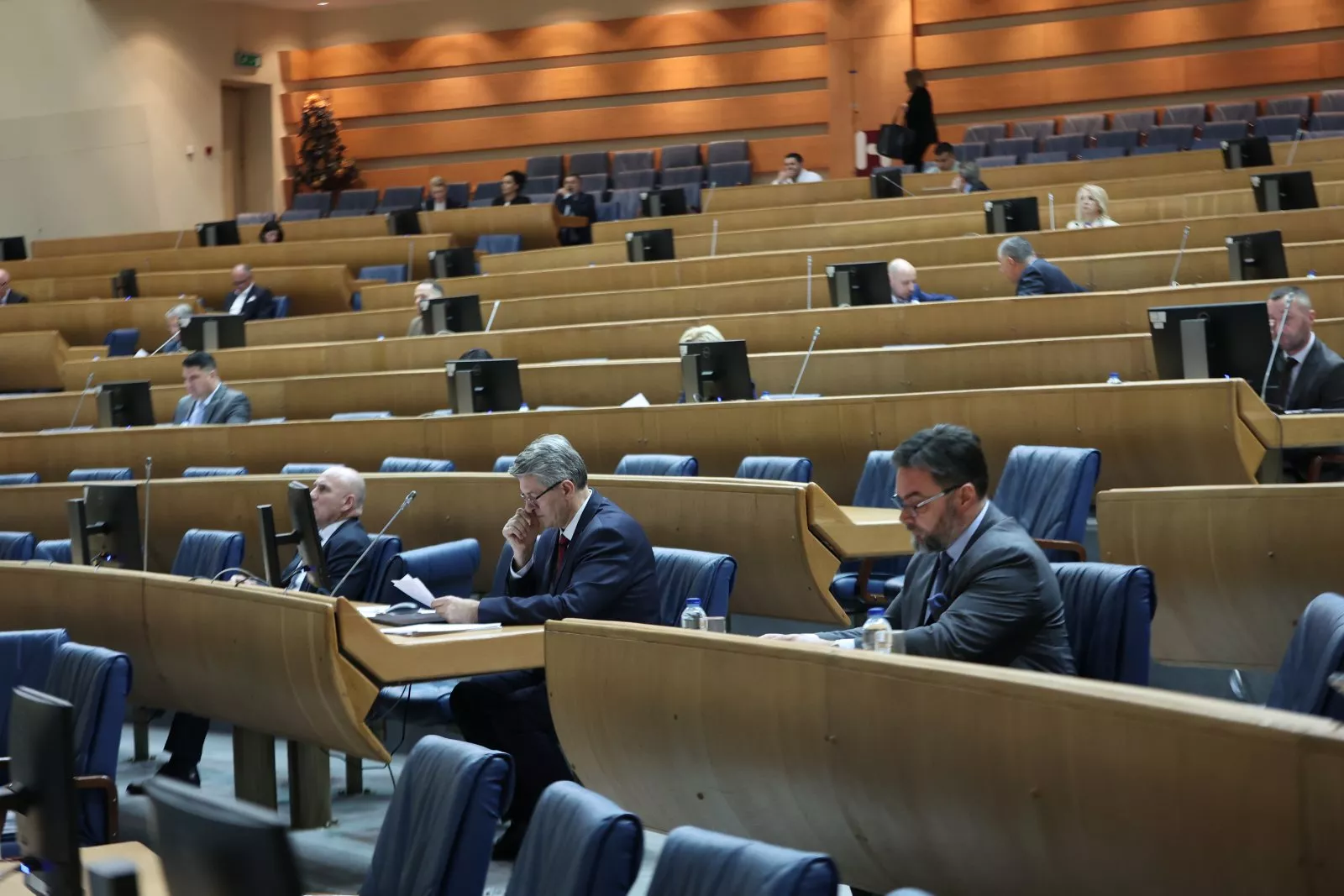
(Patria) - Five state MPs Jasmin Emrić, Elvisa Hodžić, Šemsudin Mehmedović, Aida Baručija, and Ermina Salkičević-Dizdarević submitted a request on May 8 for an urgent session of the House of Representatives of the Parliamentary Assembly of Bosnia and Herzegovina with the agenda item: "Review of data on ethnic representation of employees in Bosnia and Herzegovina institutions - causes and consequences of non-implementation of the Constitution and laws of Bosnia and Herzegovina establishing proportional representation of constituent peoples and Others in Bosnia and Herzegovina institutions".
The specific data on the representation of constituent peoples and Others as of December 20, 2024, in Bosnia and Herzegovina institutions are unambiguous, but at the same time concerning, and were collected from 71 institutions. Five institutions did not provide the requested data, and for three, publicly available data from 2023 was used.
It is concerning that the data on the national structure of employees in Bosnia and Herzegovina institutions is not updated at all, while data on gender representation is updated.
Two institutions: BHANSA, which has nearly 500 employees, and the Secretariat of the BiH Presidency are withholding the requested data, as they have never publicly released it.
Out of the 74 analyzed institutions, Bosniaks are in imbalance in 62 institutions, considering the number they are entitled to according to the laws of Bosnia and Herzegovina. The fact that Bosniaks are significantly fewer in higher-ranking, managerial, and better-paid positions, but more numerous in positions of employees with secondary vocational education, which obscures the total number of employees and the actual situation, is particularly concerning.
Given the institutions' responses regarding national representation, as well as analyzing the data published in the Official Gazette of Bosnia and Herzegovina on internal promotions within Bosnia and Herzegovina institutions in 2023 and 2024, Bosniaks are currently in a greater and more serious imbalance than before. If the obvious trend continues and the problem is ignored, it will soon be impossible to fix anything. The problem must be addressed urgently and comprehensively, according to the justification for the urgent session request.
Regarding employees from the Others category, it is concerning that the number of managerial state and police officials who declare themselves as Others is nowhere near the legally determined number, and that in many institutions, there are no employees from the Others category.
Thus, the proposers stated that in the Communications Regulatory Agency, there are more Serbs than Bosniaks among its 140 employees. Out of five managerial positions in the CRA, only one is held by a Bosniak.
In the Indirect Taxation Authority (UIO), there are 164 more Serbs employed than the legally prescribed number, while there are 121 more Croats, and 217 fewer Bosniaks than they are entitled to based on proportionality.
In BiH institutions based in Mostar, the number of Bosniaks is almost negligible, although according to the 2013 Census, there are 46,752 Bosniaks and 51,216 Croats in the City of Mostar alone.
The situation is not much better in institutions based in Sarajevo, although the largest number of Bosniaks live there. Although the headquarters of all nine ministries of the Council of Ministers of BiH are in Sarajevo, there are as many as 201 fewer Bosniaks employed in them than they are entitled to according to the 2013 Census.
In the Ministry of Security of BiH, headed by Nenad Nešić until December 2024 when he was arrested, the national structure has been changed to the detriment of Bosniaks over two years, and out of 32 people who started employment during that period, 28 are Serbs. A similar situation exists in the Ministry of Foreign Trade and Economic Relations and the Ministry of Finance and Treasury, headed by SNSD cadres.
In the Ministry of Justice of BiH, led by Davor Bunoza (HDZ), the number of Croats and Bosniaks is almost equal.
However, the national balance is respected in the Central Bank of BiH, where 50 percent are Bosniaks, 31 percent Serbs, 16 percent Croats, and 3 percent Others.
In the Public Administration Agency of BiH, headed by HDZ cadre Anita Markić, there are more Croats employed than they are entitled to by law, as well as Serbs, while Bosniaks are the least numerous.
In the Ministry of Transport and Communications, headed by Edin Forto, out of six managerial officials, only one is a Bosniak.
Currently, out of 28 positions (27 directors and one secretary-general) appointed by the Council of Ministers of BiH, only six Bosniaks, 12 Serbs, and 10 Croats have been appointed. Although Bosniaks should hold 14 of the 28 positions, Serbs nine, and Croats four, with one from the Others category.
Out of a total of 4,081 employees in 28 institutions, Bosniaks manage institutions with 339 employees, or 8%. Serbs and Croats manage institutions with 3,742 employees, or 92%. The budget of these 28 institutions for 2024 amounted to 330 million KM. Bosniaks manage six institutions with a budget of 51 million KM, while Serbs and Croats manage 22 institutions with a budget of 279 million KM.
In 13 state institutions headquartered in the BiH entity Republika Srpska, out of a total of 3,045 employees, only 1,165 are of Bosniak nationality. Bosniaks are underrepresented in 361 positions, while Serbs are overrepresented in 296 positions, and Croats in 109, and a certain number of employees from the Others category are also missing.
The structure of police agencies is filled according to the 1991 Census, and there is increasing talk about amending the Law on Police Officers of BiH to fill positions according to the 2013 Census.
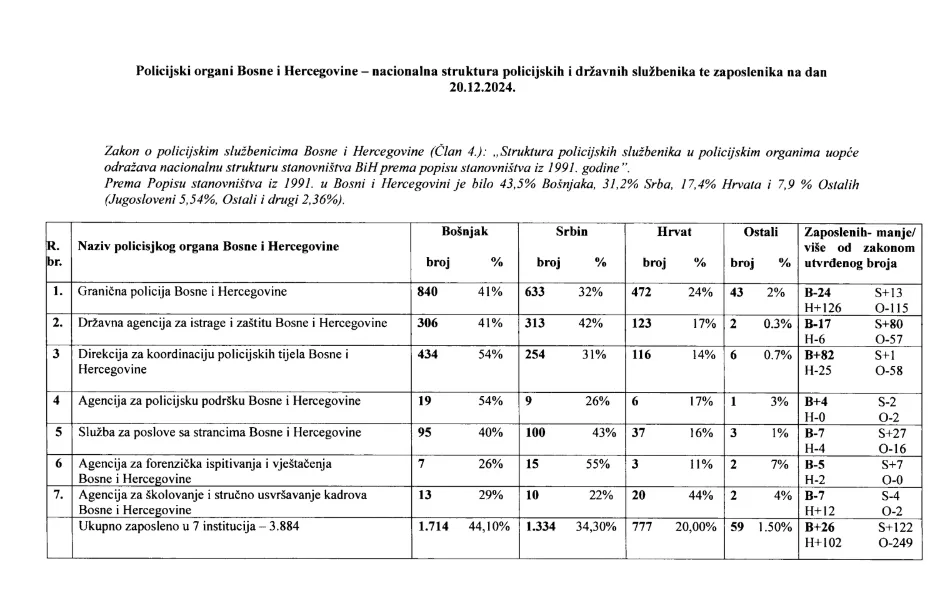
Structure of employees in police agencies
In their justification, these MPs request a moratorium on employment and appointments in institutions to determine the state of national representation and to proceed with respecting the BiH Constitution and laws on proportional representation.
The MPs request that the following attend the session and answer MPs' questions: Borjana Krišto, Chairwoman of the Council of Ministers of Bosnia and Herzegovina, all ministers in the Council of Ministers of Bosnia and Herzegovina, Anita Markić, Director of the Public Administration Agency of Bosnia and Herzegovina, Robert Vidović, Secretary-General of the Council of Ministers of Bosnia and Herzegovina, Josip Merdžo, Director of the Institute for Intellectual Property of Bosnia and Herzegovina, Zoran Tegeltija, Director of the Indirect Taxation Authority of BiH, Draško Milinović, Director of the Communications Regulatory Agency of BiH, Siniša Perković, Director of the Institution for Enforcement of Criminal Sanctions, Pre-trial Detention and Other Measures of Bosnia and Herzegovina, Zoran Đerić, Secretary-General of the Presidency of BiH, Mirko Kuprešaković, Director of the Border Police of BiH, Emir Mehmedović, Chief Inspector of Bosnia and Herzegovina.
All MPs have been provided with the materials, and it has been requested that the session be scheduled in consultation with the Council of Ministers of BiH so that all invited persons can attend the session.
Komentari (0)
Prijavite se za komentiranje
PrijavaJos nema komentara. Budite prvi!
Minuta
Sve →Iz drugih kategorija

High Representative Not Elected: Germans, French and British Against Americans, New Attempt at End of June

ČOVIĆ WITHOUT MERCY: How Those Who Brought Ademović to Office Created a Political Hell for Him



Sunny Saturday, quite warm



Tragedy in Albanian resort: Two minors drown












