
By Almir Bečarević
Almost unnoticed and unremarked upon in commentary was the Pentagon's report on Russia's influence in Eastern European countries through gas.
Gas, according to the report, is becoming a tool through which Russia influences decision-making by countries that are partners and allies of the USA, or punishes countries when their decisions are not in line with Russian influence.
What should be known about Russian gas and the current development of transport routes through which natural gas will be supplied to Europe?
Russia achieved its historical natural gas exports to Europe in 2018, when it exported slightly over 200 billion Sm3 (The term 'Standard cubic meter' (Sm3) represents 1 m3 of a gas at a standard pressure of 101305 Pa (1.01325 bar) and a temperature of 288.15 K (15 °C)).
More than 40 years ago, Russia exported around 20 billion Sm3 to Europe. In 2000, Russia supplied slightly over 130 billion Sm3 to Europe. From these data, a drastic increase in Russian gas exports can be seen, and what is particularly interesting is precisely the fact pointed out by the Pentagon, which is that countries east of Vienna are dependent on Russian gas, to a percentage exceeding 75%.
In our supply direction, Hungary is over 80% dependent, Serbia around 85%, and BiH 100%. This dependence of all Eastern European countries was not, it must be stated, forcibly realized, but was conditioned by low natural gas production in this part of Europe, as well as underdeveloped transport routes, i.e., poor gas transport infrastructure in these countries. In addition to this, it must be admitted, Russian gas was almost free in the first 20 years of export compared to today's prices, and therefore no country had an imperative to change suppliers, i.e., Gazprom. With the rise in oil prices on the world market, from $20 to $130, there was a drastic increase in Russian gas prices, which rose from $50 to over $500/1000 Sm3.
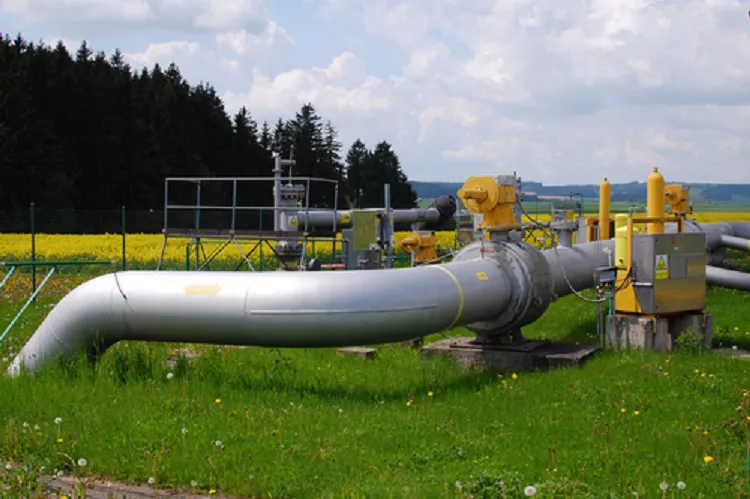
Then came the imperative for all countries to try to diversify supply sources, but at the same time, there was aggressive development of Russian gas supply routes (Nord Stream 1, Nord Stream 2, South Stream - now TurkStream, Power of Siberia to China...). Ukraine, which was the main transit route for Russian gas for decades, is becoming or will become a secondary route for gas exports from Russia.
The Pentagon's report specifically emphasizes Russian gas as a means of pressure on countries dependent on that gas, but what remains unclear is Europe's stance, which will be flooded with that gas through Nord Stream and TurkStream, and whose price currently ranges from $250 to $290/1000 Sm3, which means quite high, but not historical prices.
What about gas source diversification?
The USA, recognizing Russian gas as a tool of political pressure in its report, is working intensively to influence European countries to build LNG terminals in order to obtain more gas sources and initiate market competition, which should reduce dependence on Russian gas. At the same time, Europe is still shyly looking not at the development of LNG terminals, but at the development of new supply routes and the opening of full market competition in choosing the cheapest possible gas.
The TAP project (gas from Azerbaijan) is one of the few examples of source diversification, but Europe does not yet recognize the need to continue building the continuation of that pipeline, the IAP project, which would enable diversification of supply sources in our part of Europe. Romania, which has significant natural gas production, can become a country that can ensure gas exports for our region as well, but projects there are also developing timidly.
When we look at BiH, we can only state that we are completely dependent on Russian gas, and that Serbia is currently aggressively trying to build a part of TurkStream and direct our country's gas imports in that direction. By directing BiH into the TurkStream, we would be obliged to pay millions of dollars for that part of the infrastructure, thus again depending on only one supply route. There are proponents for this route in BiH as well, and what is even stranger, attacks from (part of) the KS Government towards the connection with Croatia contribute to the claim that someone wants us to buy gas only from Russia for the next decades. Whether this means potential political dependence, these proponents have certainly not read the report. The question is whether these proponents read anything at all, because if they did, they would see the struggle of Poland or the Baltic countries to reduce their dependence on Russian gas.
Republika Srpska wants only Russian gas, and now we have employees in the KS Government who advocate only for that and attack the possibility of buying other gas because there is no other option except Russian gas through the existing supply route. They want cheaper gas, and they are killing the very idea of having market competition. Buying gas at scarce gas hubs as cheaper Russian gas is an elementary lack of knowledge of gas markets, and if they would only look at the gas maps for corridors for that type of gas, they would surely be silenced forever.
It should be honest to say that it is generally difficult to avoid Russian gas, and the Pentagon's report does not suggest that, but having multiple natural gas entry points into the country, having diversified sources, having market competition is certainly something that every country needs, and thus that dependence and political influence would weaken.
Pentagon: Russia is blackmailing Balkan countries through gas
Regarding Russia's influence in the Balkans, dependence on Russian gas imports was highlighted. The report states that thirteen Eastern European countries import 75 percent or more of natural gas (of the total required gas quantity) from Russia and "many of these countries do not have domestic natural gas production".
"Russia uses this dependence as a means to influence the decision-making of countries that are partners and allies of the USA, or to punish countries when their decisions are not in line with Russian interests," the report states.
* The author is the former general director of the company "BH-Gas"
Komentari (0)
Prijavite se za komentiranje
PrijavaJos nema komentara. Budite prvi!
Minuta
Sve →Iz drugih kategorija

High Representative Not Elected: Germans, French and British Against Americans, New Attempt at End of June

ČOVIĆ WITHOUT MERCY: How Those Who Brought Ademović to Office Created a Political Hell for Him



Sunny Saturday, quite warm



Tragedy in Albanian resort: Two minors drown












