
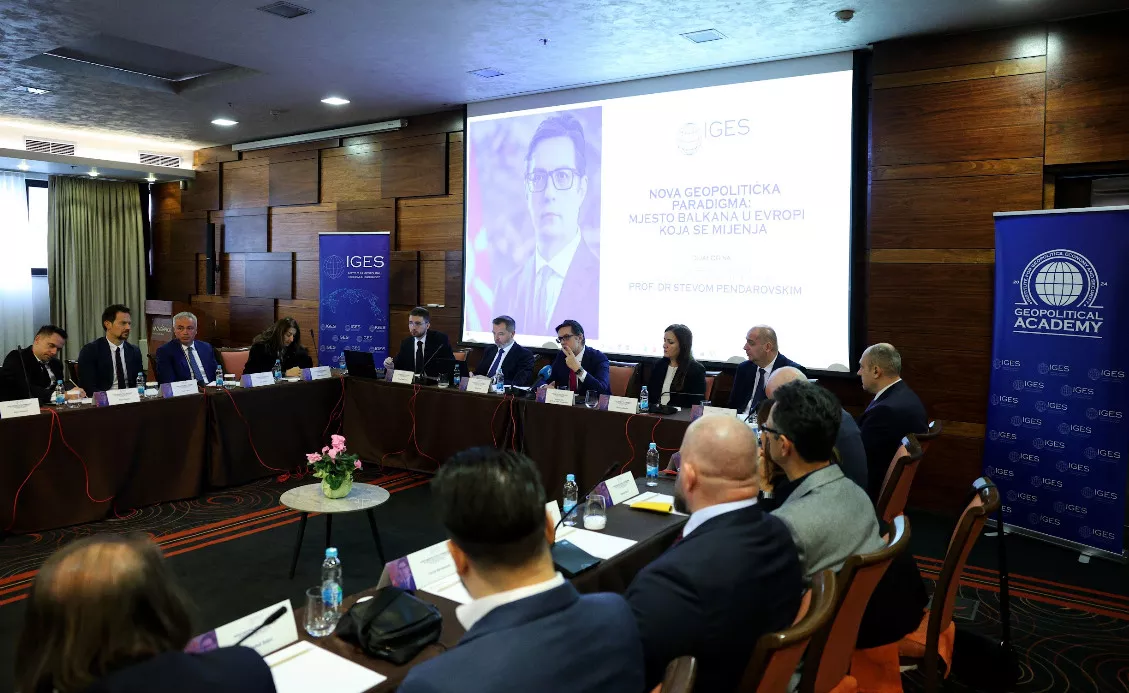
(Patria) - The Institute for Geopolitics, Economy and Security (IGES) yesterday hosted the former President of North Macedonia, Prof. Dr. Stevo Pendarovski, in Sarajevo, who gave a lecture and was the main guest in a dialogue session with members and friends of IGES titled “New Geopolitical Paradigm: The Place of the Balkans in a Changing Europe”.
At the beginning of his presentation, President Pendarovski briefly reviewed the political system of former Yugoslavia, in order to make an academic comparison between the political culture of the Yugoslav and current systems. His review in this context did not compare the systems in a qualitative sense, but rather provided a basis for continuing his presentation in which he explained the key geopolitical changes in the Balkans from the time of the dissolution of former Yugoslavia to the present day.
As he pointed out, the key geopolitical moment that is changing Europe, and thus the Balkans, is the end of the bipolar world era, which lasted from 1949 to 1991, and the entry into the so-called unipolar moment. This was a prerequisite, according to President Pendarovski, for the creation of 7 independent states in the territory of former Yugoslavia in the following years. The next important geopolitical moment was in 1999, when, as he emphasized, NATO bombed the then Federal Republic of Yugoslavia (Serbia and Montenegro) due to the situation in Kosovo. “Everyone in the region experienced that bombing differently, from approval to opposition,” said the President.
He further explained that after that, the region began to integrate into NATO and the European Union, starting with Slovenia, which became a member of both systems in 2004, thereby opening the way for the integration of other countries formed by the dissolution of Yugoslavia. “From that moment on, this area began to be called the Western Balkans. Albania and Croatia joined NATO in 2009, then in 2013 Croatia joined the European Union. Montenegro became a member of NATO in 2017 and Macedonia in 2020,” emphasized President Pendarovski.
According to him, America was more intensely present in the region until September 11, 2001, after which it began to gradually withdraw and leave political and security processes to the European Union, which, with its 27 member states, has a more complex decision-making system and is therefore slower. “Since we were left mostly to domestic economic and political elites, and we did not have democratic experience, the slowdown of Euro-Atlantic integration began,” explained President Pendarovski. “It should be known that no one changed the name of their country to become a member of an international organization, as Macedonia did when joining NATO. That made Macedonia a safer country.”
Continuing his presentation, the main guest of the conference said that the invasion of Ukraine by Russia in 2022 is also a very significant geopolitical moment, if not more important than the fall of communism itself, because it had a great impact on European consciousness, an impact that even the fall of communism did not have. “The arrival of President Trump in power for a second term also brings changes to geopolitics,” he emphasized. “Autocrats in the region and Europe support Trump because they think that sovereignists should control states. However, it is known in history that no country that closed itself off became great or could grow into an empire. Therefore, isolation is not good.”
At the end of his presentation, President Pendarovski underlined how important the announcement is that Albania and Montenegro will join the European Union by the end of the decade. “I would like my country to be in that group as well, but unfortunately, as things stand now, the government in Skopje is not thinking in the direction of Euro-Atlantic integration,” underlined President Pendarovski.
After the extensive presentation, a discussion was opened where participants asked questions which the President answered. There was particular interest in the future of the region, where the President explained and clarified that, despite all the obstacles, the Western Balkans region can only move in the direction of NATO and the European Union because that is the geopolitical reality of our space.
The dialogue was moderated, and an introductory presentation was given by the Director of the Institute for Geopolitics, Economy and Security, Dr. Adnan Kapo.
Komentari (0)
Prijavite se za komentiranje
PrijavaJos nema komentara. Budite prvi!
Minuta
Sve →Iz drugih kategorija

High Representative Not Elected: Germans, French and British Against Americans, New Attempt at End of June

ČOVIĆ WITHOUT MERCY: How Those Who Brought Ademović to Office Created a Political Hell for Him



Sunny Saturday, quite warm



Tragedy in Albanian resort: Two minors drown












