
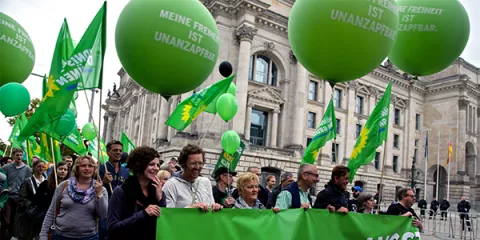
(Patria) – Voting in the European Union member states to elect the new composition of the European Parliament concluded on Sunday evening.
This year's European elections attracted significantly more attention outside the EU due to the rise of populism and the radical right in Europe over the past 5 years, resulting from, among other things, divisions regarding migration and EU policy.
As expected, voter turnout increased from 43% in 2014 to 51%, which, along with the good results of pro-EU parties and groups, supports the legitimacy of the EU. The highest turnout was recorded in Belgium (89%), and the lowest in Slovenia (28.29%).
Overall, although the right and nationalists achieved significant results, parties loyal and dedicated to the European Union retained two-thirds of the seats in the EU Parliament.
Initial results indicate a decline in the popularity of social democrats, who will lose 41 out of the 751 seats in the parliament. The centre-right has suffered a blow of similar intensity, retaining 179 positions out of the current 221, although they will remain the largest group. In any case, both groups will lose their majority and will be forced to form coalitions with the Greens or Liberals.
The real surprise for many is the success of the Greens, who have doubled their number of votes compared to the last elections in 2014. With 21% of the votes, they finished in second place, ahead of the Social Democrats. This party achieved the most success in Germany, France, and Ireland. A full third of this party's electorate in Germany are young people under 30 years of age. The success of the Greens supports the persistent campaigns for environmental protection and against climate change, which have nevertheless influenced awareness, especially among younger generations.
In Germany, the Greens are also in second place, right behind Angela Merkel's conservatives (CDU), who form the largest European party in parliament, alongside Italy's League and the UK's Brexit Party. In Finland and Denmark, they won two seats each, and for the first time, two seats in Ireland. They also secured third place in France, and a similar outcome is expected in the Netherlands and Belgium.
In Great Britain, Nigel Farage's Brexit Party won a fascinating 31% support, although the pro-EU Liberal Democrats also received a significant number of votes, which precisely reflects the division in British society regarding the EU.
Greek Prime Minister Alexis Tsipras took the defeat inflicted by the opposition on his party hard, and called for national elections.
Catalan separatists Carlos Puidgemont (in exile) and Oriol Junqueras (in prison) also won seats in parliament, as did the anti-immigration party Vox, which is entering parliament for the first time.
Predictions that the rapid rise of the right in Europe would be reflected in the election results and consequently in the European Parliament did not come true. Although the Nationalist bloc, to which Matteo Salvini's Italian right-wing League belongs, won 58 seats in parliament, the result is far from expectations.
This is partly thanks to the centre parties, which, although they suffered losses in some countries like Germany, did not lose more than 20 seats in parliament overall, now holding 505 out of 751. It seems like a loss, but it is precisely the phenomenon of the centre that prevented the right from gaining more votes – seats. This bloc includes parties like Macron's En Marche group, which won second place in France (22.6%), immediately behind the right-wing Marine Le Pen (23.6%).
The fact that the right is growing cannot be overlooked, but it is accompanied by the growth of the 'moderate middle' embodied in the centrist bloc and groups that are for the European Union.
The final result of the long-prepared and anticipated elections can be summarized in a short 'tweet' from the Prime Minister of Luxembourg, liberal Xavier Bettel:
- Europe wins! Voter turnout very high, and pro-European parties are the strongest.
Months of intensive negotiations follow regarding who will lead the European institutions, with a great chance for broad coalitions of pro-EU centre parties, writes Patria.
Komentari (0)
Prijavite se za komentiranje
PrijavaJos nema komentara. Budite prvi!
Minuta
Sve →Iz drugih kategorija

High Representative Not Elected: Germans, French and British Against Americans, New Attempt at End of June

ČOVIĆ WITHOUT MERCY: How Those Who Brought Ademović to Office Created a Political Hell for Him



Sunny Saturday, quite warm



Tragedy in Albanian resort: Two minors drown












