
• The American administration intends to resolve the issues of Republika Srpska, by all accounts, through direct dialogue with Banja Luka, and no longer with Sarajevo.
• Brendan Hanrahan, as well as John Ginkel, must be aware of the fact that both Dodik and Čović have built their political careers and profited from instability. They were always "rewarded" after blackmail and blockades with concessions at the expense of the state of Bosnia and Herzegovina. However, these concessions only calmed them down in the short term and encouraged them, but did not solve the problem in the long run.
By: Fuad Đidić
First, James J. Carafano, a leading foreign policy expert at the Washington Foundation "Heritage", in an article dated September 4, 2025, "U.S. Diplomacy in the Western Balkans" announced a change in the approach of American diplomacy towards BiH.
James Carafano's text
His predictions that the issue of Bosnia and Herzegovina is "more acute for the American administration than the issue of Serbia-Kosovo relations" were confirmed last week by American diplomat Brendan Hanrahan, a senior official in the State Department's Bureau of European and Eurasian Affairs, who, with his "behind-the-scenes" diplomatic moves, shook up the "political life" in BiH.
When the National Assembly of Republika Srpska annulled a series of previously adopted secessionist laws on Saturday, October 18, 2025, adopted in the past year and this year, the American administration announced the following day, i.e., Sunday, October 19, through Reuters agency, and welcomed the decisions of the NSRs in Banja Luka, which is, incidentally, a new precedent in American diplomatic practice to make statements on Sundays.
Announcement by the American administration reported by Reuters
The statement from the US Embassy in Sarajevo, released on this occasion, said: "The US looks forward to continuing close cooperation with all parties and constituent peoples in BiH on practical and pragmatic solutions to enhance security, stability, and shared prosperity. We look forward to a more constructive and pragmatic relationship with Republika Srpska."
However, a few days later, it became much clearer that this announcement was just the tip of the iceberg of much broader changes in the US administration's stance towards BiH.
In any case, Dodik's departure from the political scene is part of these broader changes, with which some "deal" has been reached far from public view - the content of which we can only guess at this moment.
However, such a scenario of extensive changes was first announced by another analyst from circles close to the affirmation of the "constituent peoples" policy, Max Primorac, an analyst closely linked to the Croatian political establishment, who, on behalf of the American "Thatcher Center for Freedom", published a carefully prepared study on July 4, 2025, titled "Bosnia and Herzegovina: Ending Nation-Building Failures".
Max Primorac's study
John Ginkel, Chargé d'Affaires at the US Embassy in Sarajevo, confirmed the announcements we could read in his initial meetings with local politicians and leaders, especially from James Carafano, who in the subtitle of his article emphasized: "President Trump will likely take a different political approach from his predecessors in supporting stability in the region".
Carafano repeatedly refers in his article to Max Primorac, who had already suggested sending a Chargé d'Affaires to Sarajevo instead of an ambassador to weaken the "Dayton lobby in Washington".
Where is the key novelty brought by the American administration, which largely functions along the lines of career diplomats Hardening - Ginkel, emerging?
Ginkel with Čović
We see the key change in the stance of this American administration in the fact that it contacts Republika Srpska directly through informal channels, far from public view, thereby returning Banja Luka to the very focus of all important contacts, while leaving Sarajevo as a mere political observer on this occasion.
It is difficult to say what lies behind this "new approach", which Americans now call "pragmatic", but it certainly "smells" of establishing confederal diplomatic relations in the country's political life.
However, it should be recalled that the previous US Ambassador Michael Murphy also announced "pragmatic" changes upon taking office in March 2022, and who, upon the end of his term, was insulted in a very unworthy and brutal manner, mostly by Milorad Dodik as a "Bosniak ambassador", and was also described as a top-ranking diplomat who divided the country into two parts by supporting the "vote on the Resolution on Genocide at the UN".
However, the new "pragmatic" approach of the Trump administration could be a harbinger of some unexpected changes to avoid accusations that the ambassador based in Sarajevo is always called a "Bosniak ambassador".
As things stand, the Trump administration has already implicitly acknowledged that Republika Srpska functions as an organized "parallel state", as it manages its own police and judicial system, as indicated by both Carafano and Primorac.
Furthermore, that such an approach is probable can be recognized from the text of the aforementioned statement, which explicitly emphasizes American cooperation with "constituent peoples", omitting "others" and "citizens", which was the usual vocabulary of the previous administration.
After a recent meeting with John Ginkel, member of the BiH Presidency Željka Cvijanović issued a statement welcoming the "balanced American approach to everyone" and showing an undisguised dose of relief.
"A lot will happen, I believe positively, and it will be a long road, for sure, but also an opportunity to put many things in order," Cvijanović wrote on the same occasion, thereby confirming the announcements we could read much earlier from Carafano.
Cvijanović with Ginkel
What does Željka Cvijanović refer to as - "positive"?
The American administration will, by all accounts, resolve the issues of Republika Srpska in direct dialogue with Banja Luka in the future, and no longer with Sarajevo.
At the end of this analysis, the dilemma remains. Has American diplomacy fallen into the trap again of mediating a conflict they believed they had resolved long ago!?
It is quite likely that the Americans have realized this. That is why they replaced formal diplomacy with "informal" diplomacy and, behind the scenes, "twisted Dodik's arm" and "reminded him", as Putin's pawn in the Balkans, for example, of just one corruption affair - the one concerning the purchase of the "Dedinje" villa.
However, American diplomacy must admit that their previous formula of "stabilocracy" in Bosnia and Herzegovina has failed and that it is a model that has brought the country to the brink of survival.
Brendan Hanrahan, as well as John Ginkel, must be aware of the fact that both Dodik and Čović have built their political careers and profited from instability by receiving numerous concessions at the expense of the state of Bosnia and Herzegovina and its sovereignty.
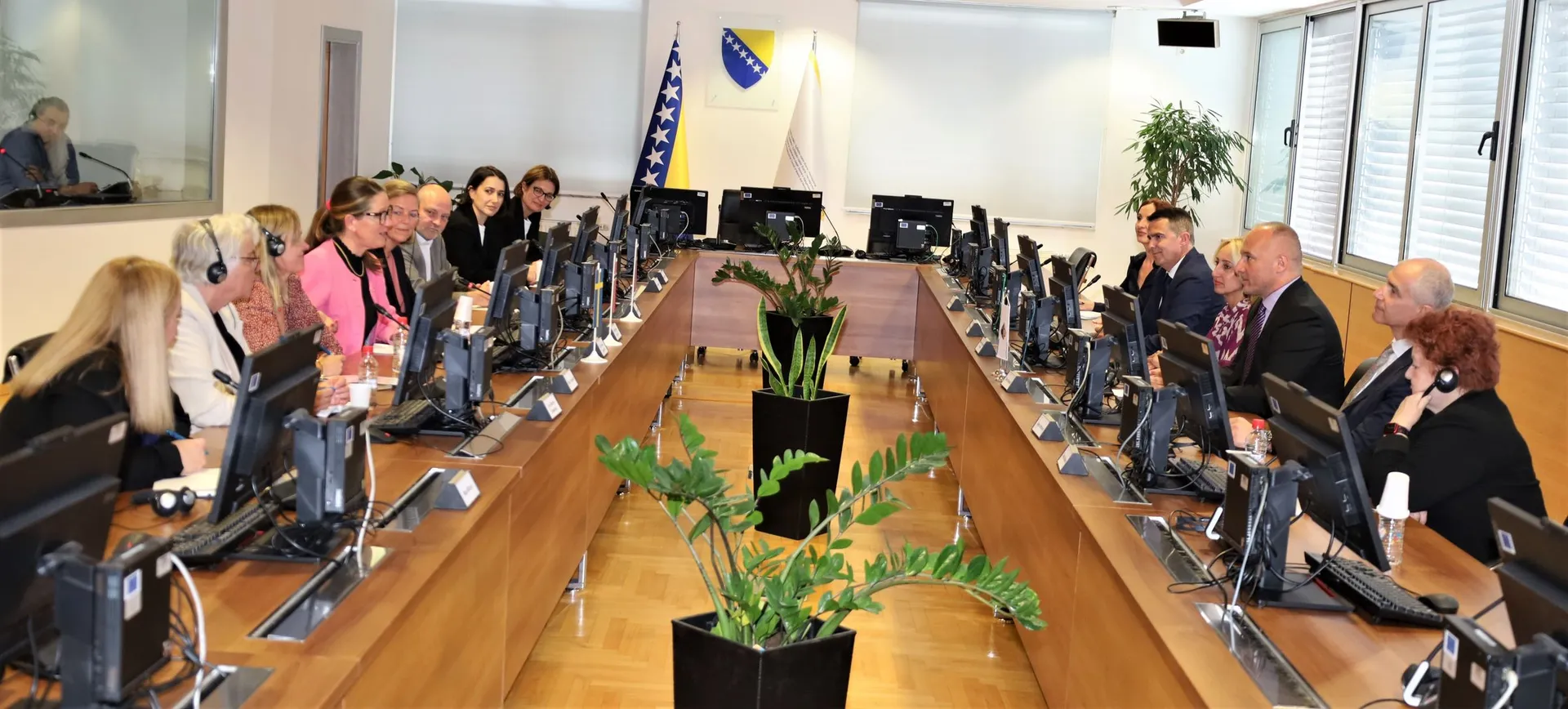
Hanrahan at a meeting with members of the BiH Presidency
The concessions only calmed them down and encouraged them in the short term, but did not solve the problem in the long run. Thus, the end of the concept and practice of "stabilocracy" is announced.
Dodik may never hold a formal position again, but whether he will continue to lead Republika Srpska from another position remains to be seen, given how deeply he has embedded his influence in the presidency and the ruling structures of the entity.
His political fall should be the beginning of a new era - the mandatory redefinition of the concept of stabilocracy, which has led the country to a state requiring radical diplomatic moves.
Komentari (0)
Prijavite se za komentiranje
PrijavaJos nema komentara. Budite prvi!
Minuta
Sve →Iz drugih kategorija
High Representative Not Elected: Germans, French and British Sabotaged Americans, New Attempt at End of June
ČOVIĆ WITHOUT MERCY: How Those Who Brought Ademović to Office Created a Political Hell for Him

Sunny Saturday, quite warm

Tragedy in Albanian resort: Two minors drown