
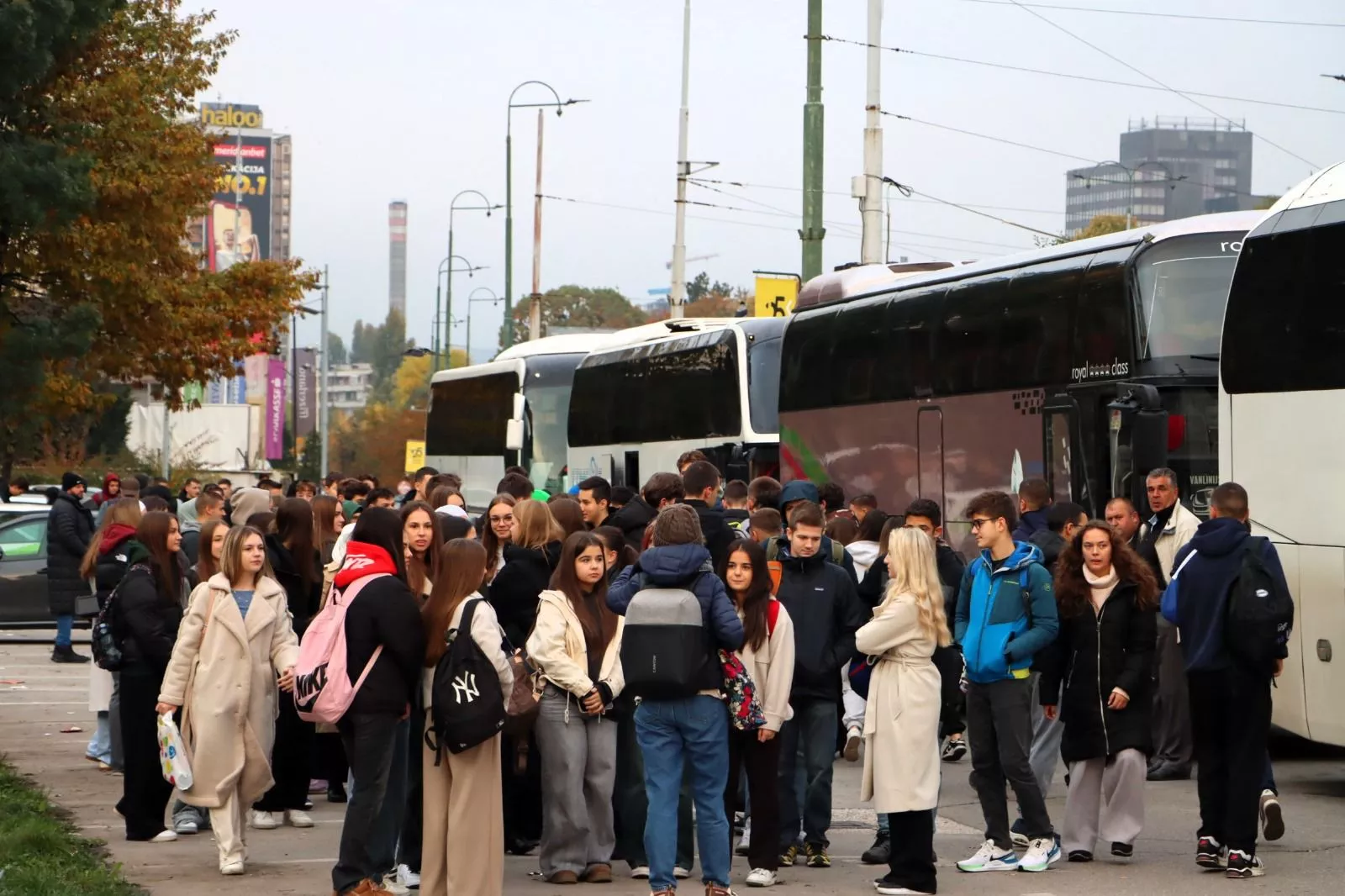
(Patria) - Thousands of second-grade secondary school students from Sarajevo Canton are visiting the Srebrenica Memorial Center – Potočari during September and October, a place that has become an integral part of education on truth, responsibility, and a culture of peace.
In front of the National Museum of Bosnia and Herzegovina this morning, the eighth group of students was seen off on their journey to Srebrenica as part of the program "Cultivating a Culture of Remembrance," which the Ministry of Education of Sarajevo Canton is implementing with the support of the Government and in cooperation with the Institute for the Development of Pre-University Education of Sarajevo Canton.
Around 400 students from the Sarajevo Secondary Music School, the First Bosniak Gymnasium, the Railway School Center, the Gazi Husrev-beg Madrasa, and the Gymnasium of the University of Sarajevo School of Science and Technology (SSST) were seen off by the Minister of Education of Sarajevo Canton Naida Hota-Muminović, Assistant Minister for Preschool, Primary, Secondary and Adult Education Lamija Husić, and Olivera Hasković, Head of the Department for Secondary Vocational Education and Adult Education.
This year, the program includes over 4,200 second-grade students from all secondary schools in Sarajevo Canton. During the visits, students tour the Memorial Center and the cemetery, attend a history lesson and a screening of the documentary film "One Week in July," and speak with educators about the importance of remembrance, truth, and responsibility. The goal of the program is to develop students' awareness of truth, responsibility, and the significance of preserving memory as a foundation for peace and mutual respect.
Minister Hota-Muminović emphasized that such visits represent an important segment of educating students about truth, responsibility, and a culture of peace.
"This is the right moment and the right age when students can and should visit the Memorial Center in Potočari. There, they attend a history lesson, tour the cemetery, and speak with survivors. These visits are not just part of the curriculum, but part of an education that develops understanding and empathy," the minister stated.
She added that through this program, the Ministry aims to strengthen the culture of remembrance and the pedagogical approach to the topic of genocide.
"It is important that new generations know what happened in the past, understand the scale of the genocide, and be determined that such a crime never and nowhere be repeated. Our obligation is to educate students who understand, respect, and believe in the values of peace and justice," Minister Hota-Muminović said.
She also reminded that the United Nations General Assembly Resolution on the Srebrenica genocide obligates all educational systems in the world to contribute to the preservation of memory and truth.
The Ministry launched the project "Cultivating a Culture of Remembrance" in 2019, and after a pause during the coronavirus pandemic, it has been implemented every school year. History teachers play a special role in its implementation, preparing students through lessons on the aggression against Bosnia and Herzegovina and the Srebrenica genocide.
Through this program, the Ministry and the Institute strengthen the culture of remembrance and develop education that nurtures truth, empathy, and responsibility, values that remain the foundation of a society of peace and mutual respect.
Komentari (0)
Prijavite se za komentiranje
PrijavaJos nema komentara. Budite prvi!
Minuta
Sve →Iz drugih kategorija

High Representative Not Elected: Germans, French and British Against Americans, New Attempt at End of June

ČOVIĆ WITHOUT MERCY: How Those Who Brought Ademović to Office Created a Political Hell for Him



Sunny Saturday, quite warm



Tragedy in Albanian resort: Two minors drown












