

(Patria) - The promotion of Nedžad Ahatović's first book "Lažna dihotomija Bosne" will be held today at the amphitheater of the International University of Sarajevo (IUS), starting at 5:00 PM.
In these fateful times for Bosnia and Herzegovina, when the further destiny of the people and the country is being decided, Ahatović dared to try to define the current situation through the prism of his own views on certain social movements in the country and abroad, which can be related to us.
Ahatović has poured all these reflections into the book "Lažna dihotomija Bosne", whose main theme is the state of Bosnia and Herzegovina.
The first part of the book discusses this, while the second part covers geopolitical movements and their reflection on Bosnia and Herzegovina, the region, and the world in general.
Namely, the Helsinki Final Act on Security and Cooperation in Europe from 1975, signed by the then great powers the USA and the USSR, guarantees all signatory states, including the former Yugoslavia, that there will be no violent border changes in Europe.
In accordance with this act, only consensual border changes within the federal units that existed at the time of signing the agreement in 1975 are recognized.
SR Bosnia and Herzegovina was, according to the Constitution of the SFRY at that time, an equal federal unit of the former state, and in accordance with the Helsinki Act, the international recognition of the state of Bosnia and Herzegovina was carried out after the referendum held on February 29 and March 1, 1992.
The entity Republika Srpska gained its legitimacy as an administrative unit within the state of Bosnia and Herzegovina through the Paris signing of the General Framework Agreement for Peace in BiH in 1995, as a consequence of the attempt to violently redraw the borders of the state of BiH by the Milošević regime.
However, Serbia has never abandoned the idea of annexing the entity Republika Srpska, as the only real gain from the aggressive wars against Croatia and BiH during the 1990s, by political or military means.
Evidence for this claim includes the so-called Memorandum 2 of the Serbian Academy of Sciences and Arts (SANU) from 2012 and the Declaration of the All-Serbian Assembly from 2024. The strategic goal of the state of Serbia, in accordance with these documents, should be the secession of the RS entity from the state of BiH.
The first phase in achieving these goals is the creation of an all-Serbian community in the region, which was given legality through the adoption of the Law on the Serbian Diaspora and the activities of the Serbian Orthodox Church. This is the Serbian reaction to new geopolitical movements in the world and the region.
Croatia's entry into NATO disrupted the strategic balance in the Balkans, and Russia is trying to secure its interests in this part of the world through Serbia, its old and faithful ally.
In this context, it is by no means coincidental that the strategic interests of Russia and Serbia coincide when it comes to the Balkans, thereby creating a neuralgic point of quiet confrontation between Russia and the West from BiH and Kosovo.
However, events in Ukraine indicate a new recomposition of relations between Russia and the West.
The application of double standards in the approach to resolving international conflicts, which Putin had attributed to the West for years - among other things through the example of Kosovo - led him, in the case of Ukraine, to decide on a military intervention himself, violating Ukrainian sovereignty in order to protect basic Russian strategic interests on the Black Sea.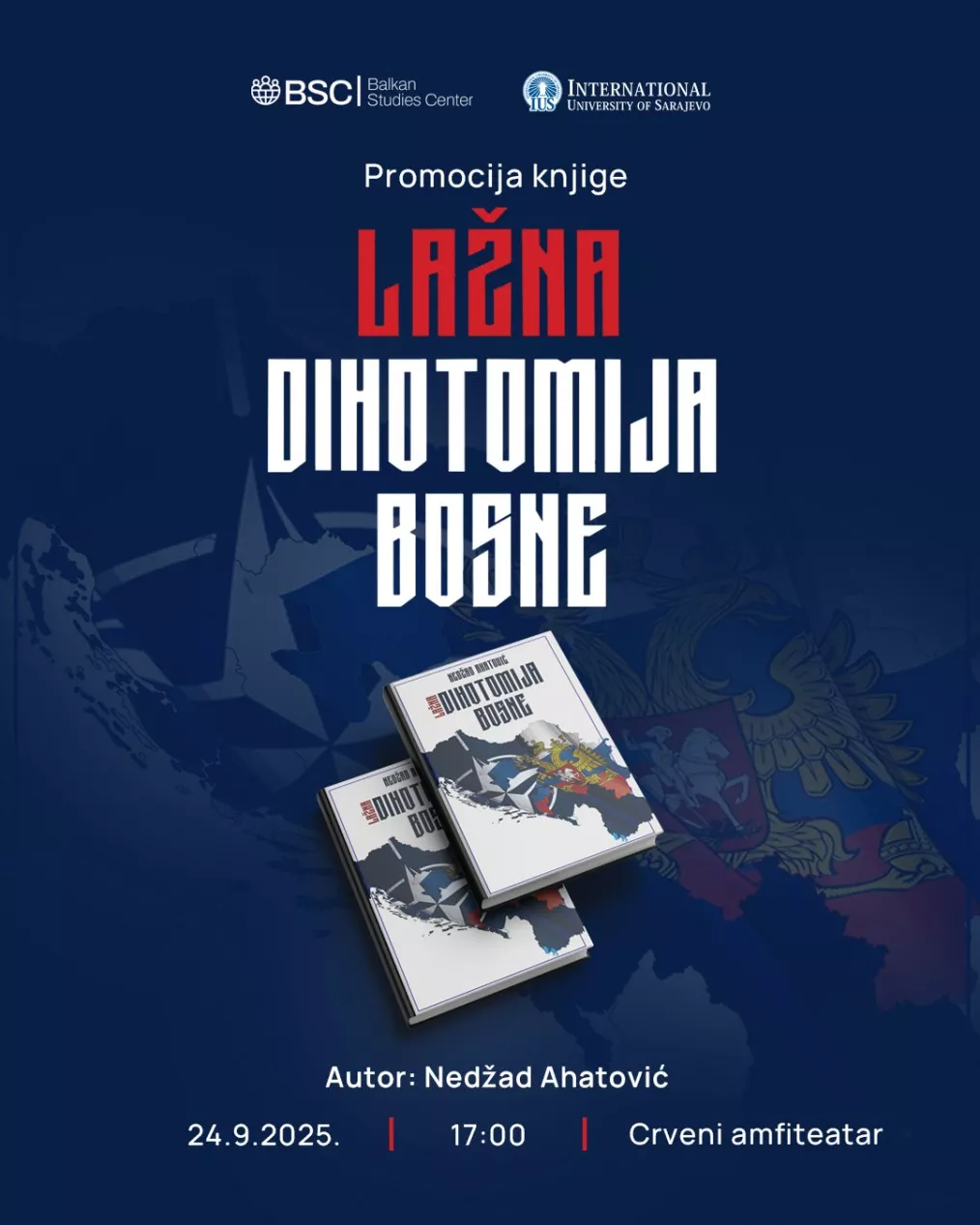
Such a radical move by Putin did not come abruptly and suddenly, but was primarily a product of the political retreat of the USA from conflicts in Syria and Afghanistan. Now, when the conflict situation moved into Putin's neighborhood, in a game of nerves he very quickly lost patience and decided to take stronger steps, openly challenging NATO and the USA to respond in the same way.
On the other hand, the Western alliance is wisely making political and economic moves, combining them with limited military aid to Ukraine, wanting in this way to publicly make Russia an aggressor both de facto and de jure.
Putin is still in a great dilemma: whether to go further in escalating the crisis and open confrontation with the West, or to withdraw from Ukraine and renounce naval bases on the Black Sea, which would open the way to negotiations and recognition of NATO's presence in Ukraine. There is also the issue of trade relations with Europe, where Russia places 84 percent of its oil production and 76 percent of its natural gas production.
Such stress within the international geopolitical infrastructure of Europe has not been seen since the fall of the Berlin Wall. Then, as today, the Balkans represent a gray zone of unresolved spheres of interest of the great powers. The then recomposition of relations between Russia and the West in the Balkans caused the aggressive wars led by the regime of Slobodan Milošević against Croatia and BiH.
Even after those war horrors, intellectual circles strive to impose quasi-truths, not only about the character of the conflict in these areas, but also about the character of relations among the peoples of Yugoslavia, which causally led to the conflict.
Because if there is no Yugoslavia - there is no domination of Serbs; if there is no domination of Serbs - there is no citizenship, civil society, and salon social democratic divisions along class lines.
The division, therefore, must be based on blood, faith, territory, and national consciousness. Only in such a division can the domination of Serbs, now viewed regionally, be maintained and strengthened.
The Western counterpoint to this thesis is Croatian national domination. Both dominations are "settled" on the territory of Bosnia and Herzegovina - through mutual division, i.e., dichotomy.
Dichotomy denotes the division or split of a whole into two equal, mutually non-overlapping parts. This means that something belonging to one half cannot belong to the other half, nor to several others, and vice versa.
Within the framework of establishing and maintaining the domination of Serbs and Croats in the area of the former Yugoslavia, Bosnia and Herzegovina was turned into a theater of total war from 1992 to 1995, which was primarily aimed at the physical extermination and political elimination of the statehood of an entire people - the Bosniak people.
Everything boiled down to the motto: no Bosnia and Herzegovina - no de facto Bosniaks; no Bosniaks - no problem in the Balkans.
Bosnia and Herzegovina, as a society, has been trying to divide itself based on the definition of dichotomy for more than 30 years, although it has existed as a single entity for more than 1000 years. Such efforts are nothing other than a false dichotomy, which is trying to be imposed as an "absolute" truth.
This is also discussed in a series of texts found in the book, which were created in the period from 2012 to 2022 and deal with topics that have left a deep mark in the recent past and are still reflected in our lives today.
These texts clearly show that what is at play is precisely the false dichotomy of Bosnia, caused by the megalomaniacal imperial aspirations of its neighbors. These are small Balkan peoples who want to be bigger than their exterior, but in fact suffer from a chronic superiority complex.
This is precisely the cause of manic outbursts of hatred towards the other and the different - towards that which refuses to bow to their complexes and desires.
Komentari (0)
Prijavite se za komentiranje
PrijavaJos nema komentara. Budite prvi!
Minuta
Sve →Iz drugih kategorija

High Representative Not Elected: Germans, French and British Against Americans, New Attempt at End of June

ČOVIĆ WITHOUT MERCY: How Those Who Brought Ademović to Office Created a Political Hell for Him



Sunny Saturday, quite warm



Tragedy in Albanian resort: Two minors drown












