
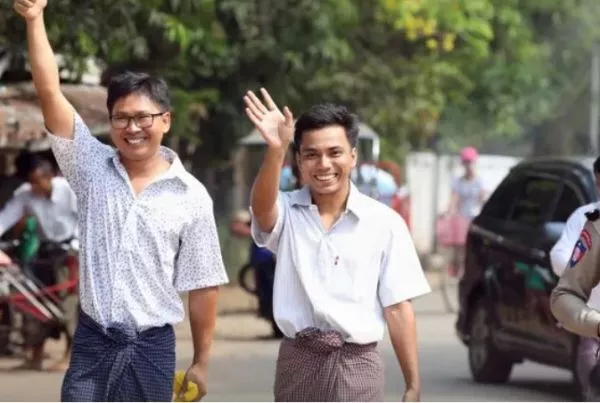
(Patria) – Two Reuters journalists arrested in Myanmar for reporting on the Rohingya population have been released after spending more than 500 days in prison.
Wa Lone (33) and Kyaw Soe Oo (29) were arrested in December 2017. They were charged with allegedly violating the colonial-era 'Official Secrets Act'. Based on the charges, they were imprisoned in Insein Prison in Yangon.
The journalists were released on Tuesday based on a presidential pardon for 6,520 prisoners.
Reuters Editor-in-Chief Stephen J Adler stated that he was 'delighted that Myanmar has released our brave reporters' and added, 'since their arrest 511 days ago, they have become symbols of the importance of media freedom around the world. We welcome them back'.
Prominent human rights lawyer Amal Clooney, who was also part of their legal team, praised Reuters' 'incredible determination' in 'seeking justice for their brave reporters' and emphasized her hope that their release would signal a stronger commitment to media freedom in Myanmar.
The Guardian writes that British Foreign Secretary Jeremy Hunt, commenting on the news of the journalists' release, revealed that he personally advocated for the journalists last September with Myanmar's State Counsellor, democratic politician Aung San Suu Kyi.
At the time of their arrest, the two journalists, also Myanmar citizens, were investigating the brutal violence against the Rohingya population by the Myanmar army in August 2017, which forced more than 700,000 people to leave their homes and flee mass killings to Bangladesh.
This year, the two brave journalists Wa Lone and Kyaw Soe Oo received the Pulitzer Prize for their reporting on the Rohingya massacre.
Dan Chugg, the British ambassador to Myanmar, as well as many other individuals and groups who fought for the journalists' release, pointed out numerous flaws in the judicial process. Among other things, the fact that the mandatory procedure was omitted and that the concept of innocence until proven guilty was ignored.
The journalists insisted on their innocence until the end, and in a statement, they also stated that it was a fabricated case where the police planted official documents on them during a meeting.
The British Guardian writes that the trial itself was widely considered rigged and false, with unconvincing evidence and witnesses. The court sentenced the journalists to 7 years in prison in September.
During the 16 months preceding the pardon by the President of Myanmar, there was pressure from diplomatic bodies, human rights organizations, foreign governments, the UN, and religious officials, but all efforts seemed futile.
Dialogue helps
Lord Ara Darzi, a member of the British House of Lords, also attended the journalists' release from prison. He claims to have been involved in 'months of dialogue' with the government of Myanmar, Reuters, the UN, as well as foreign governments and international organizations, all with the aim of pardoning the journalists.
'The outcome of this case shows that dialogue helps, even in the most difficult circumstances,' said Lord Darzi.
The news of the release of the two journalists was met with enthusiasm and relief by many organizations around the world.
Komentari (0)
Prijavite se za komentiranje
PrijavaJos nema komentara. Budite prvi!
Minuta
Sve →Iz drugih kategorija

High Representative Not Elected: Germans, French and British Against Americans, New Attempt at End of June

ČOVIĆ WITHOUT MERCY: How Those Who Brought Ademović to Office Created a Political Hell for Him



Sunny Saturday, quite warm



Tragedy in Albanian resort: Two minors drown












