
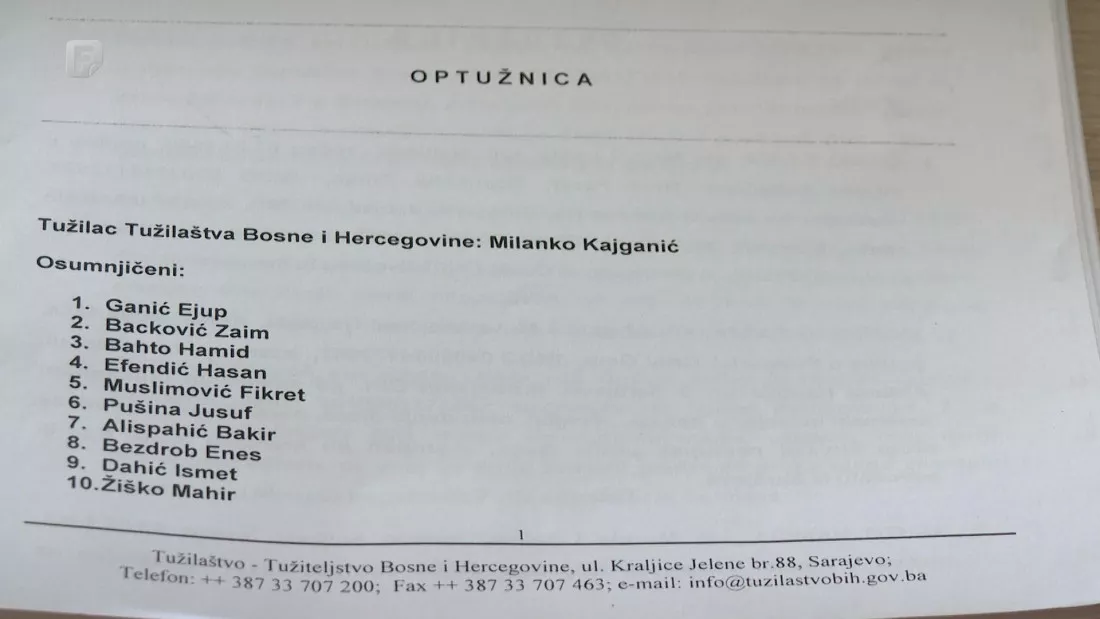
Was the JNA column in Dobrovoljačka on May 3rd a pre-planned and well-thought-out subject of manipulation by Serbian propaganda and the highest echelons of the JNA? Decades later, is the BiH Prosecutor's Office attempting to establish a forced balance in accountability for the war and mass crimes committed in BiH through the Dobrovoljačka case? Did the Prosecutor's Office file an indictment based on a sketched Belgrade indictment? What are the two new key pieces of evidence that led to the indictment, and who obtained them and how? Does the Prosecutor's Office intend to erase truth and historical facts with the new evidence? Is there a concerted effort to equate defenders and aggressors?
Truth in another, parallel way. Three decades later, the state judiciary serves those who, through propaganda and the distortion of facts, have created a myth of systematic and planned war crimes in Dobrovoljačka Street from the aggression against BiH and the defense of Sarajevo, which, according to the indictment of the BiH Prosecutor's Office, was committed by the political, military, and police leadership of the Republic of BiH.
"Prosecutor Kajganić himself knows how this court case will end. I am absolutely convinced, and I would bet everything I own, that there is no court panel that could issue convictions based on such an indictment," says Senad Pećanin, Ejup Ganić's lawyer, in a statement to Mreža FTV.
"We are actually witnessing a joint criminal enterprise of Serbia and Republika Srpska against BiH. This is a classic attempt at revisionism and rewriting history in a way that suggests everyone in BiH during the aggression was equal," claims journalist Amina Čorbo Zećo.
"Such a strategy by the state of Serbia has been in effect for over 15 years. We have numerous cases; do not forget that all the important officers of the Bosnian army against whom indictments have been filed actually have their roots in Belgrade," believes Avdo Huseinović, journalist, director, and publicist.
"The indictment made it clear that the prosecution was trying to completely change history and the legacy of The Hague," states journalist Dženana Karup Druško.
For thirty-one years, the Dobrovoljačka case has been a case. From the courts in The Hague, London, Vienna, to our State Court, the thesis of war crimes committed by BiH defenders against the JNA column is maintained. And it all began on May 2nd with the attack by the JNA, Serbian paramilitary formations, and volunteers on key facilities of the independent, sovereign state of BiH, while at the same time, the President of the Presidency of the Republic of BiH, Alija Izetbegović, was kidnapped and captured at the Sarajevo airport.
Dobrovoljačka May 2nd (Dnevnik TVSA):
"I'm listening, Alija. Ganić, you have full authority in my name to give orders until I get to the Presidency building. What is your situation in Lukavica? Alija: I am practically a prisoner here.
Izetbegović, in exchange for General Milutin Kukanjac, who was in command of the then Second Military District of the JNA in Bistrik, had agreed with Ejup Ganić and General Milan Aksentijević.
At the same time, Izetbegović agreed with Kukanjac on the exchange of the entire Second Military District and, under UN escort, came to the same place.
"The agreement signed on May 2nd stipulated that the exchange, in which General Kukanjac would be handed over to the JNA, and President Izetbegović to the legal authorities, would take place in the PTT Engineering building in Alipašino Polje in Sarajevo," adds Pećanin.
"One of Kukanjac's deputies, he talks about how some officers said then - no, Milutin - addressing General Kukanjac. You will not go with your escort, either we all go or you won't go either, you won't leave us here, and you get out. And then, under pressure from those officers, Kukanjac changed the plan and decided that the entire column would move, unagreed, unannounced, with weapons and archives, and that column started down Dobrovoljačka Street - a column, I repeat, led by the kidnapped president," says Huseinović.
"On April 26, 1992, in Skopje, the then commander of the JNA, Chief of the General Staff, General Blagoje Adžić, and Alija Izetbegović signed and published a joint statement, which stated in the last paragraph that no agreement had been reached on the fate of the JNA's weapons and equipment in the territory of BiH. Despite the fact that no agreement was reached on the fate of weapons and equipment, the column took all the weapons from the barracks in Bistrik with them, thereby, as stated in the conclusion of the investigation conducted by Carla Del Ponte, i.e., the Hague Tribunal, turning a military column into a legal, legitimate military target," emphasizes Pećanin.
For The Hague, there was no reasonable suspicion for prosecuting Ganić and others, as stated in the legal opinion of the Road Map Unit of the Rome Statute from 2003.
"That prosecutor's office made decisions, i.e., notifications, that there was not enough evidence to initiate those investigations based on the evidence at the time, but at the request of the prosecution from Belgrade, which asked for the case to be sent through Republika Srpska to the Hague Tribunal, which the Hague prosecutor's office posed as a question, but did not elaborate further on why it was done," states Mirna Avdibegović, lawyer for Bakir Alispahić.
WATCH THE REPORT HERE
Lawyers from the office of Hague prosecutor Carla Del Ponte concluded that the armed JNA column in Dobrovoljačka was a legitimate military target and that the attack on it was lawful. Alija Izetbegović, who was kidnapped and held captive by the JNA, could not guarantee his own safety, let alone the safe passage of the JNA column towards Lukavica. The investigation continued in Serbia, as well as in the BiH Prosecutor's Office.
"Specifically, I will say for Mr. Ejup Ganić - he was the subject of that Order for Conducting an Investigation, and a very, very extensive investigation was carried out not only by prosecutor Filip Alkok. He was succeeded by another international prosecutor, Romano, and they conducted a detailed investigation that lasted several years, during which a very large number of witnesses were interviewed. Huge resources were invested in this investigation to reach conclusions, facts, and examine all relevant circumstances. In the end, that investigation resulted in an order to suspend the investigation," explained Lejla Čović, Ejup Ganić's lawyer.
For the Serbian side, it was not enough, followed by the arrest of Ganić in London, and then Jovan Divjak in Vienna. And again, with the same outcome.
"We sent you everything we had, including to Salihović up there, with whom I had excellent relations, and that's where it started. He informed me periodically, and it wasn't very positive, but he expected it to be resolved positively. But you have all of that in what we provided them. As far as I remember, we even sketched out the indictment," said Vladimir Vukčević, former prosecutor of the War Crimes Prosecutor's Office of Serbia.
The dismissed Chief State Prosecutor, Goran Salihović, is unable to speak for Mreža due to health reasons, so we were deprived, among other things, of an answer to the question of why, although the Prosecutor's Office had a prepared Decision on rejecting the complaints of the victim families regarding the decision to suspend the investigation, he had not signed it even after six years.
"In the meantime, Prosecutor Salihović was dismissed. Gordana Tadić took over as head, and she simply hid Prosecutor Hukeljić's report and, abusing her position and bypassing the established procedure for assigning cases in the prosecutor's office through the so-called CMS system, electronic assignment of cases to prosecutors, she appointed a prosecutor who restarted the procedure," added Pećanin.
"It sounds simply unbelievable that the BiH Court confirmed the indictment in the Dobrovoljačka case, considering that there was a draft decision by prosecutor Mirza Hukeljić, who, in over 100 pages, clearly explained why the process ended with suspensions, with the suspension of the investigation," says Čorbo Zećo.
Salihović was dismissed, and the victim families appealed to the Constitutional Court of BiH, which ordered the Prosecutor's Office to make a decision on the complaints. Salihović's successor, Gordana Tadić, did so, disregarding the previous decision to suspend the investigation. With Kajganić taking over from the also dismissed prosecutor, Dobrovoljačka became a priority, and an expedited investigation resulted in an indictment. Due to suspicions of deliberate obstruction, Ganić's legal team filed a criminal complaint against all three mentioned chief prosecutors.
"After Milanko Kajganić was appointed acting chief prosecutor, he tried to reactivate the case by finding a suitable prosecutor who would sign the indictment. He did not succeed in this, and then he found prosecutor Vukojičić, who, together with chief prosecutor Kajganić, signed a completely unfounded, controversial, unsustainable, and I would even say shameful, indictment against Professor Ganić and other defendants," Pećanin is categorical.
"The indictment was signed by Milanko Kajganić and another prosecutor, a young prosecutor; both were members of the MUP RS, and a whole series of people in that process, from the initiation and conduct of the investigation, were actually persons of Serbian nationality, and that is why I am talking about this joint criminal enterprise against these 10 individuals," claims Čorbo Zećo.
"You are again prosecuting the same individuals for whom the previous prosecution, or rather the same BiH Prosecutor's Office with different prosecutors, stated that there was not enough evidence," stated Karup Druško.
By confirming the indictment, the Court established the existence of reasonable suspicion for the commission of criminal offenses. For the accused being tried, this is the response from the state prosecutor's office, which we asked about numerous irregularities in the case pointed out by the defense lawyers and the public, referring to the decisions of The Hague and international prosecutors.
"The prosecution, imagine, alleges that Professor Ganić, at that time a member of the Presidency and the person who took over President Izetbegović's powers at that moment, and all other accused acted contrary to the will and actions of Alija Izetbegović at that time," emphasized Čović.
"I can speak, I have publicly stated this on behalf of my client Bakir Alispahić, who was a witness in the cases until 2022. Only then was he called as a suspect for the first time and interviewed as a suspect, after which an indictment was filed against him as an accused. The question arises as to what evidence was collected and based on those interviewed witnesses who later changed their status to accused. This definitely has an impact on the defense," said Avdibegović.
The new evidence is the result of expert examinations by the Zenit institute in Banja Luka.
"They, look, made that finding and opinion based on the same evidence that they examined, and which was also considered by foreign prosecutors when they made the decision to suspend the investigation. Only these experts came to a completely different conclusion, which is totally contrary to the conclusion reached by the foreign prosecutors, and these are experts from Banja Luka, which I consider to be absolutely biased because these are members of the Army of BiH," says Čović.
"Some things, in my opinion, based on elementary logic, contradict each other. As you say, Alija Izetbegović was accepted then, he was protected by the JNA, and the idea itself, that is the thesis that we attacked ourselves. I say that the circumstances are strange, to say the least, and I will freely say that this indictment is an attempt to distort history," believes Senad Pizović, lawyer for Fikret Muslimović.
"An anonymous, obscure institute from Banja Luka is mentioned, which in its expertise relies on untruths, easily verifiable data, and generally known facts," adds Pećanin.
"The new evidence, based on dubious expert opinions from the Banja Luka Institute, actually shows a completely fabricated indictment and the monstrosity of the accusation itself, I will say freely, because claiming that Alija Izetbegović was a free man can only be conceived in a special war that Serbia is waging against BiH," emphasizes Čorbo Zećo.
Which has never ceased, and which fits into the propaganda and narrative of SANU, according to whose instructions 1250 pages were written about the suffering of Serbs in Sarajevo, which was not under siege, its citizens were free and well-fed, and the escape tunnel was 8.8 meters high, allowing Sarajevans to reach the sea.
"This is in line with what I said earlier - an attempt to achieve the goal of creating a forced artificial symmetry, whereby in a leveling, it could be said, and concluded in the end - well, all sides, it was a civil war, all sides committed war crimes, all leaders, military and political, of all peoples in BiH are war criminals," considers Pećanin.
"There are a number of indictments against members of the Army of the Republic of BiH and the MUP, territorially distributed. We have Krajina, Atif Dudaković; we have Čemerno, that's the Sarajevo region; we have Jošanica, Eastern Bosnia; Konjic, and all these indictments accuse members of the Army of UZP. If these convictions are ultimately reached, and if they are not, it will turn out that we had a civil war in BiH, regardless of what the Hague Tribunal said," emphasizes Čorbo Zećo.
This is a parallel truth, where the victim is the aggressor, and the city in flames is a deception.
"We even have a statement from Branko Kostić, then a member of the Presidency of Yugoslavia, when General Adžić reported that they had arrested Alija Izetbegović, when he says: No, you haven't arrested him, you've just detained him, protected him, and then he repeats: Blagoje didn't grasp what I wanted to tell him," states Huseinović.
Branko Kostić, former President of the Presidency of SFRY (1992):
Knowing that our conversation could be overheard, I reacted instinctively and said: Well, Blagoje, you didn't arrest him, you detained him for his personal safety in our barracks there in Lukavica. NO, he says, this one arrested him.
277 witnesses, a hundred fewer than Ratko Mladić, will testify against Ganić and others. Most of them are former JNA members, whose testimonies were collected by the Belgrade Military Court for a decade.
"What is symptomatic is that all of them, when they gave testimonies as witnesses, either in the BiH Prosecutor's Office or in police stations, almost all of them said that they were attacked by civilians and that it was not organized and that they were civilians. Now, in the courtroom, they are trying to change those testimonies," added Pizović.
And this is how it looks in the courtroom of the BiH Court, before the judicial panel chaired by Darko Samardžić, where prosecutor Mladen Vukojičić states that it is not necessary to prove the names of the direct perpetrators of war crimes in Dobrovoljačka, but it is necessary that the responsible parties were under effective control.
Mladen Vukojičić, prosecutor of the BiH Prosecutor's Office:
Certain theses put forward during the investigation, that a crowd not under the control of regular armed forces participated in the attack on the column, are unacceptable.
Danilo Beribaka, witness for the BiH Prosecutor's Office:
At Socijalno, fire was opened near Elektroprivreda, where I fired a short burst at Elektroprivreda, and we continued.
Jesenka Rešidović, lawyer for Zaim Backović:
And you remember that back in 1993, when you gave statements to those individuals, you never, at any point, mentioned lilies, berets, etc.
Darko Samardžić, presiding judge:
You do not have to answer that question. Let's move on.
Senad Pizović, lawyer for Fikret Muslimović:
In September 2014, you testified against Ratko Mladić at the Hague Tribunal as a defense witness? You testified about the circumstances of Dobrovoljačka Street, which you are discussing today, and additionally as the manager of the Batković camp near Bijeljina, am I correct?
Đorđe Krstić, witness for the BiH Prosecutor's Office:
Yes.
Pizović:
The Hague Tribunal did not give credence to this witness's testimony, and only briefly stated that the testimony he gave was largely... I feel the need to read it... is in complete contradiction with almost all the evidence.
A trial with no end, but with an achieved goal. Why is it a priority for the state judiciary to convict the state leadership of BiH at the time, rather than the direct perpetrators, which was the earlier conclusion of both the Hague and domestic prosecution? If not by political order, the question also arises as to why the focus is on the unprovable Dobrovoljačka, while war crimes, proven in Hague verdicts, such as the siege, shelling, and sniping of Sarajevo, are not on any lists, especially not priority ones. Just like those on May 2nd, when a coup d'état by a foreign army on the territory of an internationally recognized state was prevented.
Komentari (0)
Prijavite se za komentiranje
PrijavaJos nema komentara. Budite prvi!
Minuta
Sve →Iz drugih kategorija

High Representative Not Elected: Germans, French and British Against Americans, New Attempt at End of June

ČOVIĆ WITHOUT MERCY: How Those Who Brought Ademović to Office Created a Political Hell for Him



Sunny Saturday, quite warm



Tragedy in Albanian resort: Two minors drown












