
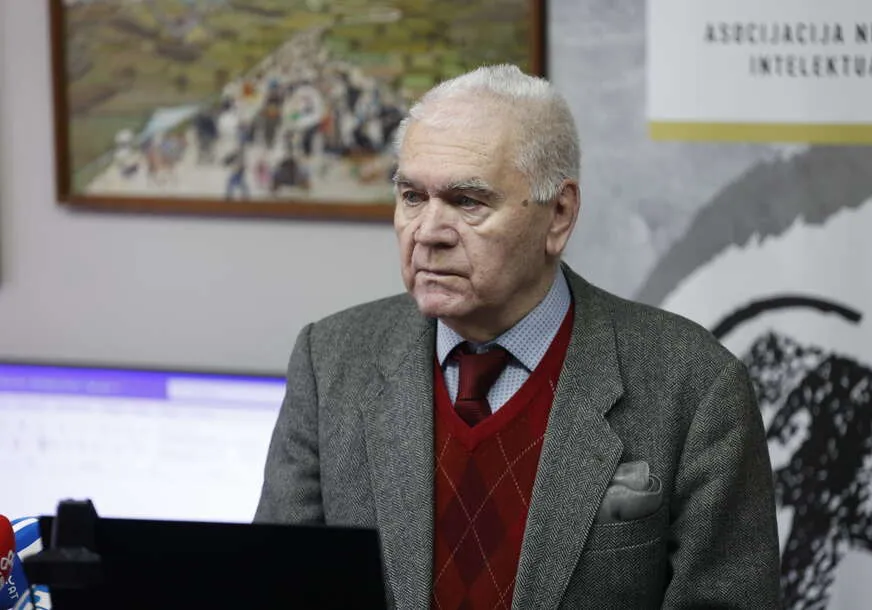
(Patria) - "Youth Resilience to Neo-Fascism" was the topic of today's regular session of the Association of Independent Intellectuals Krug 99, held on the occasion of Victory Day and Europe Day.
The introductory speakers were Petar Hadžović, a law student and Roma activist from Trebinje, Ena Matošević, a Master of International Politics and Diplomacy from Travnik, Dragana Muratović, an activist from Mostar, and Muhamed Hamzić, president of the Krug 99 Youth Forum.
Kulenović: Do Not Agree to the Ethnization of Truth
In his opening address, the president of Krug 99, Adil Kulenović, said that the title of today's session might seem like a statement, but it should also be a question: does resilience stem solely from youthful drive and natural resistance to the existing state of affairs?
Or, more pointedly, Kulenović adds, is the younger generation already irrevocably trapped in ethno-nationalist narratives – "us and them"?
- For normal people, for our old culture of living together and a healthy society, such a lineup of speakers would be quite ordinary. In our devastated society, this information is important even when not explicitly stated, as it offers hope.
This is especially true in the context of rising ethno-fascism – a policy and ideology that, no matter how much it hides and conceals itself, is our reality. And this is no longer just a situation in the hilly Balkans and in BiH, but also a consequence of the collapse of the existing international order based on the values of liberal democracy, peace, and the sovereignty of nation-states – Kulenović points out.
He states that it was a conscious decision to avoid having speakers from generations who, from the perspective of remembering the glorious battles that defeated both Nazism and Fascism, might overlook the necessity of confronting the present – both local and global – circumstances.
- However, let us at least provide some indications for understanding the term neo-fascism, which we use and which, in the name of supposed political correctness, is reduced only to fascism. This is especially important as in contemporary circumstances, we should talk about neo-fascism, by which we mean ideologies and political movements that revive the key elements of historical Nazism and Fascism.
This is not just about extreme ethnic or racial supremacy, the affirmation of the cult of the leader and militarism, but also about the rejection of democratic institutions, systematic discrimination, and violence against minority groups.
In today's context, this can include neo-Nazi organizations, but also phenomena such as myths about national "purity," historical revisionism, cultural supremacy, and the inequality of cultural identities – said Kulenović.
According to him, this is a step towards redefining political orders that would transfer sovereignty from the citizen as the holder of sovereignty to ethnic groups. And this is also a real danger to peace and a source of instability in the world.
- An unstable Bosnia and Herzegovina is merely a laboratory example of the consequences of such processes. Opening this Pandora's box for the political order of existing states and the world order as a whole, where there are currently five to seven thousand ethnic groups, the encouragement of which by such political intentions would radically affect the stability of all 193 United Nations member states.
The historical pendulum, which swings cyclically from one extreme to another, is now on the trajectory that led to Hitler in the past. It will not easily change direction without the mobilization of all societal structures, especially the youth – emphasizes Kulenović.
Despite all the power of mass manipulation of common sense, the burden of rational resistance and developing resilience to political, as well as technological challenges, which, in a new guise, are produced by ideologies that showed devastating consequences in the 20th century, rests on the youth, and not only on them.
- Young people in Bosnia and Herzegovina must not agree to the ethnization of truth, the relativization of a bloody past into three truths, nor to the dominance of ethno-nationalism as the sole and unchangeable given that generates their departure from their own country.
The path to this is the rejection of one's own and collective delusions through political emancipation into a free citizen – an individual, who will not be led by the intoxicating fervor of ethno-nationalism into new cataclysms – Kulenović stated.
Matošević: Building a Society Where There Is No Room for Radicalism
Ena Matošević, a Master of International Politics and Diplomacy from Travnik, emphasizes that she is pleased that today we are not only talking about neo-fascism as an ideology that happened in the past, but also drawing attention to the fact that its elements can appear today.
- Extreme ideologies today appear much more subtly and are adapted to the digital age, often coming through content that young people and society consume daily.
Very often, this content does not look dangerous at first glance, but that is precisely where the greatest danger lies. This is especially true when we talk about BiH, a society still burdened by war traumas and political divisions.
Unfortunately, we are growing up in such an environment where much more is said about the past, and far too little about the future – Matošević notes.
She also adds that it is important to talk about this topic during the commemoration of Europe Day.
- The EU was created as a political and civilizational response to wars, extremism, and deep social divisions. Therefore, today it is not enough to only formally talk about BiH's EU path.
It is equally important to build a society where there will be no room for radicalism that sends younger generations back to the past instead of directing them towards the future.
In conclusion, if we want a European BiH, then European values must begin to live within us, not only in institutions and documents, but in our words, actions, and ultimately the policies that lead us on that path – Matošević concluded.
Hamzić: Europe's History Offers Painful Warnings
Muhamed Hamzić, president of the Krug 99 Youth Forum, stated that when it comes to youth resilience to neo-fascism, we are not only talking about the past, nor about historical facts, nor about closed chapters of Europe's 20th-century tragedy.
- We are talking about the present. We are talking about a society's ability to recognize ideologies of hatred before they become political norms. We are talking about the character of the coming generation.
Because neo-fascism never started with concentration camps. It started with words. It started with the normalization of hatred. It started with convincing people that some were less valuable, less desirable, or less legitimate than others – Hamzić states.
He also emphasized that Europe's history offers painful but important warnings.
- Fascism in Italy and Nazism in Germany did not arise overnight. They were not produced solely by radical leaders. They grew in an environment of economic insecurity, institutional weakness, political polarization, and collective fear.
Young people at that time, instead of being a corrective force for society, often became instruments of manipulation. That is why Arendt warns that totalitarianism does not begin when the state disappears, but when the capacity for critical thinking disappears.
And that is precisely the essence of today's topic. Because modern neo-fascism does not always come in uniforms, with raised arms, or forbidden symbols. Today, it appears more sophisticatedly: through hate speech, historical revisionism, the relativization of genocide and war crimes, the cult of violence, conspiracy theories, and digital radicalization – Hamzić says.
Precisely because of this, he continues, European countries today are investing enormous efforts in building youth resilience.
- Germany, as a country that went through the darkest experience of Nazism, has developed one of the most advanced models of education about totalitarianism. Visits to memorial centers like Dachau or Auschwitz are not tourist attractions; they are part of civic education.
German students learn not only what happened, but also how it happened. In Sweden and Norway, educational systems specifically develop media and digital literacy among young people so they can recognize manipulation, propaganda, and extremist content on social networks.
France and Belgium are developing local youth programs for preventing radicalization through dialogue, volunteering, and youth participation in public life, based on a simple premise – young people who feel a sense of belonging to a community are less susceptible to extremism.
And what about Bosnia and Herzegovina? Bosnia and Herzegovina has a special historical obligation to address this issue seriously. Anti-fascism in Bosnia and Herzegovina was not an ideological luxury but an existential struggle for the survival of society and human dignity.
ZAVNOBiH emerged as a response to ideologies of division, affirming the state of Bosnia and Herzegovina as a state for its citizens and peoples. However, it is concerning that today we are increasingly facing attempts at historical revisionism.
We see the relativization of Ustasha, Chetnik, and other collaborationist ideologies. We witness the glorification of war criminals, the denial of the genocide in Srebrenica, and the normalization of hate speech through digital platforms.
Young people are growing up in a society where social media algorithms reward conflict, polarization, and sensationalism. This is a serious challenge. Because young people are not born with hatred. Hatred is learned. Just as tolerance is learned. Just as democracy is learned.
This is precisely why youth resilience to neo-fascism must be based on three pillars. The first pillar is education. Not education based on mere memorization of dates and facts, but education that develops critical thinking. Young people must understand not only what neo-fascism was, but why it emerged and how it returns in new forms.
The second pillar is democratic participation. Young people who participate in volunteering, youth organizations, debates, and public life are less susceptible to radical ideologies. Democracy is not just the right to vote – democracy is a sense of responsibility for the community.
The third pillar is social security and perspective. Extremism grows most easily where there is a sense of humiliation, hopelessness, and institutional distrust. Young people without prospects more easily accept simple answers and imaginary enemies.
Do we want a generation that will build its identity on fear and division, or a generation that will understand freedom as responsibility towards others?
Because history teaches us one simple but brutally important truth: fascism never wins through the strength of its idea. It wins when society becomes indifferent to injustice.
And precisely for this reason, it is the responsibility of the youth and all of us not to be mere observers of history, but its conscious and responsible correctives – Hamzić concluded in his address.
Hadžović: Ideologies of Hatred Do Not Disappear on Their Own
Petar Hadžović, a law student from Trebinje, says that as a young person of Roma origin, he believes that the future cannot be built without the truth about the past.
- When we talk about neo-fascism, we often think it's something distant, something that belongs to history. But ideologies of hatred do not disappear on their own.
They return when people start to forget, when they become indifferent, and when they think that the crimes of the past can never happen again – said Hadžović.
He reminds that during World War II, millions of people lost their lives due to hatred and intolerance. And among them were Roma.
- Thousands of Roma families were taken to camps, humiliated, and killed simply because they were different. This crime is known today as the Porajmos. This is not just part of Roma history – it is a warning to all of humanity.
That is why I am concerned when I see indifference among young people today towards neo-fascist symbols, hate speech, and ideas that divide people based on religion, nationality, or skin color.
Some call it a joke, a trend, or a provocation. But behind these symbols, there is no "fun." Behind them are millions of lost lives, destroyed families, and generations that never had the chance to live freely.
Young people have immense power. They can choose to spread hatred or understanding. They can close their eyes to injustice or have the courage to say that every person is equally valuable.
This is precisely why it is important that we learn history, talk to each other, and not allow divisions to turn us into a society without empathy.
As a Roma activist, I do not seek pity. I seek respect, truth, and remembrance. I want a society where no child will be belittled because of their name, language, or origin.
A society where diversity will not provoke hatred, but mutual learning and enrichment. The fight against neo-fascism is not just a fight against the past. It is a fight for the present and the future.
A fight to preserve human dignity, freedom, and the right of every person to live without fear. Because a society that forgets its victims risks repeating the same mistakes – Hadžović concluded.
Komentari (0)
Prijavite se za komentiranje
PrijavaJos nema komentara. Budite prvi!
Minuta
Sve →Iz drugih kategorija

High Representative Not Elected: Germans, French and British Sabotaged Americans, New Attempt at End of June

ČOVIĆ WITHOUT MERCY: How Those Who Brought Ademović to Office Created a Political Hell for Him



Sunny Saturday, quite warm



Tragedy in Albanian resort: Two minors drown












