
By Armin Sijamić
The arrival of Giorgia Meloni in power in Rome worried many. The public feared the far-right, although it was clear to careful observers that nothing would come of her announcements, except in the area of migration and what her supporters call the “traditional family”. Meloni is following the course of Brussels and the West, but one issue could not be ignored – illegal migration.
The number of people who tried to reach the southern shores of Italy from Africa and then head north will probably never be determined. Some of them succeeded, and some ended up at the bottom of the sea.
Meloni promised her voters that the number of illegal migrants arriving on the shores of Italy would be reduced. Some of her voters would certainly prefer the formulation that there should be no migrants at all, but that is not an option. Meloni finally realized that both those who would open the doors wide and accept everyone, and those who would turn Europe into a fortress that would not accept anyone, are wrong. Migration is a historical constant, and science shows the benefits and harms of (un)controlled immigration.
At the migration conference hosted in Rome a few days ago, to which she invited leaders from three continents (Europe, Asia, Africa), Meloni said that her government is open to receiving a larger number of legal migrants, “because Europe also needs immigration”. She also said that illegal migration harms all Mediterranean countries and that only human smugglers benefit from it. That is why she proposes “partnerships” with African countries that will, although she did not say it, keep illegal migrants out of the European Union. She also received support from Brussels for this plan.
Tunisia and other partners
In recent months, Tunisia has been the scene of political, economic, and social upheavals. Opposition representatives have been arrested, an economic crisis threatens to lead the country to bankruptcy while inflation is around 80 percent, and a real small war is taking place on the streets. The country from which the Arab Spring began is thus, disappointed with what has been achieved, beginning to deal with the consequences of multi-year processes.
After a Tunisian died in a fight with migrants in the port city of Sfax on July 3, local residents and security forces began to confront migrants. Hundreds of migrants fled or were expelled from the city, and some were transferred to the border with Libya and Algeria, into the desert, without shelter, water, and food.
The media reported that the cause of such a reaction from Tunisians was also the stance of President Kais Saied, who said in February that “hordes” of sub-Saharan migrants bring violence and that it is part of a “conspiracy” to change the demographic composition. He then stated that Tunisia had provided a lot for migrants, but refused to be a transit country or a place where migrants would stay permanently.
However, Saied had other problems. The country was sliding towards bankruptcy, its political reputation was tarnished, and the dissatisfied threatened that a new rebellion could occur. Saied ordered the expulsion of certain European officials for participating in protests. The only salvation for his government, Saied found in negotiations with the International Monetary Fund (IMF), which would lend the country two billion dollars. But the IMF conditioned its services and demanded the abolition of subsidies for fuel, electricity, food, etc., and the restructuring of about a hundred state-owned companies. Saied refused this and was left without the IMF's money.
In mid-month, an offer of cooperation was made to Tunisia from Brussels. European Commission President Ursula von der Leyen, Dutch Prime Minister Mark Rutte, and Giorgia Meloni visited Saied. A memorandum of understanding for a “strategic and comprehensive partnership” on irregular migration, economic development, and renewable energy was then signed.
Von der Leyen offered 105 million euros to support measures to combat irregular migration and 150 million euros in immediate support, as well as a long-term loan of around 900 million euros. But the long-term loan would depend on the approval of the loan from the IMF. Von der Leyen said the agreement was an “investment in common prosperity” and that “effective cooperation” on migration is needed, announcing greater cooperation against “smuggling and trafficking networks” and in search and rescue operations.
In other words, Meloni managed to get Brussels to pay Tunisia to detain illegal migrants on its territory, because the EU, for various reasons, does not want or cannot accept them.
A few days later, Saied received help from Saudi Arabia. Riyadh gave him 100 million dollars in aid and 400 million dollars in favorable loans. But this money will not be enough for Tunisia to survive without the help of the EU and the IMF.
Reception centers outside the EU
Meloni's success in convincing Brussels to take such a step is not surprising. It is already an old idea of certain circles in the EU to pay some countries to keep migrants on their territory. Reception centers would be financed by the EU, which would simultaneously decide which of these people to allow into the union. Everyone in Brussels understands that migrants are needed, because the EU population is aging rapidly and young workers and new consumers are needed. Since part of the continent outside the EU is already quite demographically depleted, Brussels can look for new immigrants in Asia and Africa.
The agreement with Tunisia is also not surprising, as that country is one of the most important points from which African migrants try to reach the Italian islands in the Mediterranean, or Malta. This year, over 75,000 migrants have arrived in Italy this way. However, what is surprising is the rapid change in Saied's stance. After the aforementioned conference in Rome, human rights groups said that the EU is shifting the burden of fighting migration to African countries, i.e., giving them the task of keeping their population on that continent.
How successful Tunisia and future partners will be in keeping undesirable migrants out of the EU remains to be seen. But what is already clear is that Meloni has found her place in Brussels and the West more broadly, despite the fear of the far-right with which she was associated until ten months ago. Her connections with parties and movements that have a fascist legacy and fears that she would destroy the EU with her views are also a past that many do not mention. Her youthful admiration for Benito Mussolini is no longer news. Thus, her extreme politics have evolved into a kind of Atlanticism, sovereignism, and ultra-conservatism that is not unique to her government. Now that she is legitimized as a politician loyal to Brussels, she has to implement some of her pre-election promises and forget some. In the meantime, migrants will remain a political and ethical issue, while millions will try to reach Europe.
Komentari (0)
Prijavite se za komentiranje
PrijavaJos nema komentara. Budite prvi!
Minuta
Sve →Iz drugih kategorija
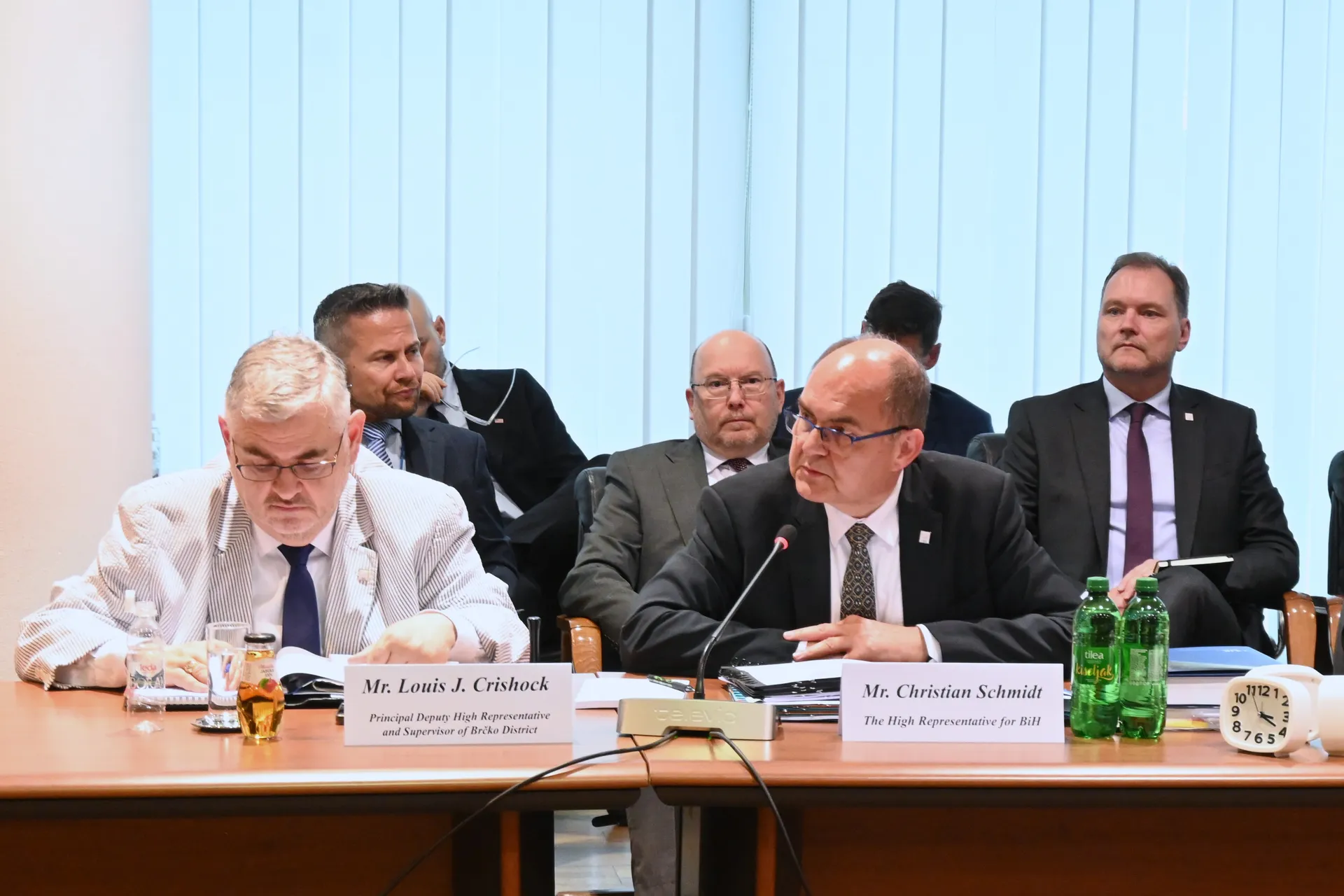
High Representative Not Elected: Germans, French and British Sabotaged Americans, New Attempt at End of June
ČOVIĆ WITHOUT MERCY: How Those Who Brought Ademović to Office Created a Political Hell for Him


Sunny Saturday, quite warm
Tragedy in Albanian resort: Two minors drown