
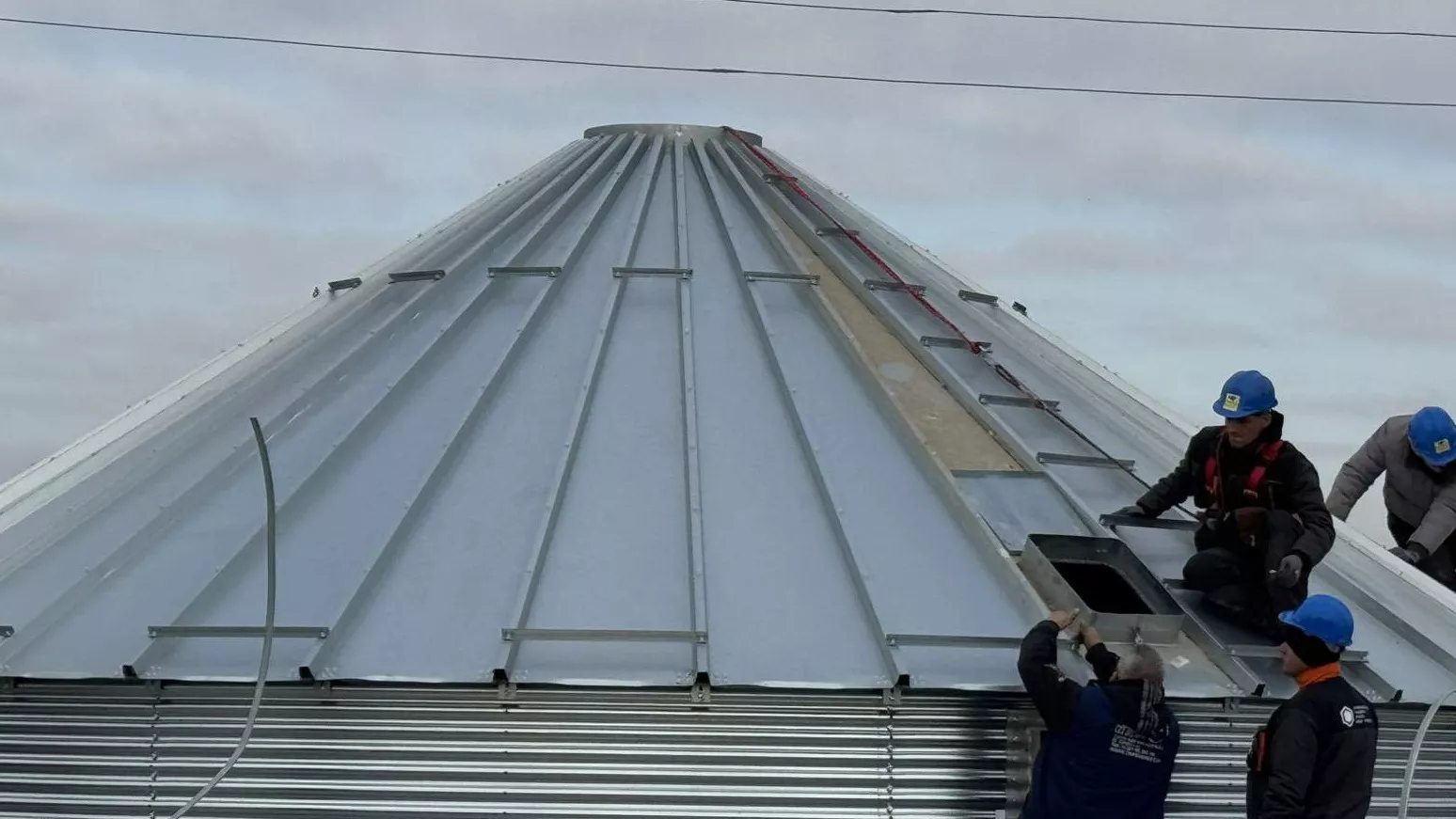
(Patria) - The Medžlis of the Islamic Community in Janja is finalising the construction of two silos and a grain dryer, a waqf project with a total storage capacity of 1,000 tonnes and a drying capacity of 10 tonnes per hour, which for the first time allows farmers in this part of Semberija to be independent from buyers during the harvest period.
The facilities are being built on a waqf plot on the Kozluk–Janja route, and the Medžlis states that the silo and dryer will be available to all producers.
The President of the Medžlis Janja, hafiz Fahret Baćevac, noted that the finishing works are underway, and that after assembly, the facilities will be connected to electricity and water, as well as the asphalt paving of the access road.
– This is a generational project. The two silos have a total capacity of 1,000 tonnes, while the dryer has a drying capacity of ten tonnes per hour. This is an infrastructural step forward that Janja has not had until now – Baćevac told the MINA Agency.
Until now, there was no silo of this capacity in the Janja area. The Medžlis currently cultivates about 140 dunams of waqf land, and the basic idea of the project was to enable, in addition to its own, the storage of grain from other farmers, congregation members and residents of Janja.
Income from waqf plots and grain sales has for years been a significant source of funding for the Medžlis's operations.
– When we started the restoration of waqf infrastructure in 2014, the goal was for the Medžlis to rely as much as possible on its own work and waqf. We envisioned supporting the Medžlis's work from the waqf and the fruits of labour. With those revenues, we maintain machinery, but also the regular activities of the Medžlis. Without God's help, that would not be possible – Baćevac said.
The project to improve waqf property by the Medžlis Janja began without its own machinery, with minimal resources, but with a clear intention and land inherited from ancestors as a trust. Since then, production has gradually grown, and experience, as they say, was built on the ground.
Both in the mosque and in the field, they were led by hafiz Omer-ef. Camić, the chief imam of MIZ Janja. With a big smile, he watches the workers installing the silos.
He recalled that in 2014, 130 dunams of wheat were sown.
– It was an amateur start. Year after year we learned, matured, and today we have serious experience in agricultural production – Camić told the MINA Agency.
The construction of the silo, he adds, was an economic necessity. The feasibility study showed that the Medžlis and local producers lose significant funds annually due to the inability to store grain immediately after harvest.
– Buyers exploit that moment and blackmail with the price. Estimates suggest we lose up to 200,000 KM annually just because we have nowhere to store grain for about fifteen days – Camić explained.
The idea of building a silo matured for almost four years. A particular challenge was finding a suitable plot. After it was found, the then-owner Hasan Aletović decided to endow the land as waqf, rather than selling it.
– We deliberately went for a larger capacity, so that the silo would be useful to other farmers in Janja as well – Camić said.
Waqf property in Janja, according to him, has a long-term perspective. He recalls that cities were built on waqfs for centuries, and both the people and the state lived from them.
– Our waqf is in arable land. We decided to engage in agriculture to fulfil the trust of the waqif and simultaneously encourage others to get involved, to do a good deed and be part of this waqf, on any basis – he said.
Imams and congregation members work together on the waqf plots, within the project of "endowing time", which the Medžlis launched several years ago.
– When people cannot help with money, they endow their time. That is how we gather, and we also see that a large number of our congregation members have endowed a large number of plots in these ten years – Camić explained.
He adds that the people in Janja are hardworking and love their Islamic Community.
– Regardless of the opportunity to hear otherwise, those are the views of individuals. In the field, however, love for the Community is shown. Congregation members and imams work together on our fields. Imams prepare the land, then the more skilled congregation members sow it – explains efendija Camić.
He emphasises that he is especially pleased that in this way they can promote the values and work of the Islamic Community in BiH.
In recent years, the Medžlis Janja has been a champion in production and yields per hectare in the area of the smaller Bosnian-Herzegovinian entity.
With the income from yields, they managed to achieve their goal – to be financially stable, for the call to prayer to be heard in this part of Semberija, and to preserve the waqf – the Bosnian land, a trust from ancestors, from decay.
Komentari (0)
Prijavite se za komentiranje
PrijavaJos nema komentara. Budite prvi!
Minuta
Sve →Iz drugih kategorija

High Representative Not Elected: Germans, French and British Sabotaged Americans, New Attempt at End of June

ČOVIĆ WITHOUT MERCY: How Those Who Brought Ademović to Office Created a Political Hell for Him



Sunny Saturday, quite warm



Tragedy in Albanian resort: Two minors drown












