
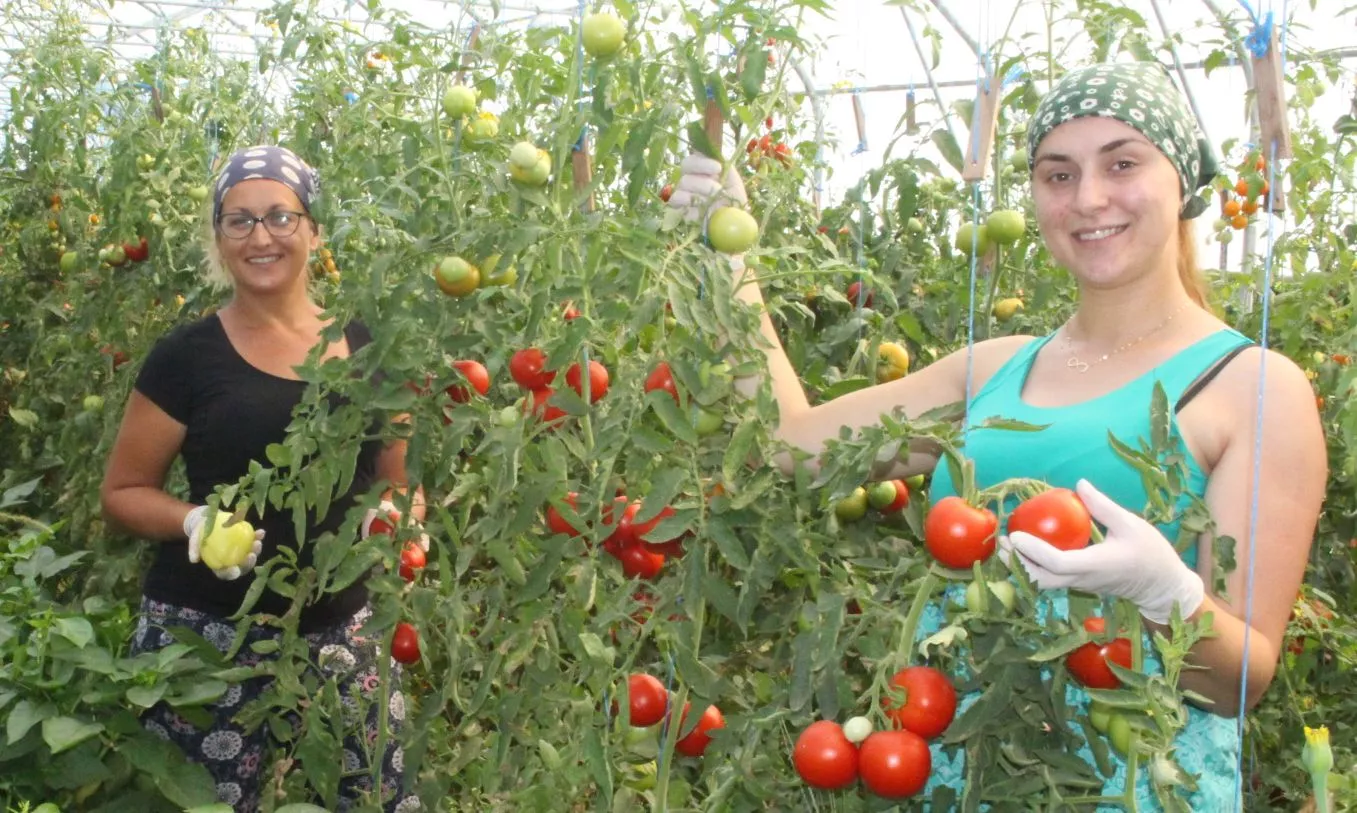
In difficult times, it is easy to spot local heroes. One of them is Hazima Topčagić from Pribava, a village near Gračanica, owner of “Topčagić Organic Products” (TOP). Hazima is self-employed in organic food production, and since the beginning of the COVID-19 pandemic, she and her family have taken on the obligation to help the vulnerable. She supplies them with fresh green salad and spring onions, and does so free of charge.
Woman Entrepreneur
For Hazima, managing her own farm is a relatively new thing.
“I always had a small eco-garden because I wanted my children to eat healthy. Since we have 3 dunams of yard, in 2016 I decided to use what God gave us and start farming. Now, during winter, we grow organic green salad, spring onions and spinach, and in summer tomatoes, peppers and cucumbers.”
In 2016, Hazima applied to the agricultural cooperative “Gračanka” for an automatic greenhouse with an area of 500 m2 (half a dunam). The cooperative allocated the greenhouse, and with her own investment in connections for electricity and water and foundations for the greenhouse, she started production in 2017.
“I used to work in some companies, but now I am self-employed and supported by my family. My daughter-in-law is unemployed and she helps me whenever needed, as does my younger son who is still in high school. My husband and older son also lend a hand when I need them.”
Organic Humanity in Action
Hazima is also active in her community. She leads the local women’s association “Pribava” established in 2014 and is known as someone who does not shy away from helping others. “Topčagić Organic Products” also uses Facebook to stay in touch with the local community. As soon as the harvest of green salad and spring onions began, this post appeared on their Facebook page:
“Today’s baskets are gone. Thank you to our customers for their trust (three hearts). A new delivery is coming. And again, dear friends, please send me in inbox the addresses of people who cannot afford to buy or are old and infirm. Your TOP organic products #strengthenimmunity #eathealthy #fighttogether.”
Hazima regularly delivers food for free to about 15 addresses. But before each announced delivery round, she receives names of another five or six new people in need, and she brightens their day when she appears at their doorstep with fresh vegetables.
The Sweden/USAID FARMA II project supported the agricultural cooperative “Gračanka” in procuring 148 milking machines for farmers, and in the past, USAID and Sweden helped the cooperative build a cold storage facility for fruits and vegetables and implement Global Good Agricultural Practices (GAP), benefiting more than 1,000 cooperative members.
“In the town, there is also a baker who distributes bread for free to the vulnerable, so we pick that up along the way and deliver it to people,” adds Hazima.
Maintaining Quality and Customer Relations
TOP sells its products, which besides fresh vegetables include processed items such as tomato salsa, ajvar and pickles. They sell at the farm, at the “Gračanka” cooperative store, and deliver in and around Gračanica.
“Honestly, before this situation with the coronavirus, people preferred to come to us and buy here, but now we have oriented ourselves to delivery. Our delivery services are also free for all orders over 5 (convertible marks), and we have also made packages for 6 KM that include a kilogram of salad and 800 grams of spring onions,” says Hazima. “We are now mostly delivering and will continue as long as there is need.” But whether there is a coronavirus or not, she follows all organic production and control rules and has a certificate. “We buy special seeds and seedlings and use organic fertilizer. Our greenhouse is automated so that the roof and sides open and close depending on internal temperature and humidity, as well as wind and rain. All this is measured by sensors.”
But there are also challenges in organic production.
“Organic spinach seeds are more sensitive, so it is possible that our yields will be lower this year, so we have not yet decided to deliver spinach.”
Continuation of the story with support from Sweden and USAID When the spring harvest ends, Hazima will start working on the next production cycle and prepare the soil for planting tomatoes, peppers and cucumbers. “We can expect the first yields in July, and after that, everything we don’t sell we will process and sell in winter.”
Komentari (0)
Prijavite se za komentiranje
PrijavaJos nema komentara. Budite prvi!
Minuta
Sve →Iz drugih kategorija

High Representative Not Elected: Germans, French and British Against Americans, New Attempt at End of June

ČOVIĆ WITHOUT MERCY: How Those Who Brought Ademović to Office Created a Political Hell for Him



Sunny Saturday, quite warm



Tragedy in Albanian resort: Two minors drown












