
By: Hamza Ridžal (Via the Silk Road)
The first dusk spread over the vast Baghdad sky. I walked along El-Mutenebbi Street, excited, like a thirsty traveler who knows the oasis is not far. I knew that only half a kilometer separated me from the building that had long ignited my imagination, hotter than this Iraqi day. From the spacious Rashid Street, we turned into the narrow Baghdad alleys, whose ancient glory is silenced by the deep shadows of dusty walls. With every step through the Džumhurijja neighborhood, my excitement grew that I was finally here.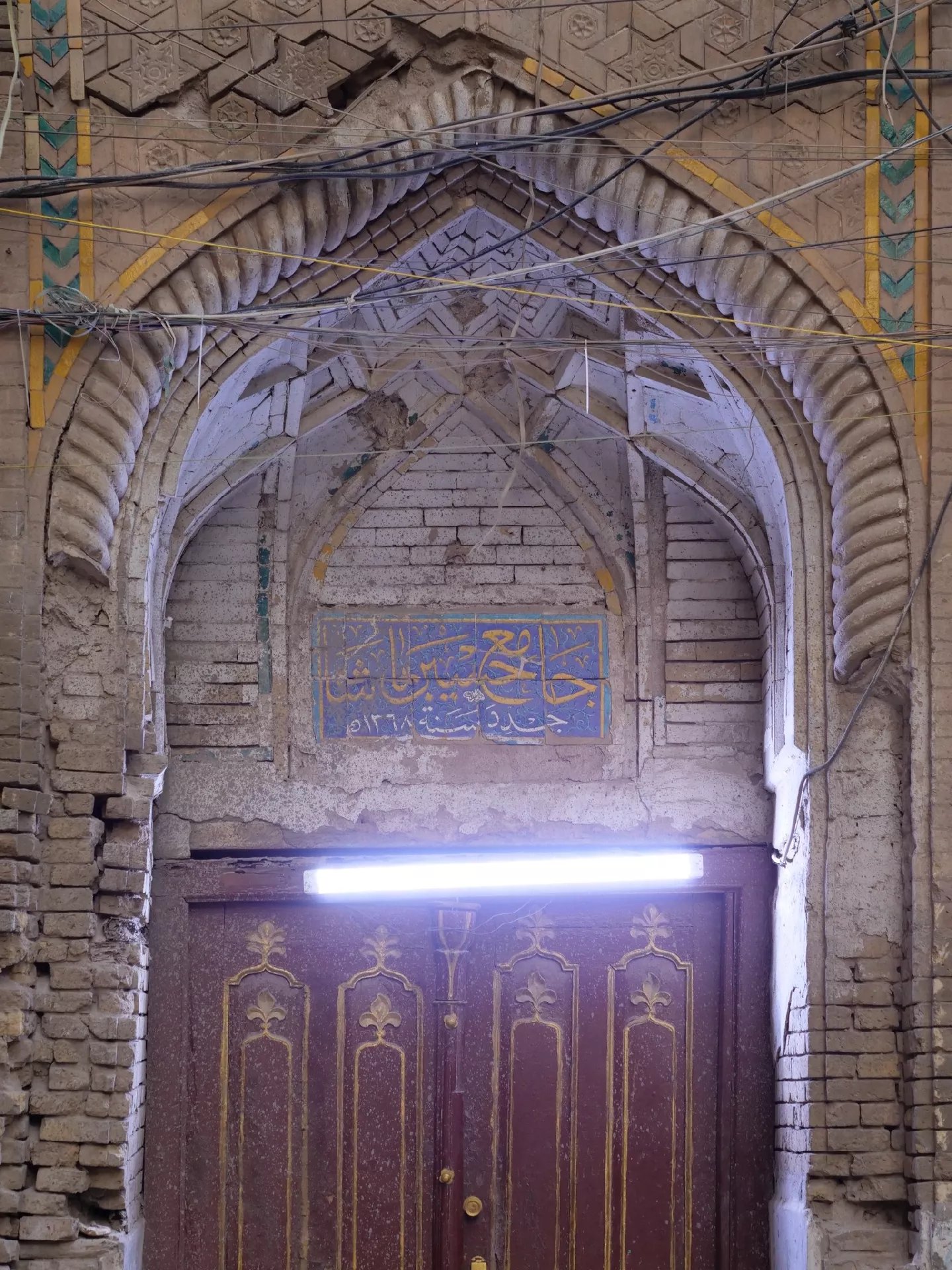
After the experience in 2023, when we paid $2,000 for an Iraqi visa and didn't get it, I feared I might never visit the building that now separated me by only a hundred meters. However, it didn't appear on the horizon. High clay walls, through whose tops only a sliver of the Mesopotamian sky was visible, hid it from my sight. And then, almost jumping, I peeked around the intersection. From the desert grayness of the Baghdad alleys, hiding in the dense canopy, peeked the green smile of the minaret I had only seen in pictures for so long.
Ah, finally! This mosque with a madrasa was built in 1673 by a Bosnian, Husein-paša Šarić, from Stoac! Right here, in the old heart of the capital of the universe! I hurried to the mosque doors to see if there was any trace of my homeland on them. And indeed, it wasn't hard to find. From a distance, I saw the beloved Bosnian flowers, eight lilies, proudly adorning the ancient mosque doors – the original doors from 1673, thank God! And here, at the end of the world, at the endowment of a Bosnian, our symbols welcomed us.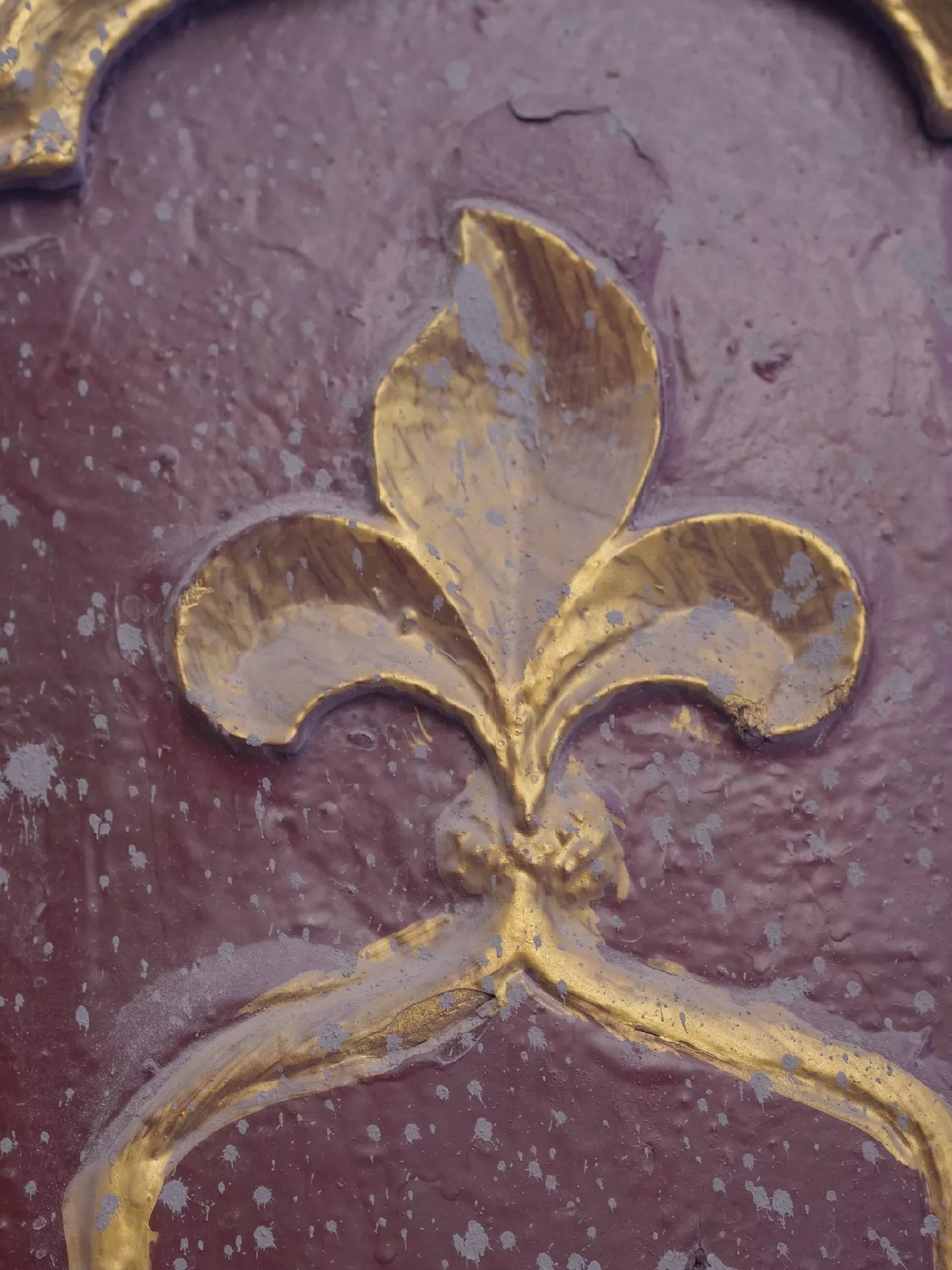
To my endless joy, the doors were ajar. With Ahmed and Hazim, I entered humbly, wanting to tour this complex and take photos. I wanted to return this mosque and the story of the Bosnian governor of the glorious city of Baghdad to my people and country – a legend lost in the mists of time. But, as soon as we stepped into the courtyard, someone shouted at us. An unknown Arab threatened us with his finger, demanding that I put the camera back in my backpack.
At first, I thought the three of us were stronger than him. I was already imagining a scenario where Ahmed held him down while Hazim sang "Ring Around the Rosie," and I took photos. But, I thought that before that, however tempting this image might be, diplomacy should be given a chance.
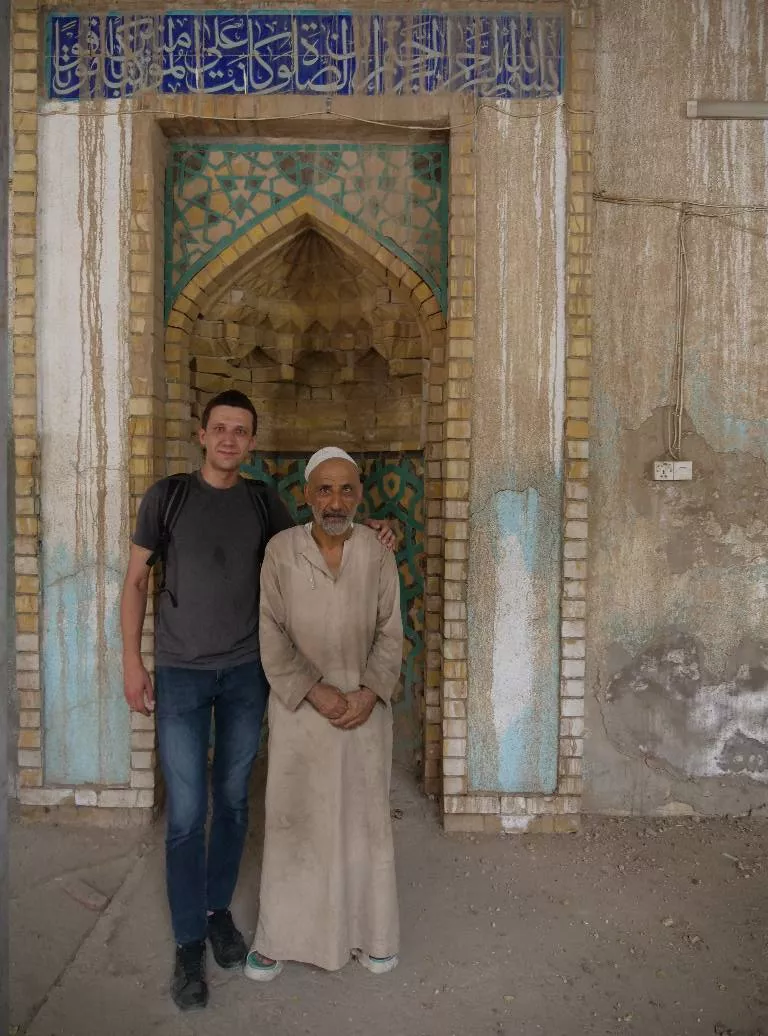
From our conversation, we learned that this man is actually the imam of the mosque. His name is Muhammed Mehdi. When we told him why we were there, emphasizing that our ancestor had built this mosque, he was delighted and said we could do whatever we wanted.
Unfortunately, Husein-paša Šarić's mosque has been demolished to such an extent that today only the minaret, mihrab, and a few walls remain, along with the entrance doors from the time of its construction. Like on the stećci tombstones, the lilies remain, defying the devastation. The mosque's dome collapsed due to neglect and lack of timely renovation. Some rooms behind the mosque that remained were used as a dormitory for madrasa students and are still recognizable.
The ground-level area, once used as a summer musalla, has been adapted for prayer. We took photos, and then we climbed to the roof of the madrasa, which has had no students for a century. When I went outside to walk around the mosque to get a better photo of the minaret, the streets were filled with the evening adhan from Baghdad's minarets. Among them, I heard a familiar voice. Wait, is that possible?
Yes, that's Hazim's adhan! I went back inside to savor this moment... The best Bosnian adhan reciter I know, singing in a Bosnian mosque at the end of the world! It seemed to me that even the lilies on the door straightened up for a moment. Hazim led the prayer, and then we sat down to talk. I also called Ahmed Šarić to help us with Arabic, so we wouldn't mistranslate any information. Muhammed Mehdi told us that he has been the imam here since 2013 and that he prays every prayer except Fajr because he lives far away. He does all this without any salary. When he said that, Ahmed Šarić asked me to give this man some money on his behalf when we leave, which we did. It seems he received a solid monthly salary.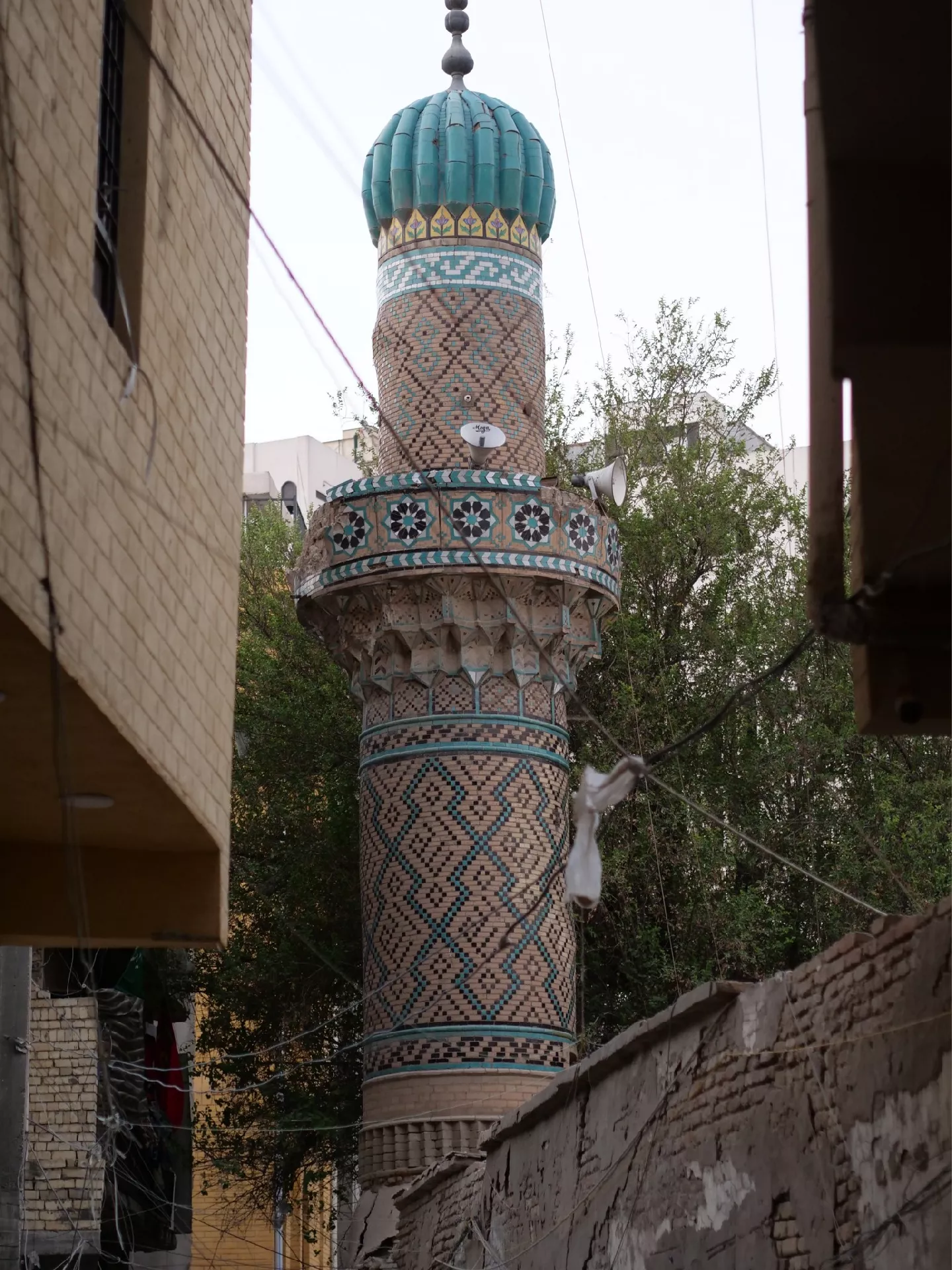
Sometime in the 1950s, this part of Baghdad was flooded, and most residents left the district forever. Because of this, at the evening prayer, besides us and the imam, there was only one other person. Muhammed Mehdi says that the small number of the congregation doesn't bother him. He considers serving this mosque his service to Islam. And we add: and to Bosnia, the distant land whose lilies still adorn Baghdad – the city of a thousand worlds.
Komentari (0)
Prijavite se za komentiranje
PrijavaJos nema komentara. Budite prvi!
Minuta
Sve →Iz drugih kategorija

High Representative Not Elected: Germans, French and British Against Americans, New Attempt at End of June

ČOVIĆ WITHOUT MERCY: How Those Who Brought Ademović to Office Created a Political Hell for Him



Sunny Saturday, quite warm



Tragedy in Albanian resort: Two minors drown












