
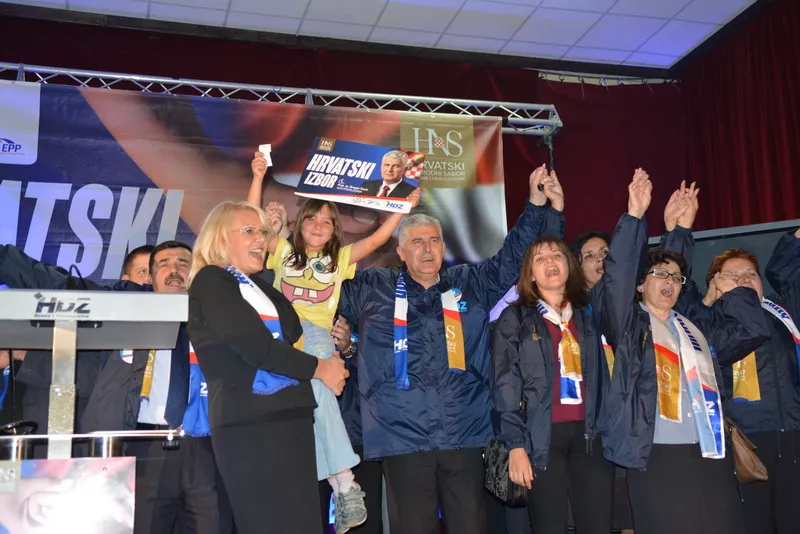
It is well known that Dragan Čović has repeatedly declared the Croatian people unequal in Bosnia and Herzegovina. The trigger for this saga was the election of Željko Komšić to the position of Croatian member of the Presidency of Bosnia and Herzegovina on two occasions, reports the Patria news agency.
In the last eight years, Dragan Čović has constantly pointed to the alleged inequality of Croats in BiH, calling for changes to the Constitution and the Election Law in BiH to ensure institutional equality for Croats.
„We want a state in which we will be fully equal, with both Bosniaks and Serbs. We do not want the international community to decide our fate, therefore we need a change of the Constitution and the Election Law. We need a state of law in which everyone will be equal so that BiH can function as a normal state. (…) I believe we can obtain candidate status in the next four years, but only if BiH functions as a normal state, and that will not happen until Croats are equal with the other two constituent peoples.” (Pre-election rally in Rama – September 28, 2014.)
It is interesting, after the elections in October last year, to look at the results of the “inequality” that Dragan Čović talks about.
In the race for the member of the Presidency of BiH, Dragan Čović received a total of 128,053 votes.
In the race for the House of Representatives of the Parliamentary Assembly of BiH from the territory of the Federation of BiH, the HNS list received a total of 119,468 votes or 12.15%, and received 4 mandates in the Parliamentary Assembly. The HNS list also has four delegates in the state House of Peoples. Therefore, if we look at the situation in the Parliamentary Assembly of BiH, we see that the HNS list has 4 out of 28 directly elected representatives (14.2%) and has 4 out of 15 delegates in the House of Peoples (26%), and in the Club of the Croatian People it has 4 out of 5 delegates or 80%.
A similar situation is at the federal level. The HNS list received 118,375 votes for the House of Representatives (11.23%), which ultimately resulted in 12 mandates, out of a total of 97, which is 12.3% of the total number of mandates. In the House of Peoples of the Federation of BiH, this list has 13 out of 54 delegates, or 24.07% of delegates. In the club of the Croatian people, HDZ has 13 out of 17 delegates (76%). Since delegates to the House of Peoples of the Federation of BiH are elected from the cantons, it is interesting to look at the total number of votes that HNS won for all cantonal assemblies. In the nine cantonal assemblies for which it had its candidates, HNS won a total of 107,431 votes, therefore, even fewer than it won in the race for the House of Representatives of the Federation.
From the above data, it is clear that Croats in BiH are by no means unequal, since HNS, with about 12% of the votes in the Federation of BiH, received the opportunity to block all processes it dislikes in the houses of peoples.
If we additionally look into the distribution of power in BiH, we will see the position of Croats, or HNS as the alliance representing the interests of the majority of Croats in BiH.
Out of a total of 13 governments in BiH that will be formed as a result of the 2014 General Elections, HDZ BiH or HNS has or will have its ministers in as many as 9 governments, which means that with 12% of the votes it will participate in 69% of governments in BiH.
Only in the Sarajevo, Tuzla, Una-Sana and Bosnian-Podrinje cantons will there be no ministers from HDZ. A particular curiosity is the ministerial position for refugees and displaced persons in the Government of the RS, which belongs to HDZ, although in the elections for the National Assembly of the RS in that entity, HNS had only 1,810 or 0.27% of the votes, more than two times less than HDZ 1990, which had 3,698 or 0.56% of the votes.
From all the above, it is quite clear that in the current political system in BiH, Croats are not only not unequal, but are even “more equal” than other peoples, and that their vote in principle “is worth more” than the votes of other peoples in BiH.
Dragan Čović receives a rating of false for this statement, writes Istinomjer.ba.
Komentari (0)
Prijavite se za komentiranje
PrijavaJos nema komentara. Budite prvi!
Minuta
Sve →Iz drugih kategorija

High Representative Not Elected: Germans, French and British Sabotaged Americans, New Attempt at End of June

ČOVIĆ WITHOUT MERCY: How Those Who Brought Ademović to Office Created a Political Hell for Him



Sunny Saturday, quite warm



Tragedy in Albanian resort: Two minors drown












