
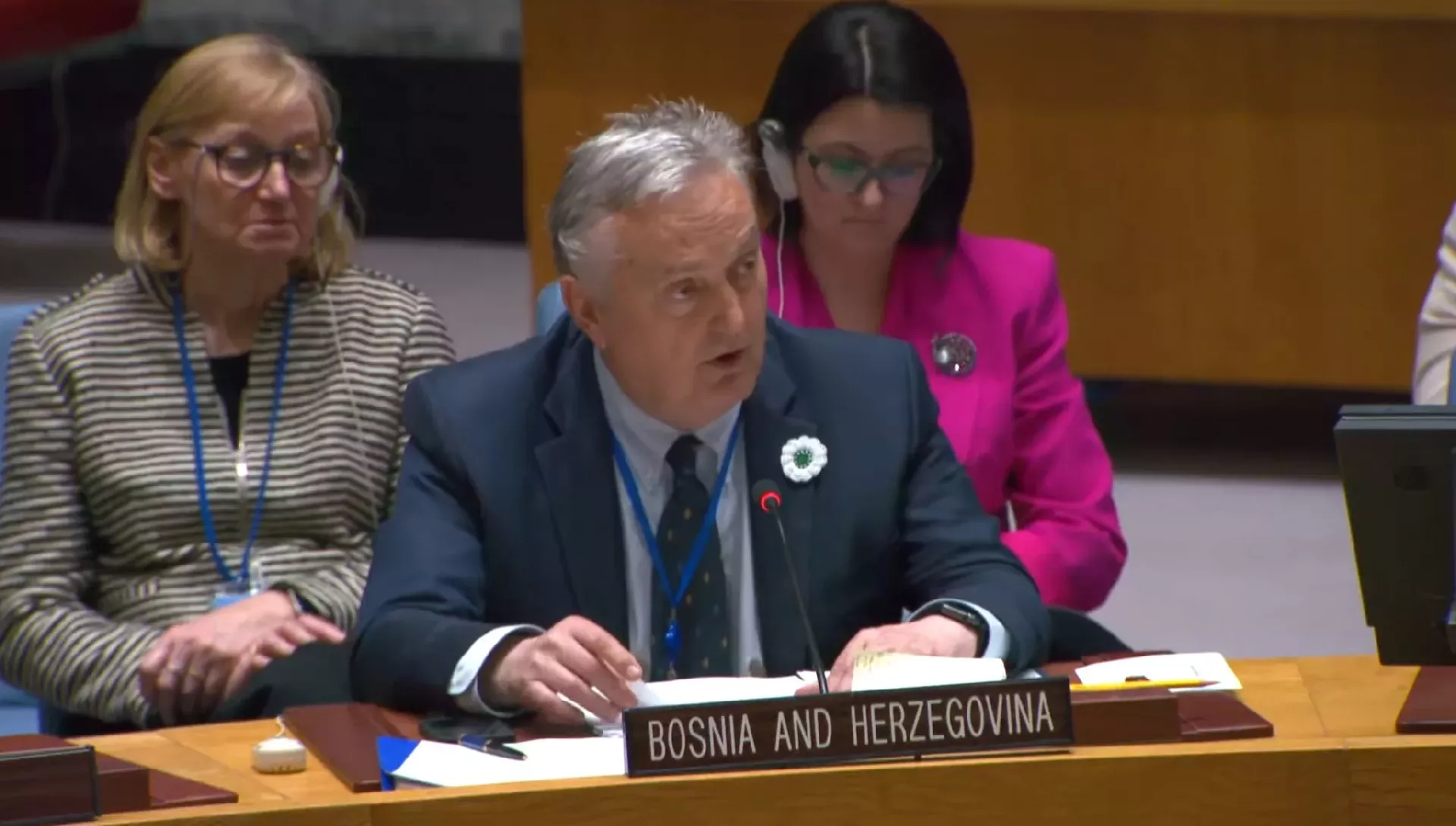
(Patria) - Chargé d'affaires, on behalf of the Permanent Mission of Serbia to the United Nations (UN), Saša Mart, wrote to the President of the UN General Assembly and all UN member state missions regarding the adoption of the Resolution on the Genocide in Srebrenica, writes N1.
Zlatko Lagumdžija responded to the letter, sending a letter to the ambassadors of all UN member states in response to the letter from the Serbian Embassy to the UN.
We are publishing Lagumdžija's letter in its entirety:
Considering the rather repetitive communication from the Permanent Mission of Serbia to the UN on the topic of the draft resolution "International Day of Reflection and Commemoration of the Genocide in Srebrenica 1995", allow me to emphasize the following:
The sensitive issue of the war in Bosnia and Herzegovina remains as such only for neighboring Serbia, incapable of moving beyond the narrative of the 1990s. The "issue", in this case, is the judicially established fact that the crimes committed in Srebrenica were genocide. Genocide happened, and this has been established by both the International Court of Justice (ICJ) and the International Criminal Tribunal for the former Yugoslavia (ICTY) in their judgments. No one except Serbia questions and condemns this.
Over 8,000 souls who were brutally killed in 1995 are still trying to find peace, while their families try to find some semblance of comfort and closure in the dignified burial of the remains. Many family members are still wandering the hills and forests of eastern Bosnia in a futile attempt to recover at least a bone, a skull fragment, any body part that needs to be buried, to have a final resting place, to have a name again, albeit on a tombstone.
Declaring July 11 as the "International Day of Reflection and Commemoration of the Genocide in Srebrenica 1995" is just a small gesture of recognition for the surviving victims and their families who are still enduring. Establishing this day would show a commitment to justice and truth and acknowledge the human dignity of the victims and survivors of the Srebrenica genocide, as they continue to be subjected daily to furious and relentless denial of genocide, historical revisionism, and the threat of renewed violence.
Regarding the internal dynamics in Bosnia and Herzegovina, regardless of our obligations to respect and implement the legally binding judgments of permanent courts and ad hoc UN tribunals as full UN members, Article 9 of the Dayton Peace Agreement obliges all parties (Bosnia and Herzegovina, Croatia, and Serbia) to respect and cooperate "in the investigation and prosecution of war criminals and other violations of international humanitarian law".
The Presidency of Bosnia and Herzegovina, with or without consensus, or anyone else, a minister or ambassador of Bosnia and Herzegovina, cannot engage in discussions about Srebrenica that completely deny the genocide committed there, nor does it have the authority to question or be above the final proclamations of the judicial institutions of this organization.
Such an action would require amendments to the Dayton Peace Agreement, the Constitution, and finally, the Criminal Code of Bosnia and Herzegovina, which prohibits public approval, denial, or justification of the crime of genocide.
Regarding consultations in the region, let me remind you that all countries in the region, except Serbia, have already supported this draft, either through co-sponsorship or by explicitly stating that they will do so, without the need for any consultations. For countries in the region, everything is quite clear when it comes to respecting international law and the principles of civilized nations.
In proposing its reasons for withdrawing the resolution, mainly speaking of consensus and agreement in the region, it fails to mention that, in this case, "consensus" means erasing the reference to genocide, thereby effectively denying the relevant judgments of the ICJ and ICTY, and "agreement" implies absolute obedience to the narrative that exists in Serbia.
So, you will forgive me if I condemn all these statements once again and focus on the text of the draft resolution itself. It is in no way offensive to any state or its people, nor can a commemorative day be used for any political purpose.
Its primary goal is to foster the process of justice, truth, and reconciliation in Bosnia and Herzegovina and the Western Balkan region. To claim otherwise is simply to stray from the facts – denial is harmful to peace, reconciliation, and justice. The process of reconciliation must consist of the overall recovery of society and confronting the past, not only through the acknowledgment of genocide and crimes, the recognition of victims and the punishment of perpetrators, with a focus on an outcome that will promote peace and justice. That is the essence of reconciliation. Instead of accountability, we hear denial; instead of compassion for the victims, we face a complete lack of humanity.
Let us not be swayed by false arguments and concerns – the warnings that the resolution could lead to instability in Bosnia and Herzegovina are nothing more than thinly veiled threats, but threats nonetheless from those whose sole aim is to maintain control over the truth in the region and continue to openly glorify and reward convicted war criminals without consequences, to erase the victims once again through action and the act of denial. Let me ask you – what in the current draft calls for violence? Who will instigate it? And why? Because someone finally stood up to the revisionist narrative and for the truth?
The culture of remembrance of the victims of the Srebrenica genocide is not and must not be a culture of denial, but a culture of remembrance so that genocide never happens to anyone again,” Lagumdžija stated in the letter.
Let us recall that Saša Mart stated in his letter that he wanted to once again address the entire process of initiating and implementing this initiative, which, as he said, relates to the sensitive issue of the war in Bosnia and Herzegovina, and requires, according to him, consultations at all levels of government in the country. In this regard, the letter points out that he wants to inform UN member states about several points. The first is that there were no consultations on the text of the resolution at the BiH level.
Komentari (0)
Prijavite se za komentiranje
PrijavaJos nema komentara. Budite prvi!
Minuta
Sve →Iz drugih kategorija

High Representative Not Elected: Germans, French and British Against Americans, New Attempt at End of June

ČOVIĆ WITHOUT MERCY: How Those Who Brought Ademović to Office Created a Political Hell for Him



Sunny Saturday, quite warm



Tragedy in Albanian resort: Two minors drown












