
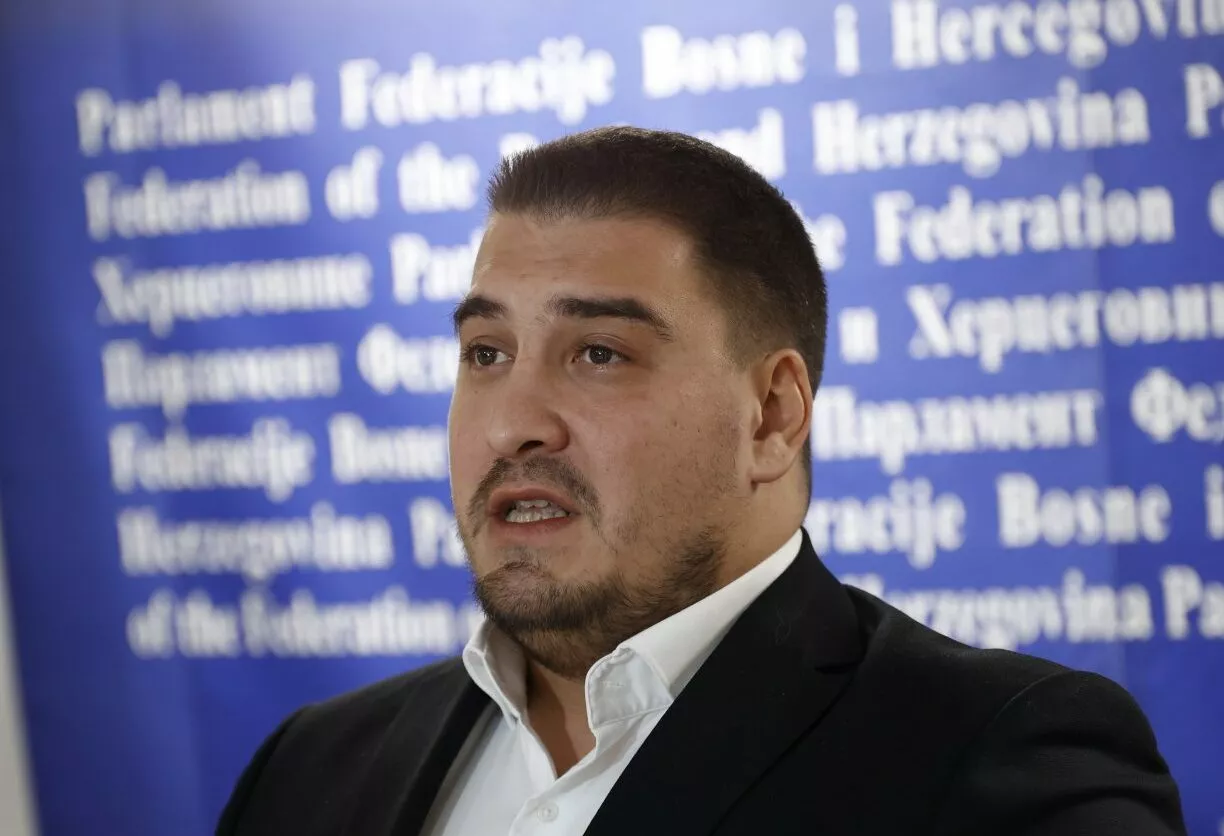
(Patria) - The Dayton Peace Agreement brought peace to Bosnia and Herzegovina, which no side was entirely satisfied with, but it was certainly better than continuing the war, said the introducer at the Circle 99 session Haris Zahiragić on the topic "Where are we now and how to move forward 30 years after the signing of the Dayton-Paris Peace Agreement".
He also recalled the words of the first president of the Presidency of the Republic of Bosnia and Herzegovina, Alija Izetbegović, who said that "this is not a just peace, but it is more just than continuing the war. In the current situation, and in the world as it is, a better peace could not have been achieved.“
After subsequent statements by Richard Holbrooke and the connection of Dayton with preventing terrorist attacks on the US from the heart of Europe, testimonies of war criminal Biljana Plavšić or, for example, the president of the RS entity Dragan Čavić about their conversations with international officials, as well as many, then secret, documents and correspondence of Western officials, which are available to the public 30 years later, that statement by President Izetbegović has been confirmed.
"The then Zagreb, as well as the then Belgrade, were even less satisfied with it, and Pale, as the then main headquarters of separatist and ultimately genocidal policy in Bosnia and Herzegovina, were completely dissatisfied. From today's distance, if we had the opportunity to ask the then signatories of Dayton what they think about its implementation after 30 years, especially the important Annex 4 (Constitution of Bosnia and Herzegovina), I think that the side representing the Republic of Bosnia and Herzegovina would again be the least dissatisfied.
Why? Because Brčko, after arbitration, did not belong to the RS entity, because today we have the Council of Ministers, which is the de facto Government of Bosnia and Herzegovina with nine ministries, because we have one currency, state border police, one state army, state intelligence service and other police agencies, we have the Court and Prosecutor's Office of Bosnia and Herzegovina, we have a unified indirect tax system, unified license plates and hundreds of important state competencies.
Those who today call for a return to the so-called "original Dayton" and those who claim that none of the listed institutions and competencies were foreseen by the original Dayton Constitution would be right if the Constitution of Bosnia and Herzegovina did not contain articles such as the one on additional competencies of Bosnia and Herzegovina, or if, for example, the Constitutional Court of Bosnia and Herzegovina was not positioned in it as it is. However, that is also Dayton and the original one, these are some of what I call the hidden mechanisms of Dayton, which were foreseen as such with the intention of long-term integration of the state of Bosnia and Herzegovina and the construction of its institutions," said Zahiragić.
On the other hand, he notes, those who today claim to have been deceived and that Dayton foresees the legitimate representation of peoples in the Presidency of Bosnia and Herzegovina are also only partially right.
"Legitimate representation in the Presidency of Bosnia and Herzegovina, to be truthful, is prescribed, but not the legitimate representation of peoples, but of all citizens of Bosnia and Herzegovina in both entities. Moreover, another of Dayton's hidden mechanisms is the prescribed direct and supralegal application of the European Convention on Human Rights, and accordingly, there are also judgments of the European Court of Human Rights that oblige our state that, in addition to active voting rights, which are civil, passive voting rights must not remain ethnic.
In addition to the above, Dayton also has some painful injustices that have not been rectified to this day. For example, Dayton legalized, and thus created, the "RS" entity, whose political and paramilitary leadership, as well as institutions, were subsequently convicted of committing genocide and other most serious war crimes. Because of this institutional framework of genocide, that policy was never defeated, which to this day, as we can all see, generates many problems in Bosnia and Herzegovina, but also in the region," says Zahiragić.
Another dimension of Dayton is the fact that it does not only apply to Bosnia and Herzegovina, but also to Serbia and Croatia, which are not witnesses or guarantors of Dayton, but parties to the peace agreement, and thus direct participants in the war in Bosnia and Herzegovina, which due to their participation in it has the character of aggression.
"One of the things agreed upon by the General Framework Agreement for Peace, which today does not receive the necessary attention, is the prescribed regional balance in armaments, specifically measures for sub-regional arms control, which today, 30 years after Dayton, is very seriously disturbed. We should also talk much more about this. Today, when the revision of the Dayton Agreement is mentioned, which would weaken the state of Bosnia and Herzegovina and further cement ethnic divisions, when Serbia tries to use institutional power within the state of Bosnia and Herzegovina, and the Republic of Croatia tries to use its international reputation and position, for the same purpose, it is important to emphasize that the Republic of Bosnia and Herzegovina signed Dayton as it is under the pressure of a four-year aggression, but also that the Dayton Peace Agreement is perhaps the most significant diplomatic action of the USA, and that any change to Dayton would be acceptable to the Bosnian side only if it meant an even stronger and more integrated Bosnia and Herzegovina.
The moral of the story is, they didn't manage to divide Bosnia and Herzegovina then, and they certainly won't succeed in that endeavor now, no matter how favorable the international circumstances may seem, because the international community did not decisively decide on it then, but rather the Bosnian patriots, who are much stronger today in every sense than they were then.
And, finally, how to move forward? Above all, it is important to continue to nurture and preserve peace, as long as it guarantees freedom and dignity for all peoples and citizens in most of the territory of Bosnia and Herzegovina. Of course, we must continue to work towards ensuring the equality of all citizens and peoples on every inch of Bosnia and Herzegovina, which, unfortunately, is still not the case today," concluded Zahiragić.
Komentari (0)
Prijavite se za komentiranje
PrijavaJos nema komentara. Budite prvi!
Minuta
Sve →Iz drugih kategorija

High Representative Not Elected: Germans, French and British Against Americans, New Attempt at End of June

ČOVIĆ WITHOUT MERCY: How Those Who Brought Ademović to Office Created a Political Hell for Him



Sunny Saturday, quite warm



Tragedy in Albanian resort: Two minors drown












