
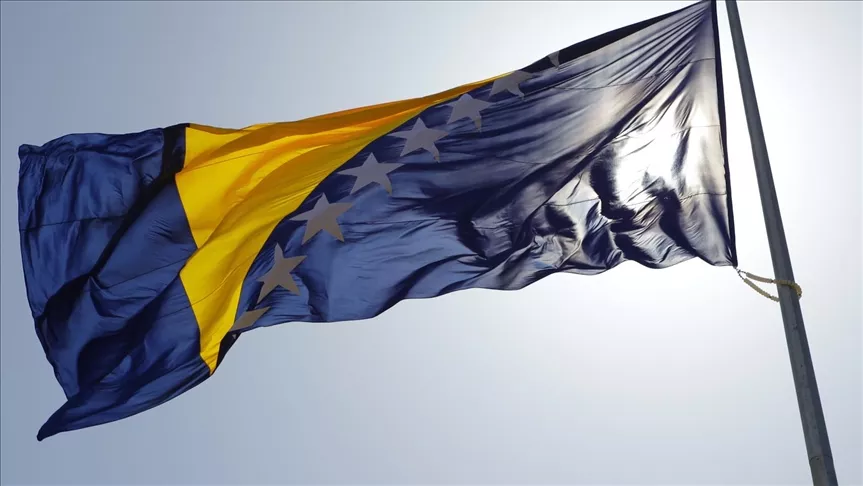
(Patria) - Today's session of Circle 99 on the topic "The Right to a Future: Bosnia is Bosnian" is dedicated to November 25 and BiH Statehood Day, but the speakers also discussed current political issues important for the future of BiH.
Only if Bosnia is Bosnian will we realize our natural and moral right to the future of a free state. Bosnia has been a historical, cultural, political, economic, multi-ethnic, multi-religious, democratic, and human fact for over a millennium, whether some like it or not, the speakers at today's session stated.
The president of Circle 99, Adil Kulenović, announced that in the coming period, they will have a series of conventions on the same topic in other parts of BiH. Kulenović mentioned the recent discussion before the Grand Chamber of the European Court of Human Rights in the case of Slaven Kovačević v. Bosnia and Herzegovina as an unavoidable topic, and condemned the unprecedented scandal of anti-Bosnian forces appearing as opposing parties, while pro-state options avoided the possibility of opposing them at the international level.
"The responsibility lies with the suspect Minister for Human Rights and Refugees, Sevlid Hurtić, but those who brought him to that position and humiliated all citizens of BiH cannot avoid responsibility either. It is also surprising that the Ministry of Foreign Affairs of BiH did not engage BiH's diplomatic network in this case," said Kulenović.
Senadin Lavić, a professor at the Faculty of Political Sciences in Sarajevo, recalled the First Session of ZAVNOBiH on November 25, 1943, in Mrkonjić Grad, when the pro-state capacity of BiH, or its statehood, was restored.
"This was a fundamental step in its historical course. That night, it was decided that BiH would be an equal political unit in Yugoslavia, which was not accepted by many nationalist-oriented ideologues, Greater Serbian and Greater Croatian chauvinists, even then."
He believes that today the platform of the ZAVNOBiH idea is transforming into a European democratic model of a state and integration into the EU and the rule of law.
"This is a civic world of human rights and freedoms. This new platform does not forget the values of ZAVNOBiH. At the core of our new Bosnian sentiment or Bosnian identity, ZAVNOBiH and its eternal values of people living together and the independent state of Bosnia and Herzegovina remain indelible."
He points out that they are publicly and inclusively establishing a progressive understanding of the nation, as opposed to one based on ethnic homogeneity, exclusivity, and religion. He emphasized that he respects the human and civic diversity of Bosnian society and its historical-political context, and that Bosnia and Herzegovina is the national state of all its citizens who perceive it as their own.
"The main deception of hidden nationalists today is expressed in the claim that someone wants to abolish national identities in BiH. Hidden nationalists mislead the public by saying that Bosnian nationality means the abolition of Bosniak, Serb, and Croat identities. This is not true and it is the insolence of daring falsifiers of the legal-political order. The false guardians of these ethnic identities only need to answer why they do not recognize Bosnian national identity and why they classify the peoples of BiH into ethnic ghettos. Consciously accepting Bosnian-Herzegovinian nationality means freedom for all citizens of the state of BiH," he stated.
Enver Halilović, a professor and former rector of the University of Zenica, spoke about the concepts of statehood and state, arguing that they are not the same.
"The statehood of a state and the statehood of a political entity that is not a state have different scopes and contents, and therefore have different meanings. A state and a political entity that is not a state, but has elements of statehood, are concepts of different degrees and contents of statehood. The degree and content of statehood are not the same when a political entity exists within a state and when the same or any other political entity exists independently, when it is politically sovereign."
Halilović also stated that, considering all the experience with the Dayton Constitution so far, it is quite evident that the ethno-national political profiling of BiH is disastrous and that peace and stability in BiH are not achieved on that political principle.
"The civic social and political organization of BiH is the only form of its organization that does not antagonize intercultural and other differences among citizens. Therefore, the only possible constitutional-political definition of a peaceful and prosperous Bosnia is not its ZAVNOBiH definition, but one that says Bosnia is Bosnian, a state of equal and equitable citizens, regardless of any of their collectivist identities," he said.
Azra Zornić, an appellant before the European Court of Human Rights, believes that the Court could not have approved a second-instance proceeding in the Kovačević case, given that the defendant did not offer a single new legal argument.
"The most important argument for initiating a second-instance proceeding is precisely the presentation of legal facts that were not known to the Court in the first-instance proceeding," she said.
She believes that the next undisputed fact relates to Croatia's donation of 100,000 euros to the European Court of Human Rights.
"Do Croatian taxpayers know from whose pockets that money was taken and for whose interests, and who approved that money and from which fund. Considering when and how that donation was made, no other conclusion can be drawn than that it was a bribe to the Court with the aim of overturning the Kovačević verdict."
Zornić believes that an investigation into this will have to be conducted because the Court must not accept any donations.
"Perhaps the Croatian USKOK (Office for the Suppression of Corruption and Organized Crime) could also have work on this matter. The question of who paid the lawyer from the most expensive law firm Blackstone, whose 'good morning' costs thousands of pounds, and from what funds, is also very problematic," she pointed out.
Zornić emphasized that the agent of the Republic of Croatia, Štefica Stažnik, also misled the Court by claiming that Croatia is a guarantor of peace in BiH.
"Croatia and Serbia have been convicted in The Hague for the Joint Criminal Enterprise and aggression against BiH, so how can they be guarantors of peace? Her presentation was entirely political and in agreement with Schmidt's lawyer and the 'BiH representatives'. As our people would say, 'they were all playing the same tune'. The role of the 'troika' in this entire court proceeding, which is extremely important for BiH, is evident because by their inaction and silence, they support HDZ's policy. Why? Well, you have to ask all the officials of the 'troika' about that," stated Zornić.
She congratulated all citizens who have Bosnia in their hearts on the Day of the Restoration of Statehood of BiH.
"So that this is not the last time we celebrate this significant date from our history, I call on all patriots to first use all legal means, then civil disobedience/protests, to engage in the fight against political and aggressive attacks on our homeland, and finally, if necessary, with our own lives, we will and can defend it," Zornić concluded.
Komentari (0)
Prijavite se za komentiranje
PrijavaJos nema komentara. Budite prvi!
Minuta
Sve →Iz drugih kategorija

High Representative Not Elected: Germans, French and British Against Americans, New Attempt at End of June

ČOVIĆ WITHOUT MERCY: How Those Who Brought Ademović to Office Created a Political Hell for Him



Sunny Saturday, quite warm



Tragedy in Albanian resort: Two minors drown












