
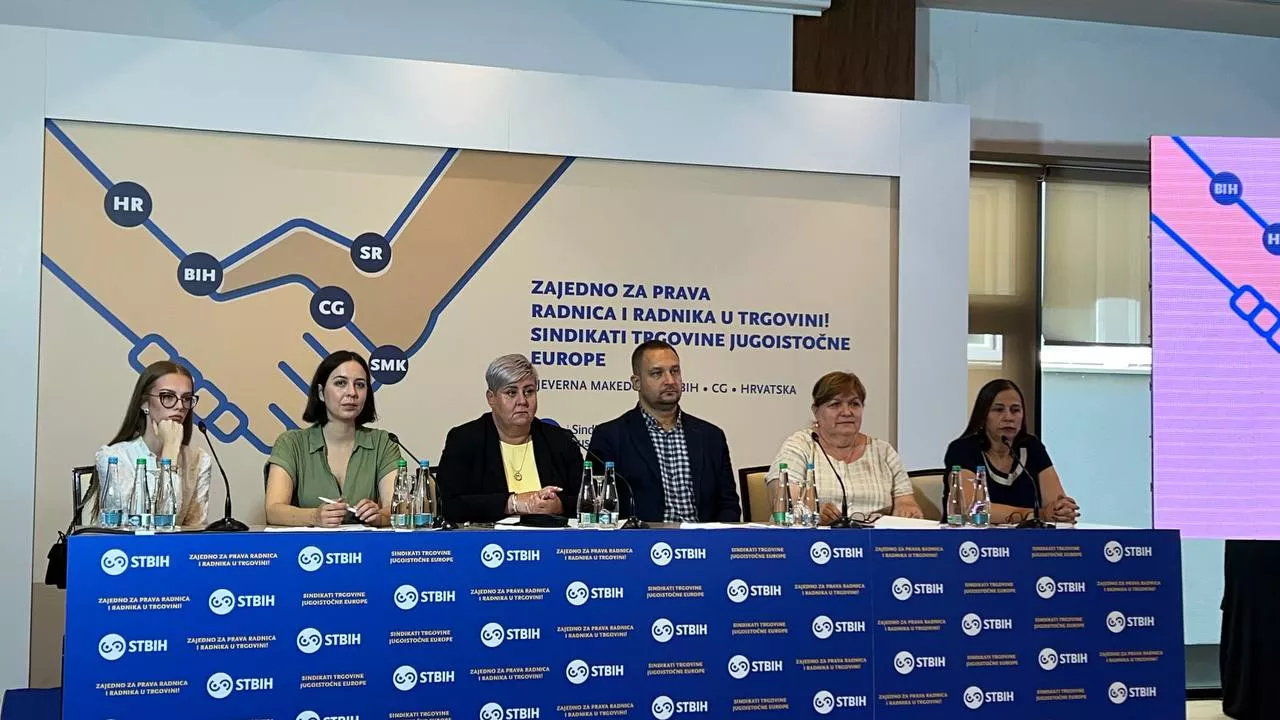
(Patria) - "Together we are stronger," was the message sent from the 2nd Conference of Southeast European Trade Unions, held in Sarajevo. Trade unions stated that together they can achieve much more and that strong and united unions strengthen their negotiating position in dialogue with employers and authorities.
Thus, today, trade unions from Bosnia and Herzegovina, Croatia, Montenegro, and North Macedonia elected a Joint Committee of Trade Union Representatives for trade union organizing in the Southeast European region. A Regional Committee of Trade Union Representatives for the Fortenova Group, which operates in BiH, Croatia, and Montenegro, was also established.
The conference highlighted that trade unions in the region face the same problems, from freedom of trade union organizing, use of annual leave and days off, working on public and religious holidays, to unpaid overtime hours and low wages.
It was also emphasized that a non-working Sunday is the first step towards improving workers' rights.
The president of the Trade and Services Workers' Union of Bosnia and Herzegovina (STBIH), Mersiha Beširović, stated that cooperation is essential in strengthening the rights of workers represented by trade unions.
"In the past year of our cooperation, we have focused on creating a strategy for trade union organizing of workers in new multinational companies present in the region. We have already identified priority companies, and we want to expand this list. The second goal is to strengthen our positions in companies where we have membership, and we will jointly approach management and advocate for a minimum of common standards at the regional level," said Beširović.
Josefin Lundmark from the Swedish trade union Handels says that the union is an important factor in society in her country, but they also face similar problems as unions in our region.
One of the common problems is the work-life balance. Employers expect workers to be available whenever they are needed, while employees need reasonable working hours and non-working Sundays," said Lundmark.
The president of the Trade Union of Montenegro, Sonja Knežević, pointed out that they managed to fight for a non-working Sunday, but there are exceptions during the winter and summer tourist seasons.
"It is important that, so far, all the arguments used by employers against the prohibition of Sunday work have proven to be unfounded, as retail sales have increased, and there is still a shortage of labor," said Knežević.
The president of the Trade Union of Croatia, Zlatica Štulić, emphasized that unionized workers can achieve much more and highlighted the importance of cooperation with employers.
"Our goal is to sit down and talk so that we can organize workers. It is difficult to work in retail, there is high staff turnover, working hours are flexible, people work a lot. Through this project, we can help each other, activate workers to become union members, and together through union work, negotiation and social dialogue, as well as through other legally permitted means, fight for the rights of our members," said Štulić.
Slobodan Trendafilov, president of the Trade Union of North Macedonia, says that in his country, 90 percent of shops do not work on Sundays, and their goal is for this to be 100 percent.
"We must be stronger and increase our membership to have a better negotiating position," emphasized Trendafilov. A joint video was also presented at the conference, through which Southeast European trade unions send a message to workers that they can only achieve their goals through joint efforts.
Komentari (0)
Prijavite se za komentiranje
PrijavaJos nema komentara. Budite prvi!
Minuta
Sve →Iz drugih kategorija

High Representative Not Elected: Germans, French and British Against Americans, New Attempt at End of June

ČOVIĆ WITHOUT MERCY: How Those Who Brought Ademović to Office Created a Political Hell for Him



Sunny Saturday, quite warm



Tragedy in Albanian resort: Two minors drown












