
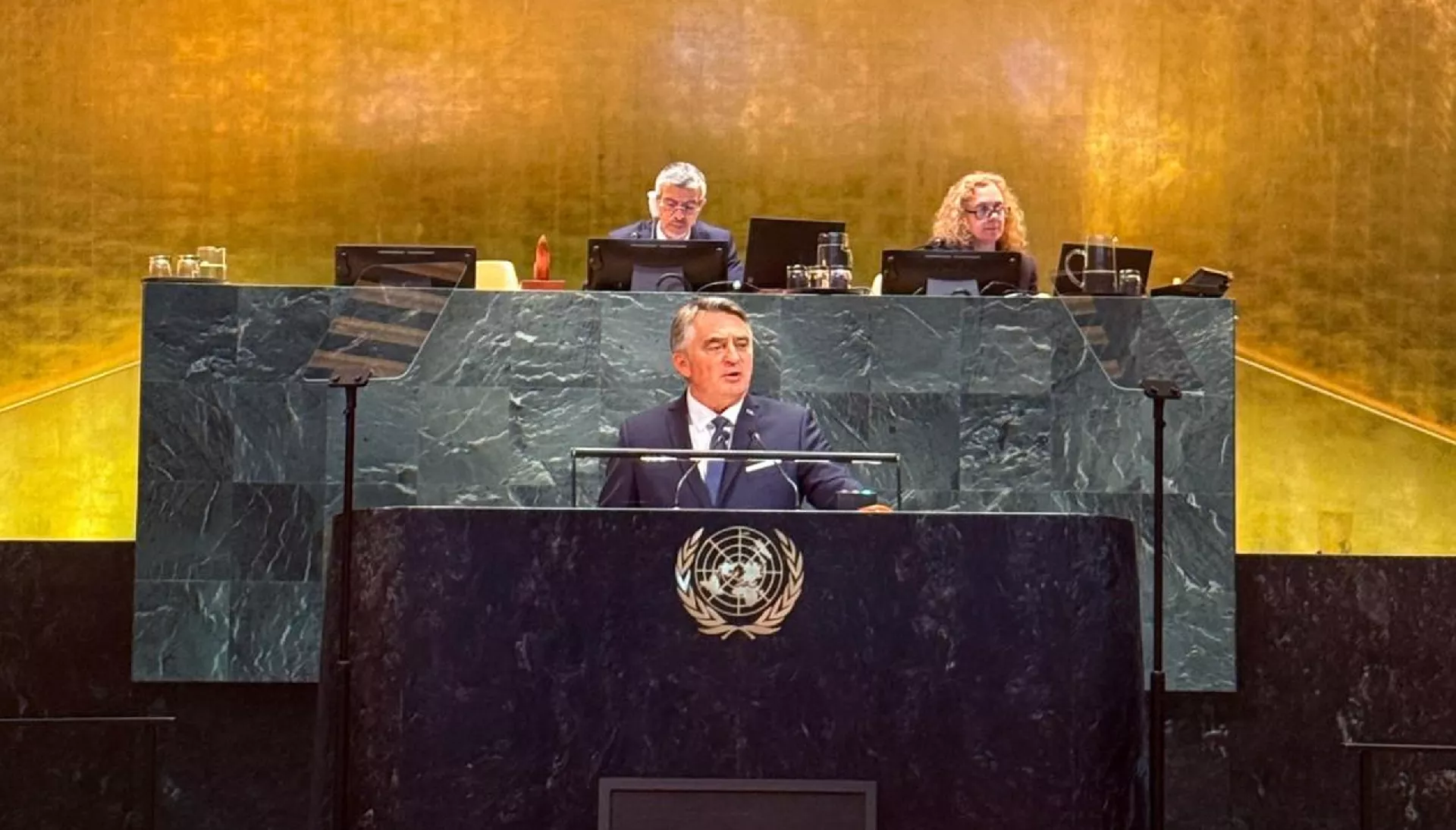
(Patria) - Chairman of the BiH Presidency Željko Komšić addressed the general debate of the 80th session of the United Nations General Assembly in New York tonight.
Read the complete speech by Komšić below.
"Starting from the theme of this year's session of the United Nations General Assembly, which reads: 'Together for peace, dignity and the power of all', allow me to express, from this significant place, on behalf of Bosnia and Herzegovina and all its citizens, congratulations to the United Nations organization on its 80th anniversary, but at the same time, on 80 years of continuous work towards the fundamental goal of this organization, which is ensuring and maintaining world peace.
History will ultimately judge the success in this endeavor in the past period, as well as the results of the work and participation of multiple generations in the United Nations itself, its bodies and organizations. However, I believe it is important to clearly state our common position today: peace in every part of the world has no alternative, and we must and should continue to work diligently together on this.
I would like to believe that we all share the same positive opinion - that we must protect peace in every part of the world. However, reality and what is happening today in different parts of our planet clearly indicate that world peace is often not in the interest of certain geopolitical actors, for whom conflict or war is a means to realize their political and economic interests, which largely deviate from the goals set out in the Charter of the United Nations.
If we add to this the fact that borders of states in the world are being changed through armed force, in a manner contrary to the Charter of the United Nations, then we can draw a simple conclusion that international law is not applied equally to all states, subjects of that same international law.
We are witnessing that in the past period, a certain armed conflict is consciously and deliberately provoked, and then through the use of significant armed force, which a state with smaller or weaker armed force cannot resist. After that, the attacked state is required to sit down at the negotiating table and sign a renunciation of parts of its territory, supposedly in the name of peace, but actually in the name of force.
I believe that all of us in this hall know that the Charter of the United Nations allows for the change of state borders, but exclusively by voluntary agreement between states, without the use of armed force or political pressure backed by armed force.
However, if armed force is used to compel the other party to agree to an imposed agreement in which it loses part of its territory, then there is no good and sincere will, but only coercion, which is contrary to several acts of international law.
In this specific case, I am referring to Ukraine and the pressures it is undergoing as a sovereign state, where it is being asked to give up parts of its territory in order to achieve a supposedly lasting and sustainable peace.
Are we, in this specific case, participants in the change of the world order, in which peace is not set as the ultimate goal, but war and armed force appear as a legitimate means to achieve the political goals of major geopolitical actors?
By changing interstate borders through the use of armed force, which creates political pressure with the aim of compelling a state to give up parts of its territory, a dangerous precedent is created in international law, which can easily become a rule, and that ultimately means that we would live in an unstable world where peace no longer has value.
This is certainly not a desired outcome, nor could such a thing be justified by any provision of the Charter of the United Nations or other acts of international law.
We have an equally undesirable situation today in the Gaza Strip, where such violence is being perpetrated against the local population that its form indicates the existence of multiple elements of genocide, as defined in the Convention on the Prevention and Punishment of the Crime of Genocide.
As a reminder, it is necessary to emphasize that genocide, in addition to physically liquidating or removing a national, ethnic, racial, or religious group from a certain territory, can also be committed if that same national, ethnic, racial, or religious group is deliberately subjected to such severe living conditions that threaten to ultimately destroy it completely in a given territory.
And finally, such an aggressive genocidal approach is used as a means for the violent occupation and takeover of territory that, according to international law, cannot belong to the one who initiates and perpetrates the aggression.
This is what we have today in the Gaza Strip, where the Palestinian people are facing these two elements of genocide, prescribed by the aforementioned Convention on the Prevention and Punishment of Genocide, while a part of the world's political public turns a blind eye and remains silent about this immeasurably terrible fact.
There is no political, or even economic interest driven by the intention to exploit natural resources, such as oil or natural gas in that part of the Mediterranean, that can justify such a high degree of genocidal violence against the local Palestinian population.
In addition to such violence being unjustified and unacceptable, silence, and at times approval, coming from various political circles in the world is equally unacceptable.
What kind of peace, development, or protection of human rights can we talk about if such violence, violence with elements of genocide against the Palestinian people, is allowed?
Does such a thing mean that the political interests of certain countries or the interests of corporate capital are stronger and more significant than our common obligation to protect peace in every part of the world, and thus the prerequisites for the development and self-sustainability of various societies, and in parallel, to protect the human rights of every individual in the world.
This is a great challenge that we face today, and we cannot run away from it, nor can we continuously remain silent about it for the sake of some higher opportunistic interests. Let us recall the phrase: silence is actually an expression of either cowardice or approval.
Allow me to briefly say something about my country, Bosnia and Herzegovina.
A little over 30 years ago, Bosnia and Herzegovina faced aggression from neighboring countries. At that time, the United Nations organization formed peacekeeping military forces called UNPROFOR, in which countries that expressed interest participated.
The role of UNPROFOR was such that they were largely mere observers of a series of war crimes, ethnic cleansing, and ultimately genocide committed by the aggressors against Bosnia and Herzegovina. Of course, there were positive examples of UNPROFOR's activities, which should certainly not be forgotten, and for which we are sincerely grateful.
But, unfortunately, a stain remained on that United Nations mission, because some UNPROFOR commanders refused to activate airstrikes to prevent ethnic cleansing, and especially the genocide committed in Srebrenica in July 1995.
Unfortunately, the genocide in Srebrenica was committed, hundreds of thousands of citizens across Bosnia and Herzegovina lost their lives during the aggression, even more were wounded, while over a million citizens were displaced worldwide.
I want to briefly remind you that the International Criminal Tribunal for the former Yugoslavia in The Hague, established by this United Nations, has found several individuals guilty of committed genocide, as well as the existence of a series of joint criminal enterprises, all of which had the same goal - ethnic cleansing with the creation of ethnically pure parts of the territory in Bosnia and Herzegovina, in order to separate these parts from Bosnia and Herzegovina and annex them to neighboring countries.
A little over a year ago, here at the United Nations, we jointly voted on the Resolution on the genocide committed in Srebrenica, which I consider a great step forward and an important document, not only for Bosnia and Herzegovina, but much wider, because the strength of that Resolution lies in its intention to prevent the potential commission of new genocides that may occur anywhere in the world.
Although we were faced with lobbying by several countries not to adopt such a Resolution, it was nevertheless adopted, creating a new environment for preventive action through a culture of remembrance so that genocide, as the most terrible war crime, would never happen again.
We then saw that there are also countries that, for their own political reasons or political convenience, were not ready to support the text of the Resolution, which was based on the judgments of the International Criminal Tribunal for the former Yugoslavia in The Hague, which, I will repeat once again, was established by this United Nations.
Let such a refusal to support the text of the Resolution be a credit to those who lobbied against its adoption and to those who did not give it clear support.
I want to remind you that during that period in the 1990s, the international community, through the bodies of the United Nations, imposed an embargo on Bosnia and Herzegovina for the purchase of defensive weapons, thereby preventing our country's defense against a double aggression.
This would have significantly shortened the duration of the armed conflict, many lives would have been saved, as a peace agreement would have been reached much sooner, for which the necessary condition was the creation of a balance in military power between Bosnia and Herzegovina and the two neighboring countries that committed the aggression.
Because of that embargo, the aggression against Bosnia and Herzegovina lasted for almost four years, and a large number of human lives were unnecessarily lost.
Such an armed conflict ended with the signing of the Dayton-Paris Peace Agreement, which brought the necessary peace, and for that we are also grateful, but it simultaneously created a *sui generis* political system in Bosnia and Herzegovina, which today, 30 years after its creation, represents a problem for the normal functioning of the state of Bosnia and Herzegovina.
Such a political system does not contain democracy, but some deviant form of it, unprecedented in practice anywhere in the world, in which ethnic affiliation is prioritized, thereby completely negating fundamental human rights, and in parallel, undermining democracy to such an extent that it almost no longer exists.
We can call this political system an incident-prone political system, which continuously destabilizes the state of Bosnia and Herzegovina.
Why do I mention democracy here? For at least two reasons.
The first is that those countries that opt for democracy and its principles should have the opportunity to fully implement that democracy within their own framework, fully aware that there is also a number of countries that, for their own reasons, be they historical, cultural, or religious, do not want democracy and its principles.
Bosnia and Herzegovina has clearly opted for democracy and a transition from the previous political system to a new democratic political system, but in reality, this is continuously being prevented through the elements of the political system established by the Dayton-Paris Agreement.
The second reason relates to the fact that, after facing an embargo on the import of defensive weapons in the 1990s, in today's times, Bosnia and Herzegovina is facing an embargo on democracy, which some actors from the international community are trying to ensure through their political and diplomatic activities.
So, after having an embargo on defending ourselves, today we have an embargo on democracy and democratic development.
How else can we explain such activity by that part of the international community, which in various ways tries to ensure this incident-prone political system in which a minority governs the majority, thus violating one of the fundamental principles of democracy which dictates a system in which, in fact, the political majority should govern its state.
Although such actors describe this as an alleged distribution of political power among ethnic communities in Bosnia and Herzegovina, it fundamentally undermines democracy to such an extent that it almost no longer exists in my country, because there is something that is simply called ethnocracy, in which a political minority governs the state because the current deviant political system allows it.
Whether such actors of the international community are trying to ban or impose an embargo on democracy in Bosnia and Herzegovina due to its demographic structure, or are trying to produce a situation where discussions about Bosnia and Herzegovina are reopened with an uncertain outcome for its existence within its current borders, remain open questions.
I will remind you here that without democracy, there is no rule of law, and without the rule of law, there is no protection of individual human rights. As an argument for such conduct by part of the international community, the so-called 'Kovačević' case before the European Court of Human Rights can be presented. A case that may be unknown to you, perhaps unimportant, but it is extremely important to us in Bosnia and Herzegovina. This is a case in which the appellant sought simple, justified, and logical protection of his active voting right, which was denied to him.
In the first instance, the case was decided in favor of the appellant Kovačević, with the established existence of ethno-territorial discrimination, which then part of the international community, investing enormous diplomatic and financial efforts, tried to annul in the second instance.
One of the countries, which is completely incomprehensible and unacceptable, provided a financial donation to the European Court of Human Rights and later appeared in the same case as an interested party, which is an expression of classic political corruption.
Therefore, the logical question arises here - can the judgments of international courts be bought?
The High Representative of the international community in Bosnia and Herzegovina also actively participated in overturning that judgment, although he was not authorized to do so by the Dayton-Paris Agreement, also investing enormous financial resources from unknown sources for which he did not have the necessary consent of the Peace Implementation Council.
Thus, a completely identical situation occurred as with the adoption of the Resolution on the genocide in Srebrenica, where individual countries, by lobbying against the Resolution, tried to deny the judgments of the International Criminal Tribunal for the former Yugoslavia in The Hague, while in the case I am citing as an example, other countries tried and are still trying to overturn the judgment through their lobbying and broader diplomatic activity, which leads us to the conclusion that there is a part of the international community that does not allow democracy in Bosnia and Herzegovina.
'Yesterday' an embargo on weapons necessary for the defense of the country, 'today' an embargo on democracy and human rights!
Therefore, I want to briefly remind you of another United Nations document, the International Covenant on Civil and Political Rights, which guarantees, among other things: '...to elect and be elected at periodic elections held by universal and equal suffrage, by secret ballot, ensuring the free expression of the will of each voter...', which unfortunately is not allowed in Bosnia and Herzegovina, with great efforts from the international community that seeks to preserve discrimination, deny democracy, which results in a lack of rule of law and ultimately insufficient and almost no protection of individual human rights.
The logical conclusion is the idea that democracy, as well as the right to defend one's country, is a privilege whose application is determined and enabled by political elites from larger and richer countries, while smaller and poorer countries can only receive as much democracy as the larger and richer ones allow. This is certainly not an expression of equality or equal rights, which we should all strive for today.
Here we also come to the issue of human rights, or more precisely, the equality of every individual in their country, and even beyond, and especially their right to participate equally and according to their own will in every aspect of social life in their country.
We have a whole series of documents or acts of international law that guarantee such a thing, so the question is openly asked here again - are we ready to be consistent or persistent in protecting individual human rights in any part of the world, using the tools that these international documents provide us?
Every issue of human rights protection begins with the fight against discrimination or any form of inequality of individuals in all their rights guaranteed by international law documents, and as a logical continuation are the documents or laws in various states.
Discrimination in any form is prohibited by acts of international law, but, unfortunately, we very often encounter situations where discrimination is silenced, and after silence, even encouraged.
Speaking from the perspective of Bosnia and Herzegovina, we have five judgments of the European Court of Human Rights, which have established the existence of discrimination against BiH citizens based on their ethnic origin or place of residence. Part of the political elites in Bosnia and Herzegovina, as well as part of the international community present in BiH, do not want to accept this and implement it through constitutional amendments.
In addition to the non-implementation of the aforementioned five judgments of the European Court of Human Rights, this sixth judgment in the case, which calls for the rejection of ethno-territorial discrimination, and which was overturned thanks to pressure, 'donations', and similar actions by certain countries, as well as by the person authorized by the peace agreement to implement that agreement and protect all aspects of that agreement, including all acts of international law concerning human rights, leads us to difficult questions and even more difficult answers.
Are human rights and their protection also a privilege of larger and richer societies and states, while smaller and poorer ones are consciously or intentionally bypassed in the protection of human rights, starting from the right to life to the right to equality and democracy?
Finally, allow me to emphasize that we can answer all three open questions, which are the subject of the session of the United Nations General Assembly, only through consistency and principled insistence on protecting peace, in order to create conditions for the unhindered development of societies in the member states of the United Nations, and ultimately, together, to appear as active protectors of human rights anywhere in the world.
Without this consistency on these issues, we will once again be just a group expressing concern over deviant phenomena in the world, such as wars, violent border changes, genocide and war crimes, denial of human rights, without actually doing anything more than expressing concern.
The consistency I refer to means complete determination to oppose various deviant phenomena in the world, through the tools provided by international law.
We must be determined and unwavering in our intentions to protect the fundamental values of the United Nations, without making any distinction among states as subjects of international law.
In that determination, I call on you not to make distinctions among us, dividing us into large and small states, rich and poor, but to actively seek and enable solutions for all open issues that arise in the world, together as an organization.
Peace is not a privilege, peace is an obligation for all of us to ensure it at all times and in all places. Likewise, human rights are not a privilege, but a lasting civilizational obligation that we must continuously fulfill.
This is certainly a lasting challenge, faced by generations before us and that will be faced by generations after us. Our mission is to leave them a better world than it is now, and for such a goal, persistent and continuous active work is needed - said Željko Komšić in his address.
Komentari (0)
Prijavite se za komentiranje
PrijavaJos nema komentara. Budite prvi!
Minuta
Sve →Iz drugih kategorija

High Representative Not Elected: Germans, French and British Against Americans, New Attempt at End of June

ČOVIĆ WITHOUT MERCY: How Those Who Brought Ademović to Office Created a Political Hell for Him



Sunny Saturday, quite warm



Tragedy in Albanian resort: Two minors drown












