By: Nihad Hebibović
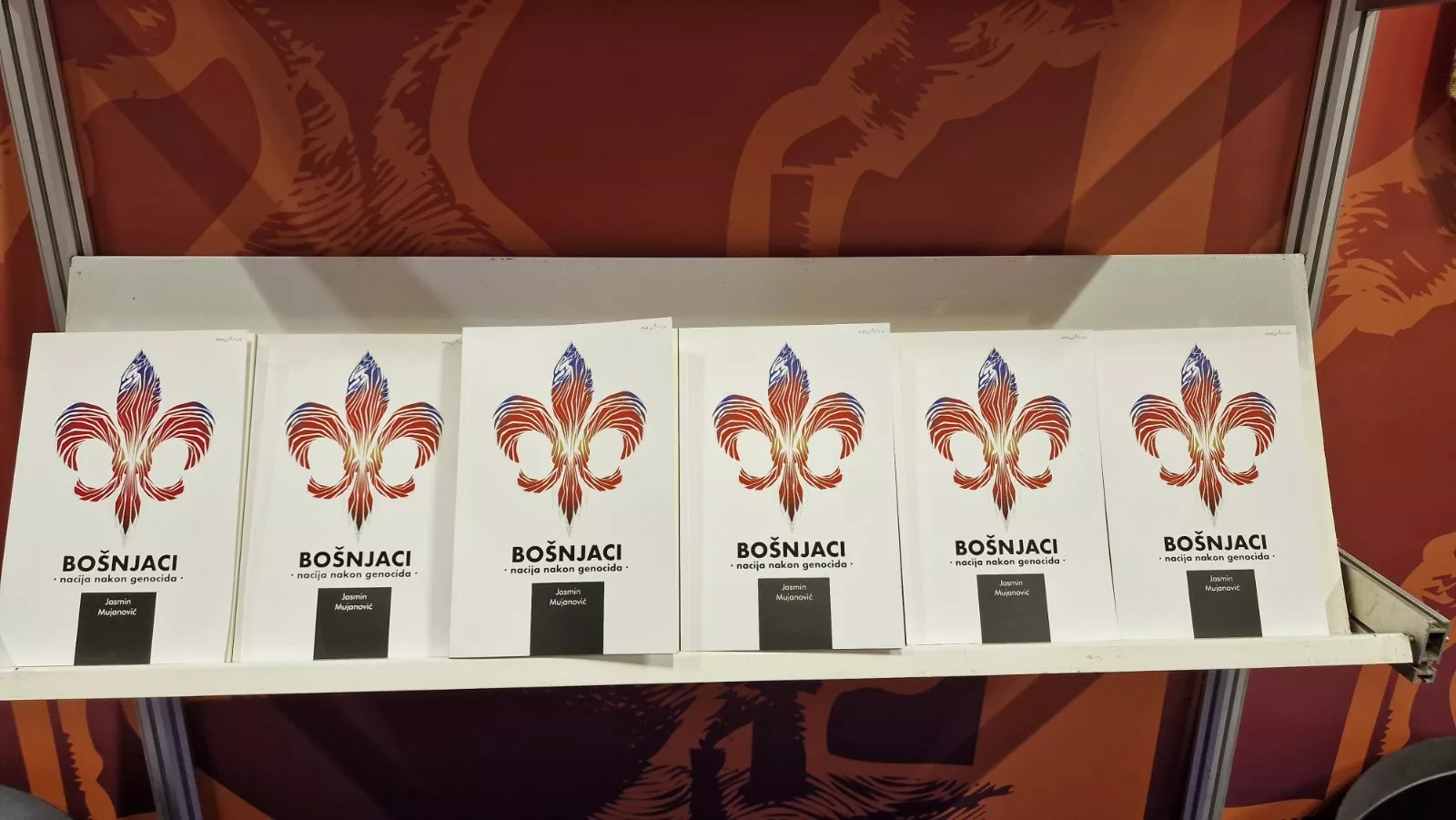
Published by "Vrijeme" publishing house during the past days of the Sarajevo Book Fair, the book "Bosniaks – A Nation After Genocide" by Bosnian-American political scientist Jasmin Mujanović saw the light of day.
This is a study that addresses the political history of Bosniaks and Bosnia and Herzegovina, a study that explains the historical development of the Bosniak nation, a book that follows the main course of contemporary political processes in Bosnia and Herzegovina, but also a book that substantively debates the future and perspectives of the Bosniak nation and the state of Bosnia and Herzegovina.
Mujanović's book "Bosniaks – A Nation After Genocide" was originally published in English, and the excellent translation into Bosnian was done by Sanin Mirvić, with editing by Kenan Efendić, editor at "Vrijeme" publishing house.
In the preface to the Bosnian edition, the author emphasizes that it is in the national interest of Bosniaks to devise a national agreement or program that will ensure the absolute sovereignty and territorial integrity of the state that Bosniaks consider their only homeland.
Such a program is not possible without what I would venture to call the Bosnian political language. With the book "Bosniaks – A Nation After Genocide," Mujanović has proven that it is possible to write in English while thinking in the Bosnian political language, something that even most authors who write exclusively in Bosnian, linguistically but not politically, fail to achieve. Therefore, the presence of an authentic Bosnian political language, the language spoken by the newer generation and group of Bosniak intellectuals and public figures, is one of the greatest values of the aforementioned book.
The political language of Mujanović's "Bosniaks" transcends the victim narrative that has been predominantly present in Bosniak political literature until now. Specifically, Mujanović speaks of a nation after genocide that possesses its vitality and necessary democratic pluralism, not of an "already genocided" nation that is permanently crippled, humiliated, and marked by the tragedy of the crime committed against it.
Mujanović's political proposals in the final part of the book stem from a positive and optimistic view regarding the "state of the nation." These proposals can be debated with approval or disapproval, but they themselves indicate that the process of national identification of Bosniaks has been completed, although, of course, their political life in an active sense is just beginning.
This brings us to the realization of the advantages of what can be called a young nation. Bosniaks are an old people but a young nation. Mujanović's political contribution to Bosniak self-awareness is the demystification of the belief in the delayed national affirmation of the Bosniak nation. In the book, which I believe is its greatest value, the burden that consisted of the belief that Bosniaks were late with their national self-affirmation has been scientifically lifted from the shoulders of Bosniaks.
By analyzing historical circumstances, Mujanović proves that what was interpreted as opportunism by the Bosniak political elite in certain historical epochs was not necessarily opportunism in itself, but rather that there was a specific historical context in which the political struggle for Bosnia and Herzegovina and for Bosniaks within various broader state structures and systems, in which the struggle for greater autonomy of the people and the state was as important as the struggle for independence and statehood itself.
For example, given that there were no guarantees for the survival of an independent state during the Gradaščević movement for autonomy, and considering the vortex of historical events the Balkans entered a few decades later, the question arises as to how the whole matter would have ended with some earlier acquired independence of Bosnia and Herzegovina and what would have happened to Bosniaks at all.
Bosniaks were not ready for a national revolution in the nineteenth century, but the Bosniak readiness for one was demonstrated in the twentieth century, because the defense against aggression against Bosnia and Herzegovina was not just a defense of the state (although that was the main goal and the reason why Bosniaks were subjected to genocidal violence), but it was a kind of national revolution, i.e., the birth of a nation.
"Even if a person did not have a brain, but only eyes, they would see with the naked eye and understand that they are witnessing – a birth: Everything is being born: a state, a nation (a new birth of the ancient Bosniak people!), an army, a government, and self-awareness and awareness of others. Everything is like childbirth: blood, sweat, screams and cries; mucus and blood, sobs and sighs. We are, therefore, witnessing a birth, that part of the birth process in which the dominant feeling is pain and suffering. Then comes joy. Infinite, omnipotent human joy." This is what the late academic Abdulah Sidran wrote in his war travelogues in 1993, as if he had already read what Mujanović published today.
Beyond the impressions recorded in the lines of this brief review of the book, Mujanović's study opens up a series of other topics that the reader can dedicate themselves to contemplating. It does not create false dilemmas about whose Bosnia it is, nor does it, in its liberal spirit and tone, advocate for any national exclusivity, but at the same time, it does not shy away from the possibility of a Bosniak national, but also civic, state as a concept, given the fact that Croatian and Serbian national policies are abandoning the idea of Bosnia and Bosnian statehood. In short, the decriminalization of the concept of a Bosniak nation-state from liberal positions is one of the characteristics of the book.
The purpose of the genocide against Bosniaks, as well as the reason why genocidal violence was applied to them, was an attempt to permanently eliminate the possibility of a state with a Bosniak majority. The attempt failed, Bosniaks did not. The future belongs to the patient.
Komentari (0)
Prijavite se za komentiranje
PrijavaJos nema komentara. Budite prvi!
Minuta
Sve →Iz drugih kategorija

High Representative Not Elected: Germans, French and British Sabotaged Americans, New Attempt at End of June

ČOVIĆ WITHOUT MERCY: How Those Who Brought Ademović to Office Created a Political Hell for Him


Sunny Saturday, quite warm

Tragedy in Albanian resort: Two minors drown