
Written by: Nermin Alihodžić, PhD
We can already state with certainty that this will be one of the worst seasons for
domestic fruit and vegetable producers and processors in Bosnia and Herzegovina. Simply, there are few domestic fruits, and therefore processors are forced to resort to imports.
Climate change is taking its toll here as well, and the situation is getting worse from season to season. The increase in temperature leads to earlier ripening of crops, which results in loss of fruit mass, color, and taste. Increasingly pronounced drought periods during the summer, an increase in the number of days with extreme temperatures, and a higher frequency of severe storms accompanied by hail all affect the final yield of planted crops.
The temperature increase in Bosnia and Herzegovina has so far exceeded the values predicted by
greenhouse gas emission scenarios and the goal of limiting the increase in global average temperature to 2 degrees Celsius compared to the pre-industrial period. Currently, a scenario of constant increase in greenhouse gases is in effect, which will result in further temperature increases in the future if humanity continues to behave as before. Under such circumstances, by the end of the 21st century, the average temperature in Bosnia and Herzegovina could exceed 5 degrees Celsius, and in the summer season, 6 degrees Celsius.
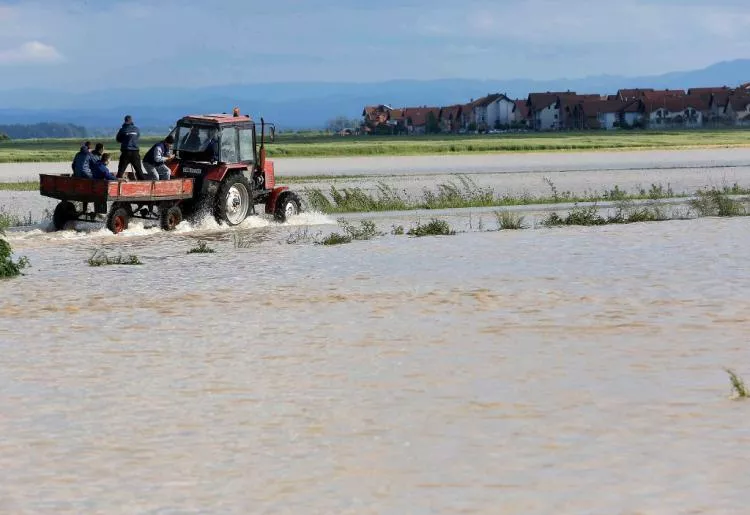
This will result in more frequent and intense repetition of catastrophic weather events that have hit our country not so long ago. Let us recall only May 2014 and the great floods with an amount of precipitation that reached a record value in the Sava River valley in the last 120 years. The total economic damage suffered by Bosnia and Herzegovina and Serbia at that time amounted to approximately 3.5 billion euros. Or, the floods and landslides from October last year that claimed twenty lives and caused enormous material damage. The consequences of this last disaster are still felt today, and the damage caused is still being tallied.
All probability forecasts of future extreme weather conditions for our area indicate higher maximum temperatures, more warm summer days, higher heat indices, higher minimum temperatures, more abundant one-day and multi-day precipitation, more warm and cold waves, and more dry periods.
In the breadbasket of Bosnia and Herzegovina, Semberija, this year the yield of cucumber, pepper, strawberry, and plum has fallen short, so there is practically nothing to harvest in the field. This should not surprise us because all climate models predict an increase in the frequency of years with unfavorable weather conditions for agricultural development in the Balkan Peninsula region, making irrigation necessary in the near future.
A direct consequence of this situation is an increase in imports, as indicated by data from the Ministry of Foreign Trade and Economic Relations of Bosnia and Herzegovina, which states that in the first six months of this year, fruit and vegetables worth more than 370 million BAM were imported, while exports were four times lower compared to the same period last year.
What the authorities in Bosnia and Herzegovina must urgently do is seriously and concretely
begin the process of adapting to the new reality. Because it is evident that the annual precipitation regime will change, with the monthly maximum of precipitation from warm months shifting towards the colder half of the year. Summers will remain dry and very warm, and winters will lose their snow cover and become increasingly rainy and mild. The distribution of precipitation by intensity will change, with the amount of precipitation falling in the form of heavy downpours increasing, as will the number of days without precipitation. All these are characteristics of our geographical area entering a subtropical climate that is advancing from the south to the north.
It is inevitable that adaptation measures to the new climate reality must be implemented. Some of the main proposed measures in agriculture include adapting work to weather conditions, which involves the timing of field work, optimization of sowing density, rational use of fertilizers, protection against frost and hail, as well as the selection of species and varieties resistant to changed climatic conditions, development of sustainable irrigation systems, and prevention of soil erosion.
All these listed measures are unfeasible without serious consideration and application of the current
most modern scientific achievements at the global level in the field of agriculture and proactive participation of all levels of government in Bosnia and Herzegovina in their implementation at the local level.
Energy and food are two vital factors for the existence and development of every society. Climate change is only a reason for us as a society to tackle the energy transition to renewable sources and turn to domestic sustainable agricultural production. Otherwise, we face dependence on others.
Because the path of humanity so far has been paved with struggle and mastery of these resources. In the future, this struggle will be even more pronounced.
Komentari (0)
Prijavite se za komentiranje
PrijavaJos nema komentara. Budite prvi!
Minuta
Sve →Iz drugih kategorija

High Representative Not Elected: Germans, French and British Against Americans, New Attempt at End of June

ČOVIĆ WITHOUT MERCY: How Those Who Brought Ademović to Office Created a Political Hell for Him



Sunny Saturday, quite warm



Tragedy in Albanian resort: Two minors drown












