
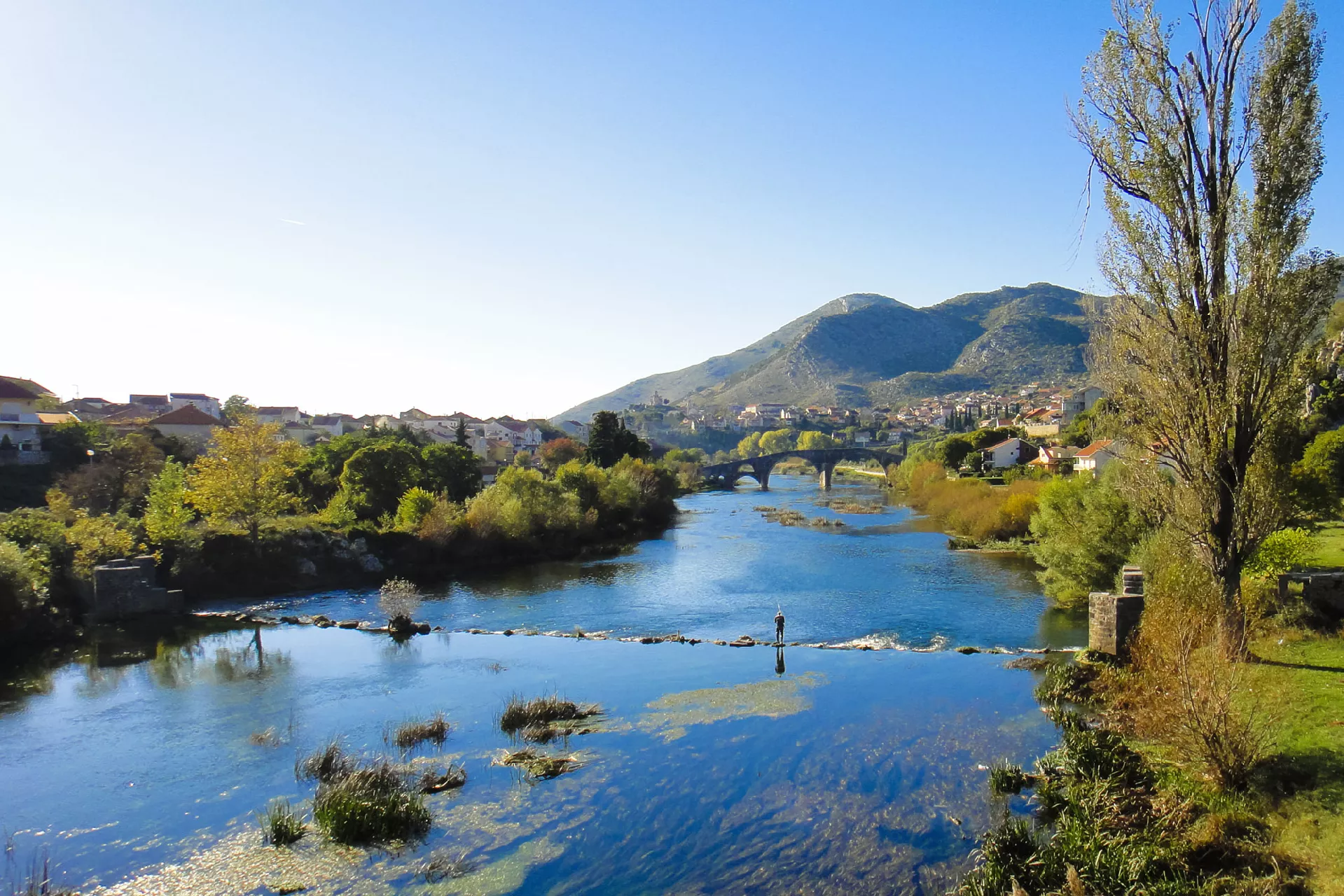
(Patria) - The Trebišnjica River is the largest sinking river in the Dinaric karst, and was once even considered the largest sinking river in the world.
Its surface flow is nearly a hundred kilometers long (96.5), and its total length is 187 kilometers, writes Punkufer.
The Trebišnjica flows mostly through Herzegovina, and to a lesser extent through Croatia and Montenegro.
It springs at an altitude of nearly 400 meters near Bileća and travels northwest on the surface, sinking near Sedlari, continuing its path underground in the opposite direction.
It is part of a vast complex of underground and surface rivers that eventually flow into the Adriatic Sea.
And before it reaches the sea, it flows somewhere in the underground darkness into one of the shortest rivers in the world - the Dubrovnik River or Ombla, only about thirty meters long.
In its name, Trebišnjica preserves the ancient Proto-Slavic word "trjeba," which referred to a sacrifice and an altar, revealing its strong cultural significance.
It was once considered a sacred river, and along its course there are numerous human traces dating back as far as forty thousand years.
But, from prehistory and archaeological excavations, tumuli, and early Christian monuments, no time has affected it as much as the most recent one.
To correct ourselves, of course, it was not time that changed it, but - man.
Since the beginning of the twentieth century, he has tried with all his might to tame and bridle this typical karst river, unpredictable and wild.
As the Trebišnjica flows through the Popovo Polje for most of its surface course, its frequent flooding and wild nature caused much damage to the inhabitants of that area.
Even during the Austro-Hungarian era, it was spoken of as a problem that needed to be "solved," and the first interventions in its course involved widening sinkholes to increase flow capacity.
The Trebišnjica mocked these attempts, not suspecting that the second half of the 20th century would forever change its appearance and character, forcibly bridle it, and - sedate it.
In the 1960s, a hydroelectric plant with a reservoir was built in the Miruša area, today known as Bilećko Lake.
It was the first of four (out of a planned seven) power plants, and part of the river was later stilled into Trebinjsko Lake.
As the river changed, so did life in and around it. With its karst spirit, the karst life in it disappeared—plants, animals, entire ecosystems—and the climate changed.
In the 1970s, the Trebišnjica was definitively conquered when 67 kilometers of its riverbed, from Trebinje to Hutovo Blato at the northwestern end of Popovo Polje, were concreted.
Local people consider it more useful this way… and it, stopped in its channel, with its sinkholes plugged, seems not to hold it against them. It reflects the clouds just as it did when it was a wild and sacred river.
Only it seems as if the forgotten thunder god Perun still sometimes rages furiously at its jailers. They say, namely, that lightning strikes nowhere in the territory of our former country as powerfully as along the power line in the valley in the upper part of the course of the sleeping Trebišnjica.
Komentari (0)
Prijavite se za komentiranje
PrijavaJos nema komentara. Budite prvi!
Minuta
Sve →Iz drugih kategorija

High Representative Not Elected: Germans, French and British Against Americans, New Attempt at End of June

ČOVIĆ WITHOUT MERCY: How Those Who Brought Ademović to Office Created a Political Hell for Him



Sunny Saturday, quite warm



Tragedy in Albanian resort: Two minors drown












