
By: A. Čorbo-Zećo
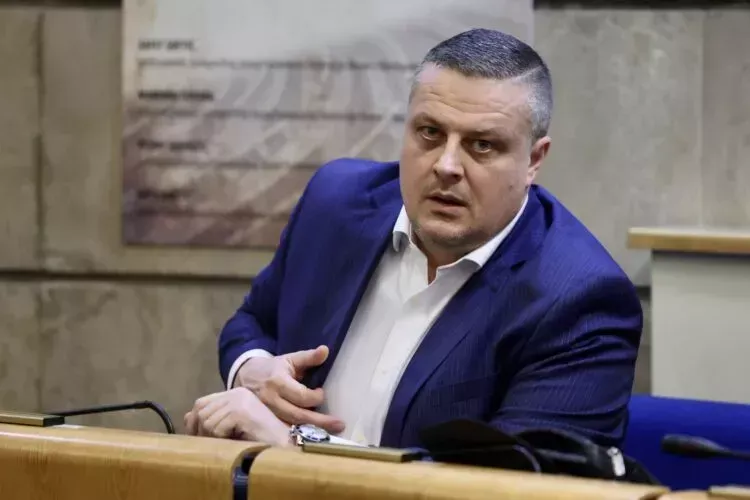
While a session of the Parliament of the Federation is being prepared to discuss the FBiH Government's Decision on a minimum wage of 1,000 KM, which has caused a storm of reactions, it is important to repeat that the FBiH Government made such a decision at the initiative of Deputy Prime Minister Vojin Mijatović, who received the support of ten ministers.
However, we never found out which experts and based on what calculations proposed such a decision, knowing that before the Government session, a session of the Economic and Social Council was held, where Mijatović's proposal was not voted on.
The minutes from the session will confirm this, so it is unclear why the public space states that there was a vote. The decision on the minimum wage itself states that it was made in consultation with the ESC.
But while the whole story is shrouded in fog, it should be emphasized that all the most eminent experts who, with clear calculations, oppose this decision, which has already entered into force.
First and foremost is Anto Domazet, a professor at the Faculty of Economics in Sarajevo and a member of the SDP Presidency, who believes that this decision is essentially unfeasible and will cause great difficulties in the economy, and that the economy of the FBiH will bear an additional burden of 1.5 billion KM this year due to this decision.
"840 million for salary increases (for the benefit of workers), and 680 million for taxes and contributions (for the benefit of the Government). Employers will bear this entire burden," said Domazet.
He also stated that "there is no economy that can cover a 5% impact on GDP in the next year without it being reflected in price increases".
Adnan Smailbegović, president of the Employers' Association of the Federation of BiH, pointed out that the goal of increasing the minimum wage to 1,000 KM is not to improve the financial status of workers, but to pump an additional 700 million KM into the budget of the Federation of Bosnia and Herzegovina.
“This is throwing dust in people's eyes. What about medium and large companies with 500 or more employees? An increase in the minimum wage also leads to an increase in other wages. Over the weekend, I spoke with representatives of a large company that provides services. They said, if necessary, we will lay off 100-200 workers,” said Smailbegović.
Šerif Isović, former director of the Tax Administration of the Federation of Bosnia and Herzegovina (FBiH), also commented on the FBiH Government's decision on the amount of the minimum wage in 2025, which is 1,000 KM.
“In 2025, it was set at 1,000 KM and increased by 381 KM or 61.55 percent. From this comparison alone, it is clear to any objective person who understands reforms that increasing the minimum wage without other fiscal policy measures is the wrong order of steps, just as it was wrong to 'keep' such a low minimum wage for a long time. Who is responsible for this? Those responsible usually remain silent and fish in troubled waters, and the answer is clear and lies in the prescribed competencies in the Constitution and laws,” explains Isović.
Admir Čavalić, an economic analyst, has also analyzed this on several occasions.
“The FBiH Government has not offered fiscal reforms. It has not offered analyses of the effects of this measure either. It only offered a decision two days before New Year's. Plus a few sentences in the media from which it can be read that the FBiH Government (probably the Ministry of Entrepreneurship and Crafts) will finance contributions for some companies. Perhaps the hare is in this bush for the whole story. Plus a few good headlines in the media for the Government. The problem is that everyone else is at a loss. Especially the workers to whom this economic populism is being fed,” emphasized Čavalić.
Faruk Hadžić, an economist, also commented on the decision of the Government of the Federation of Bosnia and Herzegovina (FBiH) according to which the minimum wage in 2025 will be 1,000 KM.
"I will not argue about the part concerning the increase in the minimum wage received by the worker. The decision-makers have of course only announced that the minimum wage will increase from 619 to 1,000 KM (an increase of 381 KM or about 61%), but it was not announced that due to the increase in the minimum wage, there will be additional expenses for contributions of 304 KM. In my opinion, this part is the most controversial in this topic about the minimum wage, and it is a big mistake that the opportunity was not used to go with the proposal of 'frozen contributions' which I proposed about six months ago," points out Hadžić.
Zlatko Lagumdžija, a long-time professor at the Faculty of Economics in Sarajevo, also emphasized that the decision to set the minimum wage at 1,000 KM is an excellent decision, but the part of the decision that leaves contributions at the full amount, instead of the previous amount, is catastrophic.
"The minimum wage was 619 KM, the total was 1,020 KM. The employer paid 400 KM to the state. What should have been done is to leave the contributions at 400 KM, and the employer would give 1,000 KM to the worker and 400 KM to the state. Now the worker gets a thousand, and the state gets 700. 380 KM is given to the state, and the state has treated itself to an additional 300. This cannot be sustained and it is absurd. I am saying this as a professor of economics. I fear that the experts were not involved, because the experts would not have supported this. A thousand marks for the worker was necessary, and other things should have been done, leaving the state the same amount as before," said Lagumdžija.
Igor Gavran, an economic analyst, warns that, first of all, a much better solution is what everyone agrees on – to reduce taxes and contributions, and then no one would need subsidies because this increase would be bearable.
“But if the solution is like this, subsidies are necessary and should be based on the actual results of the companies. The question is whether the money for subsidies even exists. I fear that some businesses will start laying off workers as early as these days,” said Gavran.
And this is only a part of the prominent experts from the economic field who spoke analytically about the sudden decision that the minimum wage in 2025 will be 1,000 KM, without fiscal reform being implemented.
There is still no economic expert who has publicly supported this decision with a meaningful explanation, without demonizing employers, as politics does. Their profits are calculated in billions, and the profit tax is still 10 percent. One of the lowest in Europe, while payroll taxes are among the highest.
Therefore, it is clear that Vojin and his team approached the problem populistly, broke the solution over their knees, and the consequences of this decision will be felt most by the workers, to whom they are now trying to appeal by speaking disparagingly about employers.
The FBiH Government has not explained to us how much the budget will be filled, so economic analysts, who were not asked anything in the decision-making process, have also dealt with this.
Of all the expected answers from the FBiH Government, not a single one has arrived, except for arrogance. Thus, Nermin Nikšić, Prime Minister of the FBiH, sent a message to the Foreign Investors Council, which, as he said, he generally respects very much.
– Those investors for whom a salary of 1,000 KM is an obstacle to investing should freely look for some “banana” states, and give workers salaries of a few hundred euros there,” said Nikšić.
Imagine that? Serious expert analyses are answered with barroom language. The decision to increase the minimum wage to 1,000 KM was made without consultation with key stakeholders and without accompanying measures to ensure its sustainability.
Experts agree that workers and employers will feel the consequences, while the Government will face pressure to justify this decision. An urgent revision of the measure and the introduction of comprehensive fiscal reforms are needed to avoid economic destabilization. And when it all comes due, what then?
Therefore, an investigation into negligent work in the FBiH Government should be considered urgently (especially since we know that some ministers only heard about this just before the vote), whose decision will undoubtedly affect the economic (non)development of the Federation and the overall standard of living. Because of this, someone will have to answer, if we are not a 'banana state'.
Komentari (0)
Prijavite se za komentiranje
PrijavaJos nema komentara. Budite prvi!
Minuta
Sve →Iz drugih kategorija

High Representative Not Elected: Germans, French and British Against Americans, New Attempt at End of June

ČOVIĆ WITHOUT MERCY: How Those Who Brought Ademović to Office Created a Political Hell for Him



Sunny Saturday, quite warm



Tragedy in Albanian resort: Two minors drown












