

(Patria) - The Grand Chamber of the European Court of Human Rights concluded in its final ruling in the case "Slaven Kovačević v. Bosnia and Herzegovina" that the applicant intimidated High Representative Christian Schmidt and the acting agent of Bosnia and Herzegovina before the Court in Strasbourg, writes Istraga.ba.
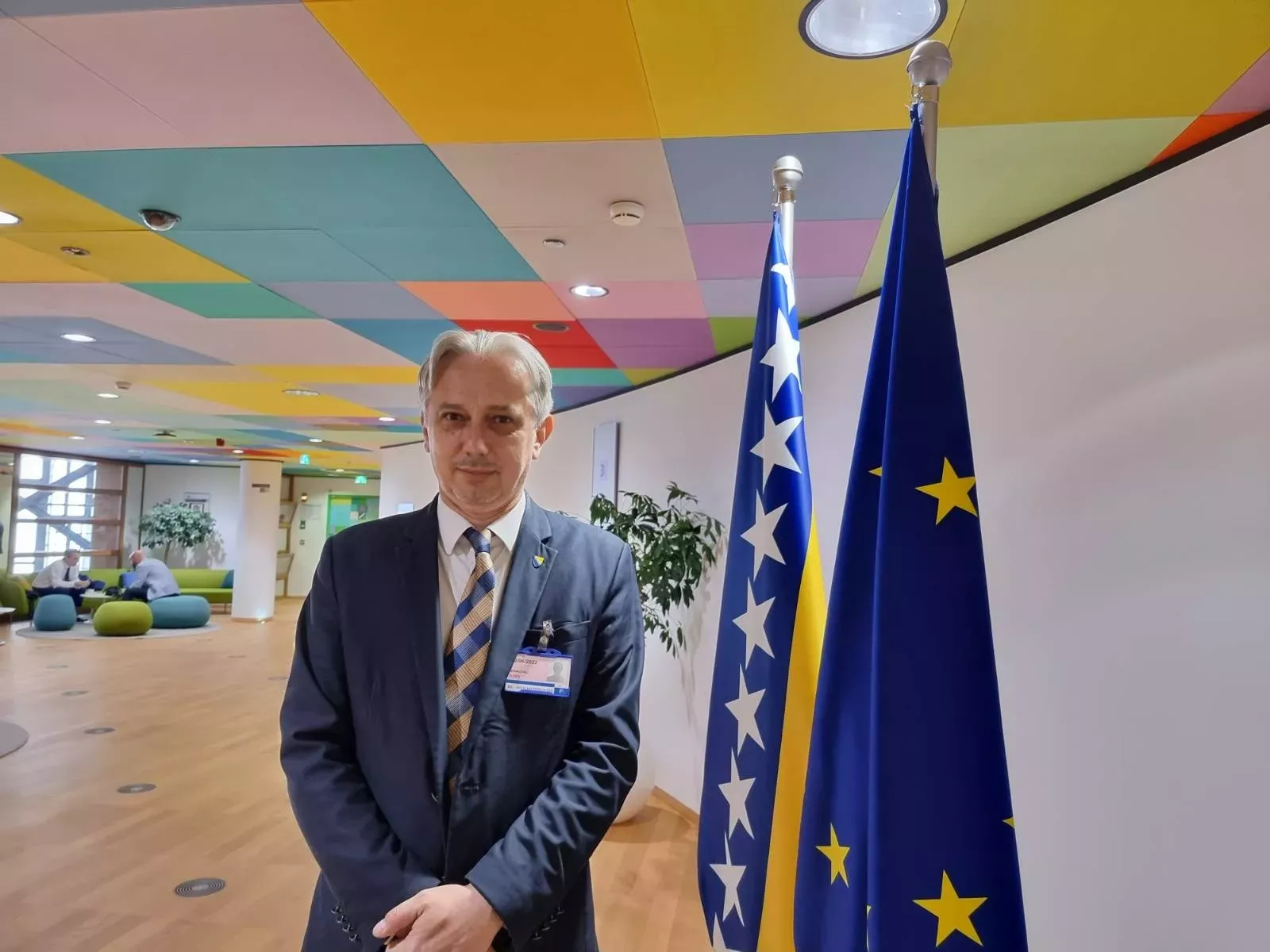
The Court emphasizes that it rejected the challenge to their legitimacy because the arguments Kovačević invoked were not based on events that occurred after the first-instance ruling, but were equally applicable during the proceedings before the Chamber.
"Allowing the applicant to challenge the authority of the acting agents at this stage of the proceedings would be detrimental to legal certainty and stability, as well as contrary to the proper administration of justice.
Furthermore, in the meantime, there have been no official decisions by the Council of Ministers of Bosnia and Herzegovina, nor by any other competent state body, regarding the withdrawal of the request to refer the case to the Grand Chamber, nor the authorization of the current acting agents.
Accordingly, for the purposes of Rule 35 of the Court's Rules of Procedure, the acting agent retained her status as representative of the Government in the Grand Chamber proceedings. If there was any actual irregularity in terms of domestic law, it was not for the Court to resolve it," the Court concluded.
The Court also concluded that Kovačević made certain remarks and accusations regarding the Court's judges, particularly the then-President of the Court, the acting agents, and the High Representative for BiH.
"Which amounts to unjustified personal attacks, intimidation, and malicious accusations that have crossed the boundaries of permissible criticism. The Court emphasized that by attacking the then-President of the Court so contemptuously, Kovačević showed disrespect for the very institution to which he turned for the protection of his rights.
The Court also considers that during the proceedings, he acted misleadingly regarding a question potentially relevant to the case (regardless of whether he represented himself as a Croat while he was a member of the Sarajevo City Council), the reasoning states.
"Regarding the elections for the House of Peoples, the Court noted that the applicant's right to vote in the elections for the cantonal assembly and thus, indirectly, in the elections for the House of Peoples was not sufficient to establish his status as a victim of discrimination.
Otherwise, he and, by analogy, the entire electorate, would practically automatically have victim status regarding electoral rules, without proving that these rules have a direct and personal discriminatory impact on him.
Nor was it sufficient that he was subject to the legislative authority of the House of Peoples, like all citizens of Bosnia and Herzegovina. A more precise assessment had to be made based on concrete complaints," the Court points out.
The Court adds that it could not grant him victim status solely on the basis of the Court's findings in the Sejdić and Finci case and similar cases against BiH.
The Court underlined that this case differs significantly in that the challenge to the rules was not from the perspective of the right to run for office, i.e., the "passive" right, but from the perspective of the voter exercising the "active" right to vote.
The Court did not find that Kovačević's arguments contained any substantiated element of discriminatory treatment that directly and personally affected him, either at the individual or group level.
"The Court noted that the conduct of elections for legislative bodies in each entity of Bosnia and Herzegovina is regulated by different electoral rules, specific to the entity's structure as established in their respective constitutions.
For the purpose of determining the composition of the House of Peoples, each group of voters exercised their right to vote in their respective electoral units within each entity, not directly, but through separate legislative bodies that governed their respective entities.
Just as the applicant could not participate in the process of electing Serb delegates to the House of Peoples from Republika Srpska, voters from that entity were excluded from the corresponding process in the Federation," the Court states.
The Court adds that if Kovačević complained about his inability to participate in the electoral process in another entity and invoked the functioning of the electoral system based on a single electoral unit, he was effectively challenging the foundations of the electoral and constitutional system in force in BiH.
"Instead of pointing out a real difference in treatment between two different groups of voters in exercising the right provided for by the Convention or national law," the Court states.
The judges emphasized that the Court cannot conduct a general review of the compliance of the electoral system in the respondent state along entity lines with the Convention, nor can it abstractly compare how elections were conducted in each entity.
"The Court's task was to determine whether the specific rules had a direct and personal discriminatory impact on the applicant.
The Court noted that Kovačević provided no evidence as to whether and how he, as an individual voter residing in the Federation, was disadvantaged or otherwise subjected to different treatment as a result of the organization of elections along entity lines, and provided no information on how the functioning of the electoral system in practice affected his vote at the cantonal level and his representation in the BiH House of Peoples, differently compared to voters in Republika Srpska," the Court points out.
The Court concluded that Kovačević's complaints regarding the House of Peoples aim to provoke fundamental and conceptual changes in the constitutional structure and electoral legislation in BiH in general.
Additionally, the Court concluded that Kovačević, in the context of the elections for the Presidency of BiH, failed to prove that he was a "victim" of discrimination regarding any perceived deficiency in the election process for the Presidency.
Komentari (0)
Prijavite se za komentiranje
PrijavaJos nema komentara. Budite prvi!
Minuta
Sve →Iz drugih kategorija

High Representative Not Elected: Germans, French and British Against Americans, New Attempt at End of June

ČOVIĆ WITHOUT MERCY: How Those Who Brought Ademović to Office Created a Political Hell for Him



Sunny Saturday, quite warm



Tragedy in Albanian resort: Two minors drown












