
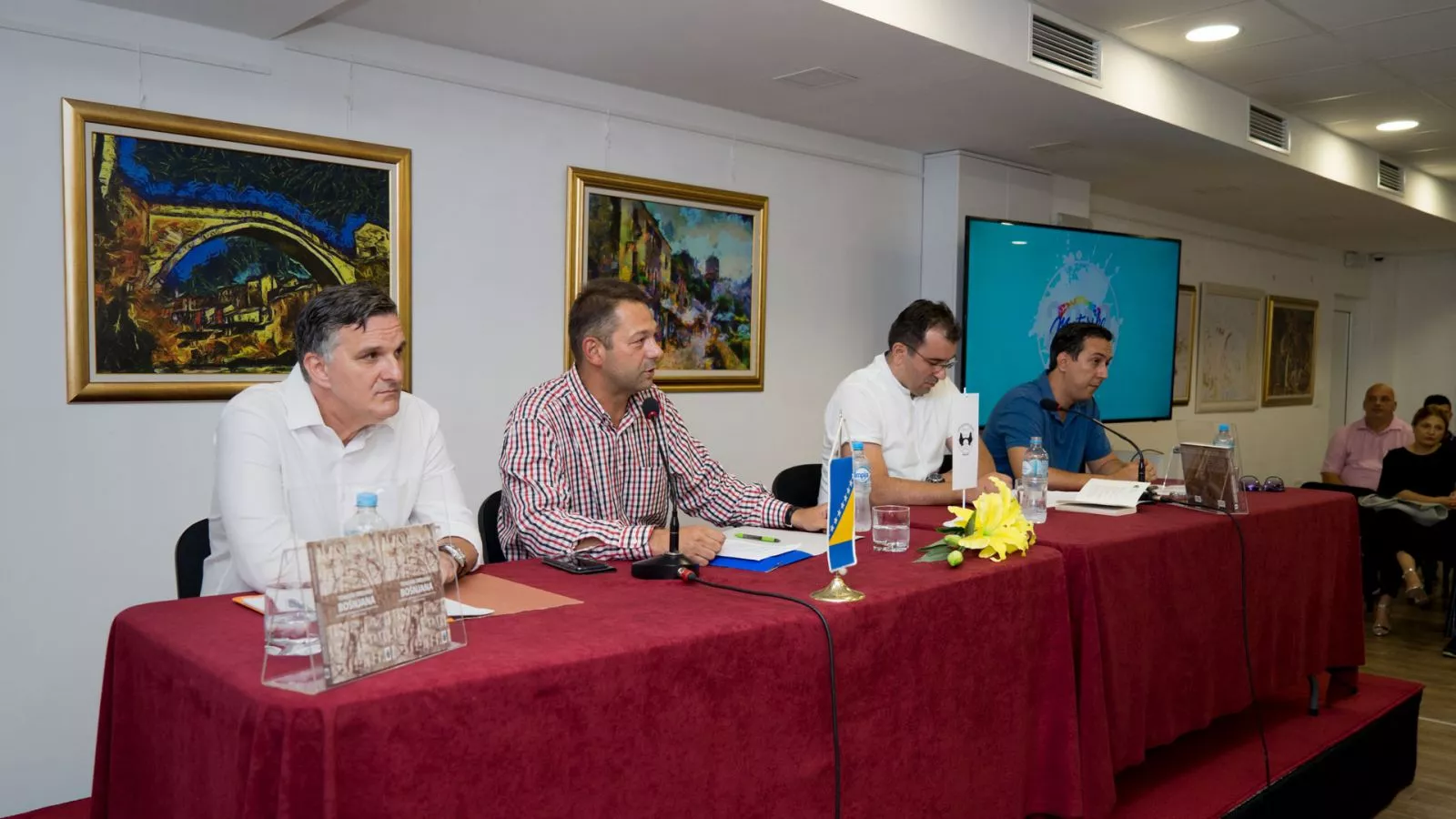
(Patria) - A public lecture on the topic „Bosnian State and National Identity“ with a discussion on the book „In the Footsteps of the Ancient Bošnjani“ was organized at the Mostar Culture Center, as part of the „Mostar Summer“ event.
Taner Aličehić and Đenan Galešić are the authors of the book „In the Footsteps of the Ancient Bošnjani: Bosnian Statehood and National Identity(ies) Through History“. Aličehić holds two master's degrees and is an associate professor at the Faculty of Economics in Lausanne. Galešić is a graduate lawyer who independently researches the history of Bosnia and Herzegovina and the Balkans, as well as the influence of the religious factor on the formation of nations and the future of Bosnia. The authors are also connected by being members of the Center for Strategic Studies of the International Forum Bosnia.
The path to a national state that will unite people of good will and followers of the Bosnian idea through understanding and accepting original Bošnjaštvo as an ideology and national identity naturally built on the basis of religious plurality and inclusiveness, acceptable to believers, atheists, agnostics, and, finally, to every human being, is thorny. And such a Bosnian idea of society is urgently needed by the whole world today.
The insinuation that Bosnia is both Serbian, Croatian, and Muslim is an example of anti-Bosnian politics. Bosnia is neither Serbian, nor Croatian, nor Muslim, but Bosnian. Bosnia is the national space of the Bosnian people, who throughout history, like any other people, changed their name from Bošnjani, Bošnjaci to Bosanci, but always nurtured freedom of religious choice, unlike, for example, the Serbian ideology, which remained trapped in hatred through the idea « one faith, one people, one state ». That is why today Bošnjaci should nurture religious plurality and can be Catholics, Buddhists, Jews, Orthodox Christians, Muslims, agnostics, atheists, or anything else – the authors point out.
As they say, this text was born out of the need to expose imposed misconceptions that the inhabitants of Bosnia (and Herzegovina) have naively or well-intentionedly accepted both through the education system and through the systematic destruction and denial of Bosnian national identity and state.
"Returning to the awareness of belonging to the Bosnian people requires exposing numerous myths that are the result of anti-Bosnian activity of nationalism in the last hundred and fifty years, primarily Serbian, then Croatian, and more recently Bošnjački. These ideologies are built on completely opposite foundations to those on which Bosnia was shaped throughout its long history.
The Bosnian people loved Tito's Yugoslavia, recognized Bosnian values in Yugoslavism. They accepted the Partisan movement as their own when they were expelled from Serbia and fought for the restoration of Bosnian statehood through ZAVNOBIH. The key insight is that both Bosnia and the Bosnian population survived as a unique people and state shaped by both great empires and national movements from more recent times“, the authors state.
„There are many examples of the violation of Bosnian statehood through the falsification of its history, the occupation of its territory, the denial of Bosnian national identity, i.e., of Bošnjaci as a state-forming people. Even today, in a significant area of the Bosnian-Herzegovinian state, a political strategy of eradicating and denying Bosnianness is present. The reality is that the state borders of Bosnia, which are largely centuries-old, have been defended. Regardless of crimes and persecution, Bosnian-oriented inhabitants are present in all parts of the state“ – says one of the authors, Taner Aličehić.
No one has the right to forbid any inhabitant of Bosnia from being a Bošnjak, Bosanac. Awareness of the erroneous perception of Bošnjaci as a religious group, which they certainly are not from a historical point of view, is beginning to be noticed everywhere. It should also be added that the perception of Bošnjani, Bošnjaci or Bosanci is one and the same from a historical point of view.
Komentari (0)
Prijavite se za komentiranje
PrijavaJos nema komentara. Budite prvi!
Minuta
Sve →Iz drugih kategorija

High Representative Not Elected: Germans, French and British Against Americans, New Attempt at End of June

ČOVIĆ WITHOUT MERCY: How Those Who Brought Ademović to Office Created a Political Hell for Him



Sunny Saturday, quite warm



Tragedy in Albanian resort: Two minors drown












