
(Patria) - Due to a decision by someone in the Ministry of Foreign Affairs (MFA) of BiH to unilaterally alter the report of the Commission appointed by the Presidency of BiH for the election of a judge of the European Court of Human Rights (ECtHR) in Strasbourg, and send such a "censored" report to the Council of Europe for consideration, the entire process is now on the verge of complete failure.
As Istraga previously reported, Šahbaz Džihanović, former judge of the Constitutional Court of the Federation of BiH, who chaired the Commission appointed by the Presidency for the election of an ECtHR judge, informed the Presidency about the MFA's actions that led to complete confusion in the Council of Europe, as well as among the members of the state Presidency.
- Allow me to say - I am aware, I don't know how, what report the BiH MFA sent to the Council of Europe, but I have evidence where the MFA secretary asked the Presidency Secretariat to provide him with the report in Word format, and that report, this commission's report was redrafted, meaning it was not credibly submitted to the Council of Europe - Džihanović said at the beginning of April at a session of the BiH Presidency.
In addition to the names of the three selected candidates for the ECtHR judge, the original report of the BiH Presidency Commission contained the names and ranking lists of individuals who applied for positions in other bodies of the Council of Europe.
After the BiH Presidency submitted the Commission's report to the Ministry of Foreign Affairs, the MFA first requested the report in Word format, then blacked out a large part of the document, and then sent it to Strasbourg without informing the Presidency or the Commission.
Parts of the original text of the Commission's report were blacked out on as many as 14 pages. Below, we publish several screenshots of the "corrected" Commission report that the MFA sent to the Council of Europe.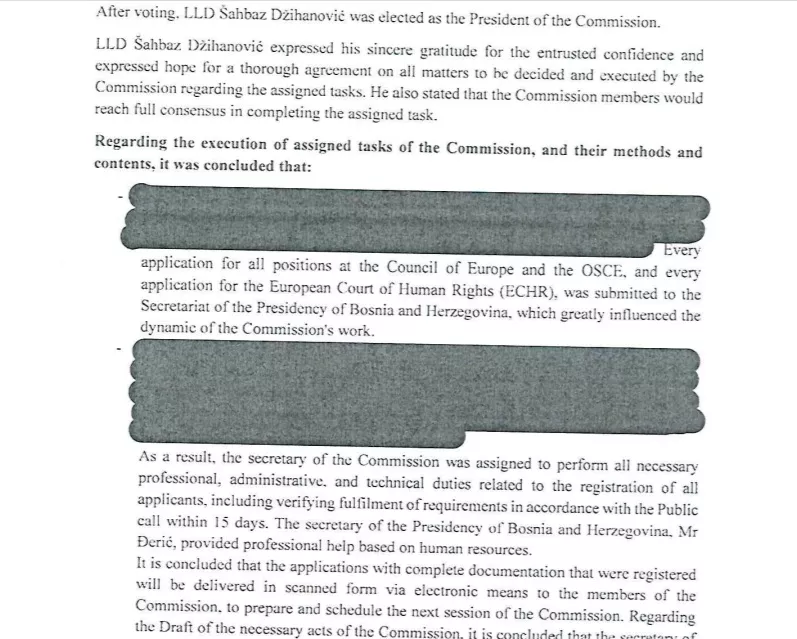
After the Council of Europe received the report from BiH, censored in the style of Epstein's files, their advisory panel requested in writing from the Council of Ministers of BiH to determine the credibility of the BiH Presidency Commission that compiled the list of candidates, and also asked whether one of the three proposed candidates was "assessed as a credible candidate for the position of judge of the European Court of Human Rights".
As Šahbaz Džihanović informed the Presidency members, the CoE requested that these questions be answered by March 10 of this year. The Presidency Secretariat received the request on March 6 via the Ministry of Foreign Affairs.
Džihanović directly pointed out at the Presidency session that the BiH MFA had no right to alter the report without the prior consent of the Presidency members, who had unanimously adopted it. Below is a part of the transcript from the session.
ŽELJKO KOMŠIĆ: Thank you for your answer. Well, I could now delve deeper into this story and this topic by asking - and why do you think the Ministry of Foreign Affairs changed that report?
ŠAHBAZ DŽIHANOVIĆ: I am not getting into that, sir.
ŽELJKO KOMŠIĆ: No, no, no, I said I could, I didn't say I would.
ŠAHBAZ DŽIHANOVIĆ: In my opinion, the Ministry of Foreign Affairs, nor anyone else, had any right to…
ŽELJKA CVIJANOVIĆ: Of course.
ŠAHBAZ DŽIHANOVIĆ: ... do anything regarding the final report that the Presidency of Bosnia and Herzegovina unanimously adopted.
ŽELJKA CVIJANOVIĆ: I agree.
ŠAHBAZ DŽIHANOVIĆ: That is a question that would probably need to be answered. Because if this is a precedent that the Presidency takes note of, and does nothing to ensure that state acts of BiH are treated as such, then we are in big trouble.
ŽELJKO KOMŠIĆ: I agree, Mr. Džihanović, that's why I insisted on this issue, and thank you for saying it.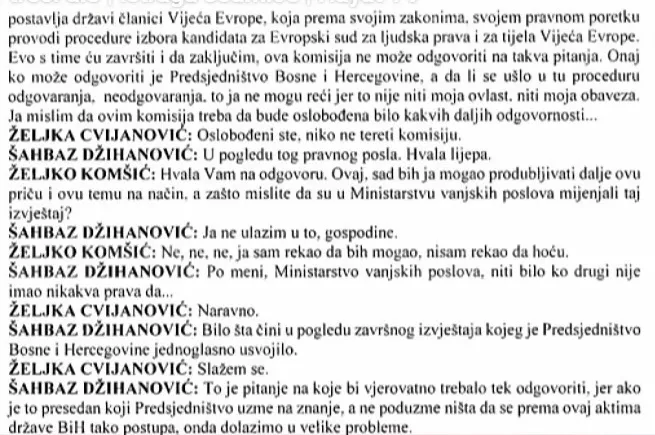
In the continuation of the discussion, Željka Cvijanović and Željko Komšić stated that this is a very serious (accidental or intentional?) oversight.
ŽELJKA CVIJANOVIĆ: This is now more serious than it seemed at the beginning.
ŽELJKO KOMŠIĆ: Well, of course it's more serious, that's why I insisted on it.
ŽELJKA CVIJANOVIĆ: How can it be? I mean, now we really have to go back to that story. Who and how changed it, who can change it?
After the discussion, Džihanović proposed to the Presidency that they adopt a conclusion which reads:
"The Ministry of Foreign Affairs of BiH is tasked to, without delay, and no later than 15 days from the date these conclusions enter into force, determine how, for what purpose, and by whose order the Final Report of the Commission from point 2 of these conclusions was redrafted, by blacking out the text on pages 3, 5, 7, 8, 9, 10, 12, 13, 14, 15, 16, 17, 18, and 19, thereby severely violating the integrity and authenticity of this document, which is contrary to the rules of public service and contrary to the law domestically, but also severely damages the international dignity and reputation of the state of Bosnia and Herzegovina in this specific case, and to submit a comprehensive report on this to the BiH Presidency."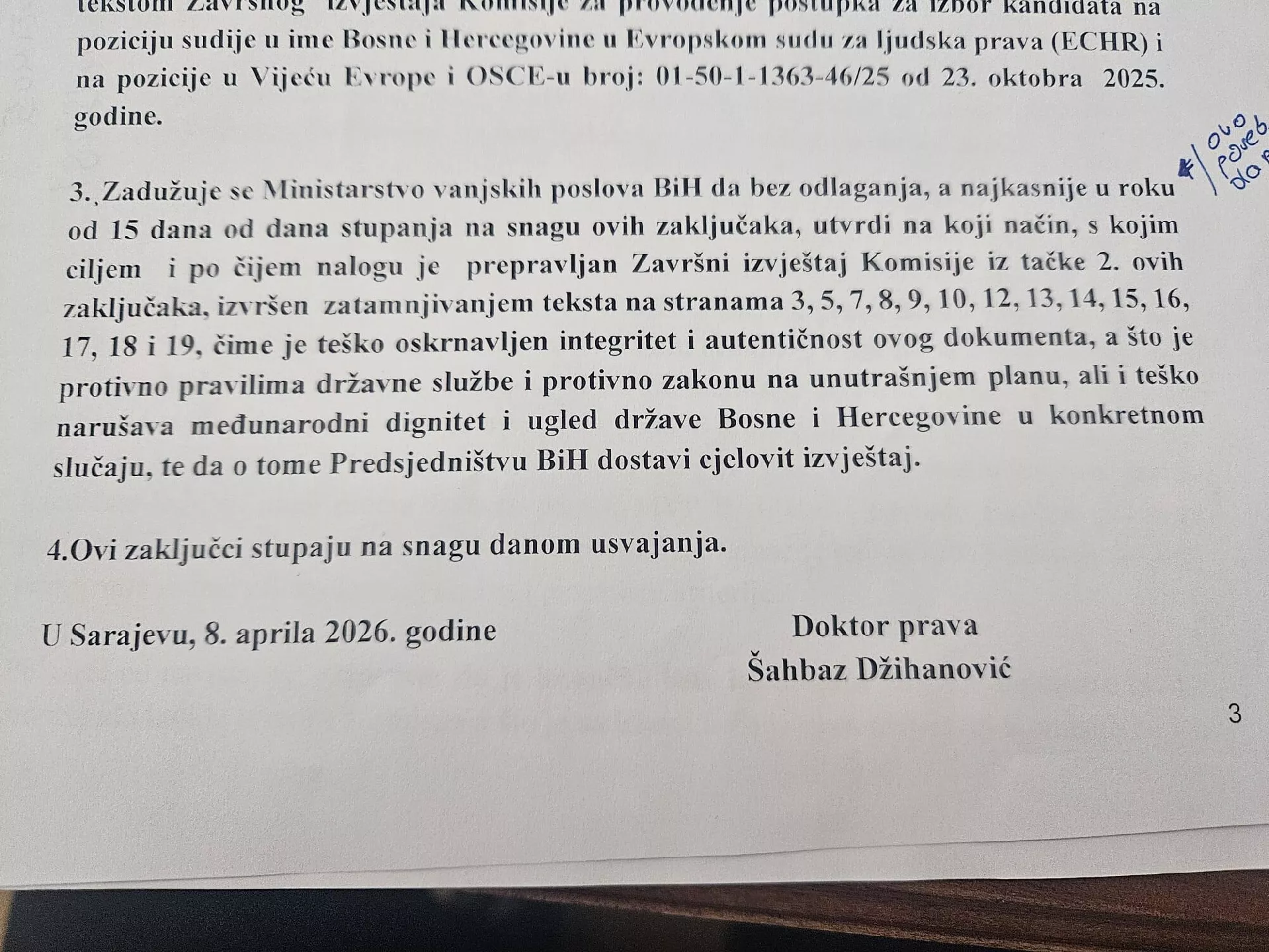
However, as Istraga learns, the Chairman Denis Bećirović and his chief of staff Alija Kožljak did not allow the mentioned conclusion to be put to a vote. Instead of insisting on the MFA's accountability, the following conclusion was adopted: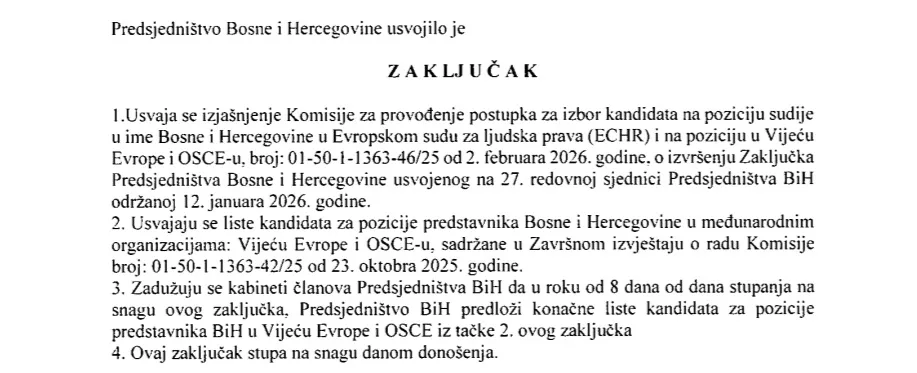
Questioning the credibility of the Commission's report, which was consciously created within the Ministry of Foreign Affairs, opens the possibility for the entire process of electing a BiH judge in Strasbourg to be blocked or annulled, thereby risking serious institutional compromise and loss of influence for BiH in one of the most important European judicial bodies.
The MFA's decision to send a redrafted report to Strasbourg without prior consultation with the Presidency sends a signal of institutional misalignment and poor control over the administration, which can have long-term consequences for the trust of international partners and the state's ability to fulfill its obligations under European conventions.
For the Council of Europe and its procedures, especially in the context of electing a judge for the European Court of Human Rights, transparency, integrity, and consistency of national procedures are key. Any deviation in this regard automatically raises doubts about the regularity of the process and can lead to the rejection of the candidate list or its return for revision.
Domestically, things are clear: the Ministry of Foreign Affairs, through its actions, has directly violated the hierarchy of decision-making and jeopardized the legal certainty and integrity of the Commission appointed by the Presidency.
The problem is not only in the censored document, but in the message that even the highest state acts are not protected from arbitrary interventions, which directly undermines both the internal legal order and the international legitimacy of BiH.
And on a political level, the current situation and the delay in electing an ECtHR judge primarily benefit Dragan Čović, who expects HDZ to get its member of the Presidency in October - and in that case, a new list with new candidates would go to Strasbourg.
Komentari (0)
Prijavite se za komentiranje
PrijavaJos nema komentara. Budite prvi!
Minuta
Sve →Iz drugih kategorija

High Representative Not Elected: Germans, French and British Against Americans, New Attempt at End of June

ČOVIĆ WITHOUT MERCY: How Those Who Brought Ademović to Office Created a Political Hell for Him



Sunny Saturday, quite warm



Tragedy in Albanian resort: Two minors drown












