
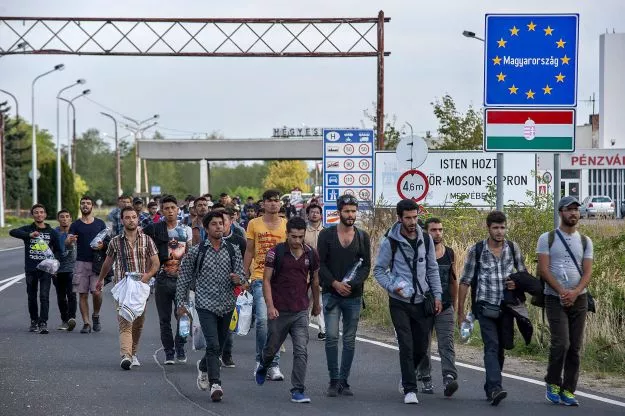
A meeting of foreign ministers in Prague on the topic of mandatory quotas for accepting refugees yielded no progress. The Czech Republic, Hungary, Slovakia, and Poland reject the plan presented by European Commission President Juncker earlier this week, reports the Patria news agency.
Czech Minister Lubomír Zaorálek stated that they are convinced each country should retain control over the number of refugees it can accept.
His German counterpart thus leaves Prague empty-handed and warns:
"The largest European refugee crisis since World War II could be the greatest challenge for the European Union in its history."
If interior ministers fail to reach an agreement on the distribution of refugees at their meeting on Monday, an emergency summit of the leaders of the 28 EU member states may be held as early as this month, announced European Council President Donald Tusk.
"On Monday, interior ministers are gathering for an emergency meeting. From that meeting, we will need a concrete and positive sign of solidarity and unity. From the contacts I have had with member states in recent days, I feel we are closer to a solution based on consensus and genuine solidarity. Without such a decision, I will have to convene an emergency meeting of the European Council as early as September," Tusk said in Nicosia, where he is visiting Cyprus.
The European Commission proposed on Wednesday mandatory quotas for the distribution of 120,000 asylum seekers, mostly from the Middle East and Afghanistan, currently located in Italy, Greece, and Hungary. In addition, another 40,000 refugees are to be distributed, as the Commission proposed back in May.
This is a proposal aimed at easing the burden of the refugee crisis on three countries. Subsequently, the Commission wants to establish a permanent mechanism that would allow migrants and refugees coming to Europe fleeing war and poverty to be distributed fairly and according to specific criteria among member states.
These proposals are supported by Germany and France but are strongly opposed by some Central and Eastern European member states, primarily the four Visegrad Group countries (Hungary, Czech Republic, Slovakia, and Poland).
Bulgaria and Romania do not share the stance of the Visegrad countries, but they condition their consent in a way that requires approval for their entry into the Schengen area. The European Commission has assessed for several years that these two countries meet all technical conditions for Schengen entry, but it has stalled at the political level because some member states refuse to vote for it, claiming that Sofia and Bucharest must strengthen the rule of law, the fight against corruption, and organized crime.
Western EU members criticize their Central and Eastern European partners for not showing solidarity, even though they have profited from solidarity through European structural and cohesion funds, writes Index.
Komentari (0)
Prijavite se za komentiranje
PrijavaJos nema komentara. Budite prvi!
Minuta
Sve →Iz drugih kategorija

High Representative Not Elected: Germans, French and British Sabotaged Americans, New Attempt at End of June

ČOVIĆ WITHOUT MERCY: How Those Who Brought Ademović to Office Created a Political Hell for Him



Sunny Saturday, quite warm



Tragedy in Albanian resort: Two minors drown












