
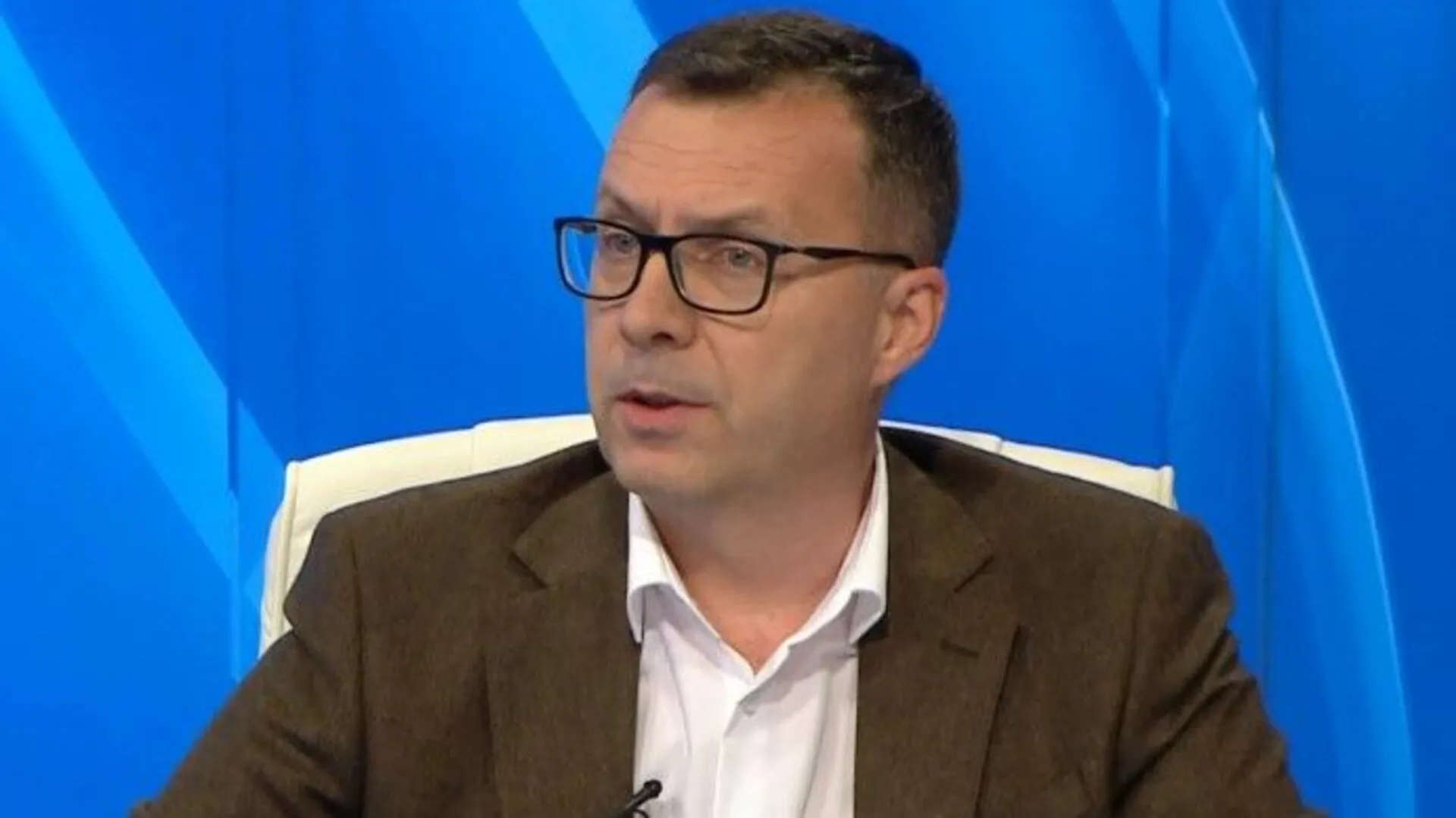
(Patria) - Former Federal Minister of Energy, Mining and Industry Nermin Džindić warned of a dramatic decline in the industrial sector in Bosnia and Herzegovina. According to him, strategically important symbols of the economy are facing collapse due to the lack of timely reactions and wrong decisions by the Government of the Federation of Bosnia and Herzegovina.
In the show Istraga sedmice (Investigation of the Week) on Hayat television, Džindić analyzed the causes of the collapse of economic giants. The current minister, Vedran Lakić, refused to participate in the discussion. Džindić assessed that the country's economy is extremely vulnerable and too dependent on external influences.
- Regarding the Steelworks itself, I don't think we should have missed several opportunities that were before us, nor should we have allowed them. I think that's why we are where we are today. To understand the problems and challenges that exist in the Steelworks, you must also understand all the important input elements: The Steelworks relies heavily on ore from the Ljubija Mine, and significantly on good electricity and gas prices, and that under certain circumstances it must be supported and subsidized by the state.
Then the Steelworks can survive. It should also be added here that about a year ago, the Coke Plant in Lukavac had its contract with the Smederevo Steelworks, which was its buyer, terminated. Unfortunately, the FBiH Government did nothing and did not intervene to save that contract or return it to its parameters. That's where this problem began. The Lukavac Coke Plant sold its coke to Smederevo Steelworks, according to my information through an intermediary, and Smederevo Steelworks found coke from Poland that was cheaper for them. So, imagine that coke from the EU is cheaper than that from BiH, and it is known that labor is cheaper here.
After that, the FBiH Government boasted that coke production in Zenica was being shut down and that coke would be redirected to Zenica from Lukavac, which is another mistake, and after that, the Ljubija mine, from which iron ore for Zenica Steelworks came, was also shut down. This, of course, has no direct connection with the FBiH Government, but the industry in the FBiH is like driving a car on the highway at 130 kilometers per hour. You have to be completely focused on your driving, you can't swerve, and at the same time, you have to be aware of everything happening around you left and right if you want to stay on the road without problems, Džindić portrays some of the key problems and failures made in industrial policy by the current FBiH Government, and then explains them in detail:
In addition to all this, the FBiH Government did not react to the problems related to energy sources in Zenica Steelworks, i.e., electricity and gas. Last year, i.e., 2025, the price of gas from the Russian supplier dropped twice. The government did not react even once, and it should have, in order to pass it on to the population and businesses of the Sarajevo Canton and the Zenica-Doboj Canton. This was not done, and it should have been, because the collected funds created an extra profit of KM 13.5 million for Energoinvest. It is unacceptable to take money from citizens like this, but also from businesses, which is very important because, for example, Arcelor Mittal also used gas, and Energoinvest did not offer them a lower price, neither the first nor the second time - Džindić points out.
Speaking about the correctness of Energoinvest's move to enter Zenica Steelworks, Džindić says it is not good to combine two sick entities and adds:
- The entire production chain and the way Zenica Steelworks operates is very complex and needs to be known perfectly. Before the last war, Zenica Steelworks produced up to 14 million tons of iron, and recently, before it shut down, it produced barely around one million. Many changes have occurred, and today it is very difficult to say with certainty that it is possible to create a successful concept. Of course, one should try, but I fear this is too big a bite for Energoinvest. I don't think Energoinvest can save Zenica Steelworks, but one needs to look at the bigger picture.
When I was the responsible minister, I had daily communication with the director of Zenica Steelworks. A solution must be found here, but it is unacceptable to increase the price of electricity or gas, for example, to Arcelor Mittal without prior consultation with them. In an earlier period, you will surely remember, for example, in 2022, Arcelor Mittal had a profit of 200 million, Lukavac Coke Plant around 70 million, and Elektroprivreda BiH and Željeznice FBiH operated with a surplus. All that is happening now will have an exceptional impact on Željeznice FBiH.
Therefore, I think the FBiH Government is to blame for what happened to Zenica Steelworks because it did not react correctly and in a timely manner. The collapse of Zenica Steelworks is a direct drop of 1% of Bosnia and Herzegovina's GDP because it was our largest exporter. That's just the direct impact, for example, a restaurant that fed 2,500 people, not to mention the small and indirect impacts, for which there is no precise estimate - Džindić clearly expresses his position.
Komentari (0)
Prijavite se za komentiranje
PrijavaJos nema komentara. Budite prvi!
Minuta
Sve →Iz drugih kategorija

High Representative Not Elected: Germans, French and British Against Americans, New Attempt at End of June

ČOVIĆ WITHOUT MERCY: How Those Who Brought Ademović to Office Created a Political Hell for Him



Sunny Saturday, quite warm



Tragedy in Albanian resort: Two minors drown












