
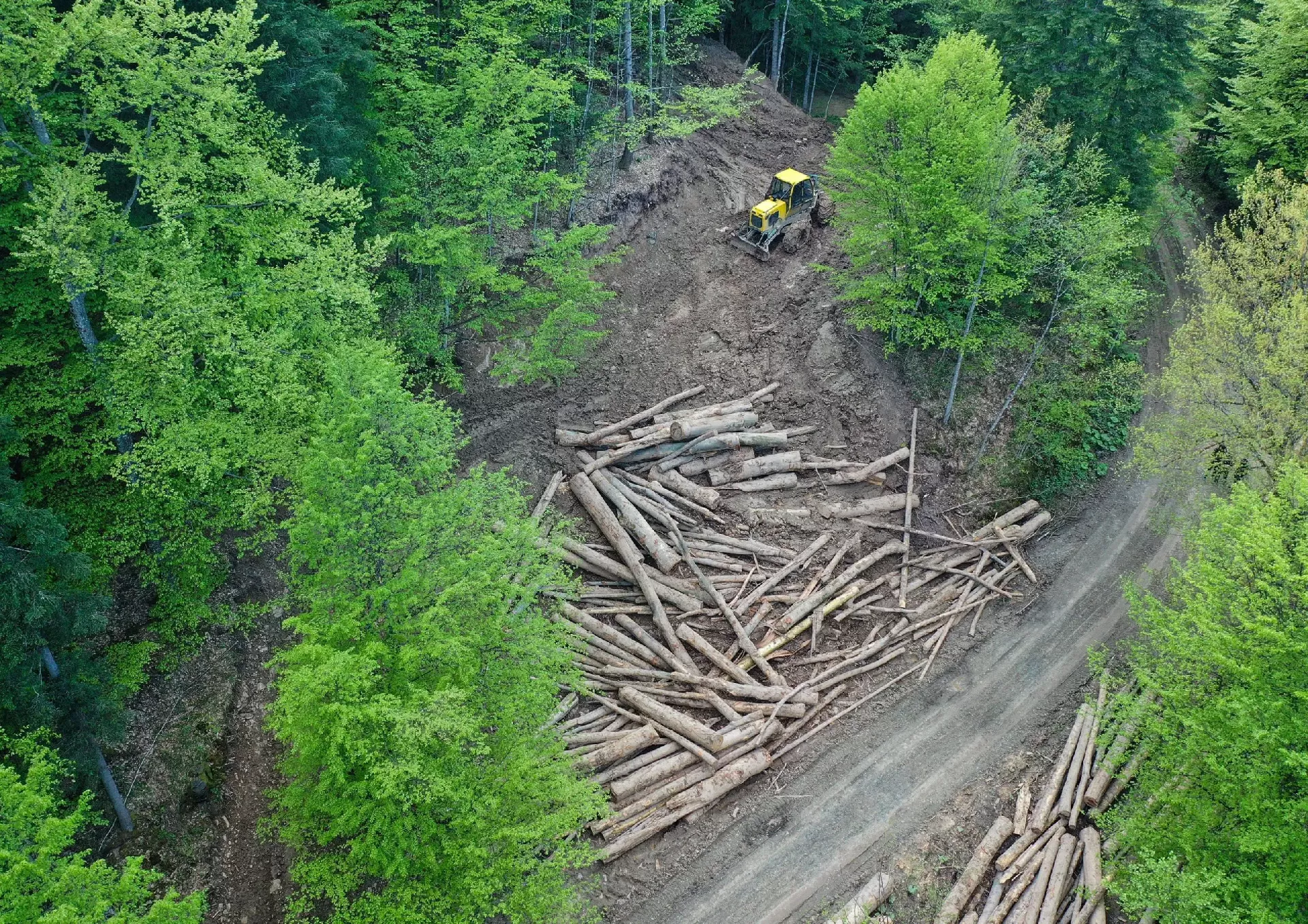
(Patria) - Public forestry companies in Bosnia and Herzegovina annually cut millions of cubic meters of timber and generate hundreds of millions of marks in revenue, but the benefits citizens derive from this vary significantly depending on the entity. While in the Republic of Srpska 48.4 million KM was collected from forest fees in 2023, in the Federation of BiH that amount was only 15.8 million KM.
An analysis by Transparency International in BiH shows that in 2023, the Republic of Srpska and the Federation of BiH had almost the same volume of logging, a similar number of employees, and comparable total revenues, while the collection of forest fees in RS was more than three times higher than in the Federation of BiH.
These differences do not stem from the amount of forest cut or differences in the quality of forest products, but are the result of a lack of legislative framework and a fragmented management system. For example, in the Una-Sana Canton, the fee for using state forests amounts to 9% of revenue from the sale of timber at the stumpage price, of which 2% goes to the canton's budget, while 7% of that amount is paid into the account of the municipality on whose territory the timber was cut. On the other hand, the Central Bosnia Canton charges 4% for this fee, of which 1% is collected by the canton and 3% by the municipal budget.
For comparison, in the Republic of Srpska this fee amounts to 10% of revenue from sales at the truck road – which is higher than the stumpage price because it includes, among other things, the costs of extraction from the forest and transport to the point of sale – meaning that in this entity the basis for calculating the fee is larger and the method of calculation, collection, and distribution is uniform for all municipalities.
The Federation of BiH has not had a law on forests since 2009, which forced cantons to adopt their own laws that treat this area differently, leading to weak control, uneven amounts and methods of fee collection, as well as different models for planning the use of these funds. As a result, citizens of the Federation of BiH derive significantly less benefit from forest exploitation compared to RS.
In addition to these differences, the analysis showed concerning trends in forest sustainability. Forestry companies cut 3.78 million cubic meters of forest, achieving 77% of the planned logging volume, while only 51% of the planned area was reforested in 2023. Furthermore, plans for building forest roads, which are crucial for successful and efficient exploitation, accessibility, and forest growth and cultivation, are implemented at an average rate of around 59%.
These data indicate that forests are managed with a short-term focus on exploitation, logging, and revenue generation, while long-term sustainability and forest cultivation are systematically neglected.
High Revenues, Minimal Profit
Despite total revenues exceeding 470 million KM and over 9,000 employees, forestry companies in BiH achieve symbolic profit, which in 2023 amounted to 3.83 million KM. If these data are compared with the number of employees, it appears that public forestry companies generate only about 400 marks of profit per worker annually.
The serious inefficiency in managing one of the most valuable natural resources is also indicated by the fact that companies managing forests achieved only 0.04 KM in profit per cubic meter of timber cut in 2023.
Debts, Receivables, and Extreme Price Differences
The analysis also shows high amounts of uncollected receivables from customers, which in 2023 amounted to 27.73 million KM, while receivables older than one year, whose collection is unlikely, reached 15.88 million KM. In some companies, doubtful receivables older than one year account for more than half of total customer debts, raising questions about the responsibility of those who allowed timber to be cut and delivered to suppliers while delaying collection of receivables to the detriment of the public company.
A particular risk is the method of pricing forest products, which varies to an extent that can hardly be explained by market influences. Thus, buyers paid 152 KM for a cubic meter of first-class oak in Posušje, while the same product was sold by JP ŠUME TUZLANSKOG KANTONA DD KLADANJ for 567 KM/m3, a price difference exceeding 250% over a distance of just over 200 kilometers.
Transparency International attempted to obtain data from public companies on buyers of forest assortments, quantities purchased, values of concluded contracts, and the method of agreeing on timber delivery, in order to assess whether this is a case of poor management or favoritism towards certain business entities. However, only four public companies (JP Šume TK dd Kladanj, JP ŠGD šume Hercegovačko-neretvanske doo, Šumarstvo Prenj dd Konjic, ŠGD ŽZH doo Posušje) provided data on buyers and delivered amounts.
Lack of Transparency Hinders Oversight
This lack of transparency prevents adequate insight into the distribution of forest assortments and assessment of pricing policy, as well as broader insight into the management of forestry companies.
The low level of transparency is further illustrated by the fact that only 34% of key documentation for the period 2022–2024 is available on the official websites of forestry companies, and only two companies have published a work report for 2024, while more than half do not even publish the price lists according to which they sold and delivered to customers.
As earlier analyses showed that over 80% of directors of forestry companies and forest estates have confirmed political connections, and that employment in these companies is possible without a public competition, and conflicts of interest are tolerated, it is clear that these companies are becoming outposts of political parties, where resources are used for party patronage employment.
The lack of transparency in the sale and distribution of timber assortments, the unavailability of price lists, the impossibility of public control, and the low level of efficiency in operations further confirm suspicions that forest management in Bosnia and Herzegovina is unsustainable, driven by short-term interests and exploitation, and aimed at favoring privileged buyers rather than serving the general public interest.
To eliminate the identified systemic deficiencies, it is necessary to establish a unified forestry information system that would enable standardized data collection and processing, and to define clear technical standards for geolocation marking of logging areas, which must be aligned with the requirements of the EU Deforestation Regulation (EUDR). Additionally, inspection oversight and control mechanisms must be significantly strengthened through clear procedures for verifying timber origin, and the oversight process must allow for the participation of the non-governmental sector and professional associations, which can offer an adequate level of protection of the public interest.
Without depoliticizing management, adopting a law on forests in the Federation of BiH, and introducing uniform rules for collection and reporting aligned with European rules and standards, forests in BiH will remain a resource under political control, thereby jeopardizing long-term sustainability.
Data on the operations of public companies, collection of forest fees, and general benefits from forests are also available through the registry koncesije.transparentno.ba, which TI BiH has updated with new data on forest management in Bosnia and Herzegovina.
Komentari (0)
Prijavite se za komentiranje
PrijavaJos nema komentara. Budite prvi!
Minuta
Sve →Iz drugih kategorija

High Representative Not Elected: Germans, French and British Against Americans, New Attempt at End of June

ČOVIĆ WITHOUT MERCY: How Those Who Brought Ademović to Office Created a Political Hell for Him



Sunny Saturday, quite warm



Tragedy in Albanian resort: Two minors drown












