
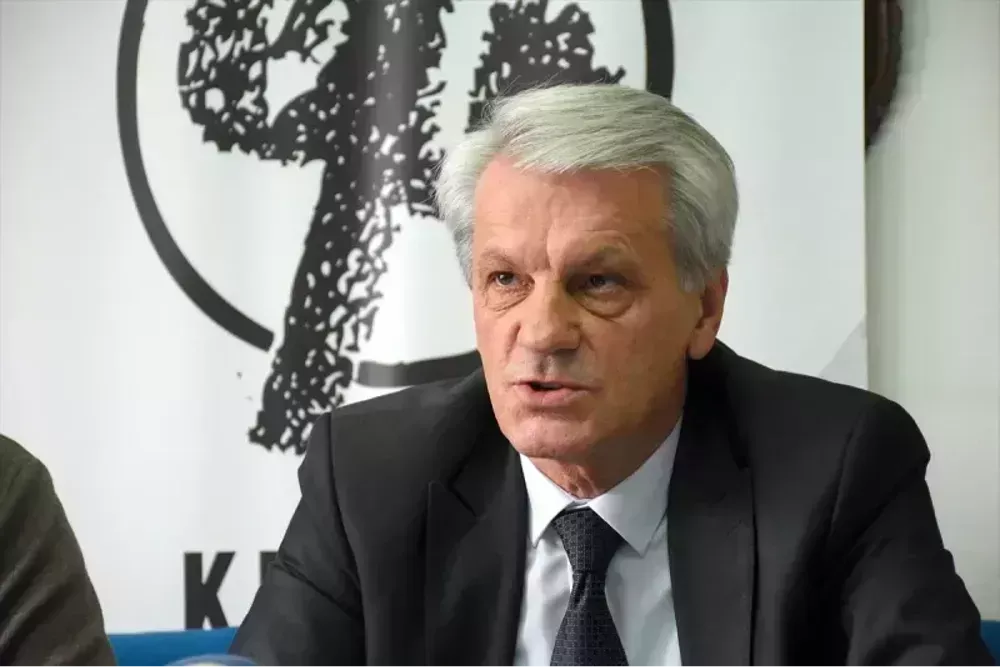
Address by legal expert and member of the Presidency of NES Enver Išerić at the "Krug 99" session
The title of today's session is almost unbelievable. It is confusing, intriguing, and frightening. And the title itself, which is also a statement, is unsustainable. The situation is unsustainable and must be changed urgently. To try to explain what this is about, we will have to start from the Constitution of Bosnia and Herzegovina itself. Article I 2. of the Constitution of Bosnia and Herzegovina stipulates:
„2. Democratic Principles
Bosnia and Herzegovina is a democratic state that functions in accordance with the law and on the basis of free and democratic elections.“
And democracy literally means the rule of the people, i.e., the citizens. This means, so as not to be misunderstood, not the rule of the "constituent peoples", but the rule of the citizens of a state.
Citizens exercise this power by making decisions directly or indirectly, i.e., directly or indirectly. The direct exercise of the people's power in making decisions is done by a majority of votes in elections, and citizens exercise indirect power through their elected representatives in parliament. Indirect exercise of power also implies decision-making by a majority of votes of representatives.
Further in the Constitution of Bosnia and Herzegovina, in Article II, which deals with human rights and freedoms, it is stipulated that Bosnia and Herzegovina and both entities will ensure the highest level of internationally recognized human rights and fundamental freedoms.
Paragraph 2 of the same article stipulates that the rights and freedoms provided for in the European Convention for the Protection of Human Rights and Fundamental Freedoms and its protocols are directly applicable in Bosnia and Herzegovina. These acts have priority over all other laws.
It is also important to note, and we must constantly talk about it, that Article II 4. prohibits any form of discrimination against citizens, and Article II 4. of the Constitution reads:
„The enjoyment of rights and freedoms, as provided for in this Article or in the international agreements listed in Annex I to this Constitution, shall be secured to all persons in Bosnia and Herzegovina without discrimination on any ground such as sex, race, colour, language, religion, political or other opinion, national or social origin, association with a national minority, property, birth or other status.“
Annex I to the Constitution of Bosnia and Herzegovina lists additional human rights agreements that will be applied in Bosnia and Herzegovina, i.e., a total of 15 conventions and other international documents protecting human rights.
Unfortunately, despite such very clear and, at first glance, encouraging constitutional norms, the citizens of Bosnia and Herzegovina have not been able to exercise all the rights guaranteed to them by the constitution. The reason for this is the fact that the constitutional provisions governing the basic issues of elections to government bodies and the decision-making process in these bodies discriminate against our citizens in such a way that the exercise of the right to vote is prevented depending on whether you declare yourself a member of one of the constituent peoples or not, but also on where in the country you live, i.e., have your residence.
For the protection of their rights guaranteed by the Constitution of Bosnia and Herzegovina, especially Article II 2. which stipulates that the rights and freedoms provided for in the European Convention for the Protection of Human Rights and Fundamental Freedoms and its protocols are directly applicable in Bosnia and Herzegovina and that these acts have priority over all other laws, citizens who are discriminated against have sought protection of their rights before the Constitutional Court of Bosnia and Herzegovina.
However, the Constitutional Court, based on Article VI 3., is obliged to uphold the existing Constitution and has no jurisdiction to change the constitutional provisions that clearly stipulate the method of electing members of state institutions (Presidency of BiH and House of Peoples), even though they contradict the constitutional provisions that guarantee human rights and prohibit any form of discrimination.
Therefore, the applicants turned to the European Court of Human Rights and sought its protection.
By ratifying the European Convention for the Protection of Human Rights and Fundamental Freedoms in 2002, Bosnia and Herzegovina accepted the jurisdiction of the European Court of Human Rights to decide on applications from individuals who claim or believe they are victims of a violation of rights established by the Convention, committed by BiH.
Thus, the judgments Sejdić-Finci, Zornić, Pilav, Šlaku, Pudarić were rendered, and finally, we have the Kovačević judgment.
The main difference between the earlier judgments of the European Court of Human Rights and the 'Kovačević' judgment is that the earlier judgments established a violation of the rights of our citizens to be elected to government bodies, while the Kovačević judgment establishes that his rights to vote for members of the Presidency and delegates to the House of Peoples of the BiH Parliament have been violated.
And unlike all previous judgments, an appeal was filed against the Kovačević judgment.
The news of this judgment echoed through the Bosnian sky with such force that the proponents of human rights violations experienced a classic knockout, shock, and disbelief that the end of their manipulations, human rights violations, and further fueling of hatred and ethnic divisions among the peoples and citizens of Bosnia and Herzegovina had come.
Therefore, a "state of emergency" was declared in their ranks. All their forces, both legal and political, were mobilized to obstruct or otherwise hinder, even temporarily, the finality of the judgment. The appeal was filed by agents of the Council of Ministers before the European Court of Human Rights, whose mandate had expired, and they had no legal standing to communicate with the European Court of Human Rights in any way, let alone to file unfounded appeals. The agents were illegally appointed several times for a period of three months, and it is possible to be appointed a maximum of twice for three months. In addition, their appointments lasted significantly longer than three months.
Finally, the question can also be justifiably raised whether the Council of Ministers, by adopting the Decision on the Agent of the Council of Ministers of Bosnia and Herzegovina before the European Court of Human Rights, acted in accordance with the Constitution of Bosnia and Herzegovina.
Namely, the Constitution of Bosnia and Herzegovina stipulates that the appointment of ambassadors and other international representatives of Bosnia and Herzegovina is within the competence of the Presidency of Bosnia and Herzegovina, not the Council of Ministers (Article V 3. b).
When adopting the Decision on the Agent of the Council of Ministers before the European Court of Human Rights, Article 17 of the Law on the Council of Ministers is cited as the legal basis, which stipulates: "In exercising its rights and duties, the Council of Ministers shall adopt decisions, conclusions and rulings, adopt drafts and proposals of laws, analyses, information, strategic documents, programs, agreements, protocols and other acts (hereinafter: acts).“
Since it is neither its right nor its duty to appoint international representatives, its decision is in contradiction with the Constitution of Bosnia and Herzegovina, and thus with the Law on the Council of Ministers.
Finally, the applicants did not sue the Council of Ministers, but Bosnia and Herzegovina, and the Council of Ministers cannot have its own agent. Bosnia and Herzegovina, as the defendant, can have an agent, and the agent can and must be appointed by the Presidency of Bosnia and Herzegovina.
To make matters worse, Article 9 of the Decision on the Agent of the Council of Ministers before the European Court of Human Rights itself stipulates: "If the representative of the Council of Ministers, in relation to a specific case being considered by the European Court of Human Rights in Strasbourg, determines that a domestic regulation is not in accordance with the European Convention for the Protection of Human Rights and Fundamental Freedoms, they are obliged to provide the Council of Ministers of Bosnia and Herzegovina, or another competent body, with an initiative to harmonize that regulation with the European Convention for the Protection of Human Rights and Fundamental Freedoms.“
So, it does not say here "if the representative of the Council of Ministers, in relation to a specific judgment", but rather "in relation to a specific case being considered by the European Court of Human Rights in Strasbourg", determines that a domestic regulation is not in accordance with the European Convention for the Protection of Human Rights and Fundamental Freedoms, they are obliged to provide an initiative to harmonize that regulation with the European Convention for the Protection of Human Rights and Fundamental Freedoms.“
And instead of the representative of the Council of Ministers worrying about the execution of the judgments of the European Court of Human Rights in Bosnia and Herzegovina and informing the Council of Ministers of Bosnia and Herzegovina and the Committee of Ministers of the Council of Europe about it, as stipulated by Article 7 of the Decision on the Agent of the Council of Ministers, the agents are preparing a request to bring the Kovačević case before the Grand Chamber of the European Court of Human Rights, thus unnecessarily and unjustifiably further endangering the rights of the citizens of Bosnia and Herzegovina, which they are obliged to protect through their work and actions.
“The European Court, in the case of Sejdić and Finci (para. 43 and 44), took a position that can be summarized as follows:
discrimination based on a person's ethnic origin is a form of racial discrimination that is a particularly cruel form of discrimination and, given its dangerous consequences, requires special caution and decisive action from the authorities. For these reasons, the authorities must use all available means in the fight against racism and thus strengthen the vision of a democratic society in which diversity is not seen as a threat but as a wealth.“
All other judgments of the European Court of Human Rights that we have mentioned could be summarized in this way.
As a state, we are obliged to eliminate discrimination and change our electoral system, i.e., the Constitution and the Election Law of BiH, in order to ensure equal rights for everyone in BiH.
In addition, the Criminal Code of Bosnia and Herzegovina (Article 239.) stipulates:
“An official in an institution of Bosnia and Herzegovina, the Federation of Bosnia and Herzegovina, Republika Srpska, Brčko District of Bosnia and Herzegovina, or in a canton, city or municipality or local community or any local administration and self-government body, or a responsible person who does not apply, implement, execute or otherwise respect a final and binding decision of the Constitutional Court of Bosnia and Herzegovina, including a decision on a temporary measure, a final and enforceable decision or a temporary measure of the Court of Bosnia and Herzegovina, the Human Rights Chamber of Bosnia and Herzegovina or the European Court of Human Rights, or who prevents or otherwise obstructs the application, implementation or execution of such a decision, shall be punished with imprisonment from six months to five years.“
Considering that Dragan Čović committed a criminal offense under this article, by drafting and submitting amendments to the Election Law regulating the issue of electing members of the Presidency of Bosnia and Herzegovina in a manner contrary to the judgments of the European Court of Human Rights, Azra Zornić filed a criminal complaint against him with the Prosecutor's Office of Bosnia and Herzegovina.
The Prosecutor's Office of Bosnia and Herzegovina, i.e., the prosecutor in charge, issued an order not to conduct an investigation in that case, claiming that such action does not constitute a criminal offense. Instead of expanding the investigation to other responsible persons in the Council of Ministers and the collegia of the houses of the Parliamentary Assembly, and thoroughly and in detail examining the circumstances why the judgments of the European Court of Human Rights were not executed, which constitutes a criminal offense, the prosecution refers to the Decision of the Constitutional Court of Bosnia and Herzegovina in case U-14/22, by which the court determined that the Proposal for Amendments to the Election Law did not violate the interest of the Bosniak people in Bosnia and Herzegovina.
Such reasoning makes no sense or basis, as it concerns the criminal offense of non-execution of the judgments of the European Court of Human Rights, including the ZORNIĆ judgment, which does not declare herself as Bosniak.
Furthermore, as stated earlier, the Constitutional Court upholds the Constitution and existing constitutional solutions. The European Court orders changes to these discriminatory provisions of the constitution.
To make matters even worse and more dramatic, the Prime Minister of the Government of the Republic of Croatia, Mr. Plenković, when speaking about the judgments of the European Court of Human Rights, recently stated: "All these cases are fabricated. I think that the Sejdić-Finci judgment, which was rendered by the same European Court of Human Rights, and all other judgments in that direction, are a legal path to achieving political goals. BiH exists on the foundations of what unfortunately happened between 1991 and 1995 and what was agreed upon regarding the country's structure. What we are seeing through all these cases are attempts to change something through the practice of the European Court.“
Thus, the Prime Minister of an EU member state denies the judgments of the European Court of Human Rights and advocates for racial discrimination in another country, contrary to the decisions of that court, and grossly interferes in the internal affairs of our country. In doing so, he violates the Charter of the United Nations, which prohibits interference in the affairs of other sovereign states, as well as the Convention on Diplomatic Relations, which calls for the goals and principles of the Charter of the United Nations on the sovereign equality of states, the maintenance of international peace and security, and the promotion of friendly relations among peoples.
Plenković went so far, behaved so arrogantly, rudely, and insolently that he stated:
“Amendments to the Election Law of Bosnia and Herzegovina are crucial for the quality functioning of institutions in BiH. All three constituent peoples should be fully equal.“
So, in what way are these constituent peoples not equal, with regard to the existing Constitution of Bosnia and Herzegovina and the Election Law? And what would Plenković change in our election law? To introduce apartheid and tribal voting!? Does Plenkovic know that there are judgments of the European Court of Human Rights that Bosnia must implement and incorporate into its constitution and election law? If that system of constitutionality is good, introduce it in Croatia? And prescribe there that only Croats can vote for the president of the country, and that members of other peoples (Bosniaks and Serbs...) do not have that right. And as soon as you do that, we will incorporate it into our constitution and law. But since Croats are the majority people in Croatia, then it would also apply to the majority people in Bosnia and Herzegovina. So, you can't do that, Mr. Plenković! It's not civilized.
And if we are to talk about the endangerment of any people in Bosnia and Herzegovina, then it is the Bosniaks as the majority people and other citizens. The Bosniaks themselves are most to blame for their endangerment, i.e., those who represent them, and for the others, everyone in power who does not want to implement the judgments of the European Court of Human Rights and thus make all citizens equal is to blame.
Your statement that “Mr. Komšić is not a representative of the Croatian people in the Presidency of BiH, as stipulated by the Paris-Dayton Peace Agreement and the BiH Constitution” and “I will gladly come to the Presidency when that changes", is completely inappropriate for a prime minister. Members of the Presidency are not elected as representatives of the people. Do you need this explained? They represent and must represent all citizens, and they are elected from among the constituent peoples. This will not change as you have planned. You are trying in vain. Anyone in Bosnia who agrees to your demands is a traitor to the state of the first category. In the second category are those who allow you to belittle our institutions in our country and interfere in our internal affairs. And betrayal is the most serious and unforgivable act.
What do you think if one of the Bosniaks in Bosnia and Herzegovina said that they would not meet with you and the president of your country because you are not representatives of Bosniaks in Croatia?
These are not the actions and deeds of friendly countries, Mr. Plenković. Perhaps you don't care about that. If you do, withdraw and apologize. But you will not interfere in the affairs of our country! You were at the opening of the bridge in Počitelj. You say it coincided with your visit to Bosnia and Herzegovina by chance. It's as much a coincidence as nightfall. You came to open concrete bridges, and to destroy relationships between people. It is a shameful act.
Finally, we can conclude that two bodies, the Council of Ministers, along with the agents it appointed, and the Prosecutor's Office of Bosnia and Herzegovina, have shown that they do not care about human rights, their protection, or the execution of the judgments of the European Court of Human Rights.
Komentari (0)
Prijavite se za komentiranje
PrijavaJos nema komentara. Budite prvi!
Minuta
Sve →Iz drugih kategorija

High Representative Not Elected: Germans, French and British Against Americans, New Attempt at End of June

ČOVIĆ WITHOUT MERCY: How Those Who Brought Ademović to Office Created a Political Hell for Him



Sunny Saturday, quite warm



Tragedy in Albanian resort: Two minors drown












