
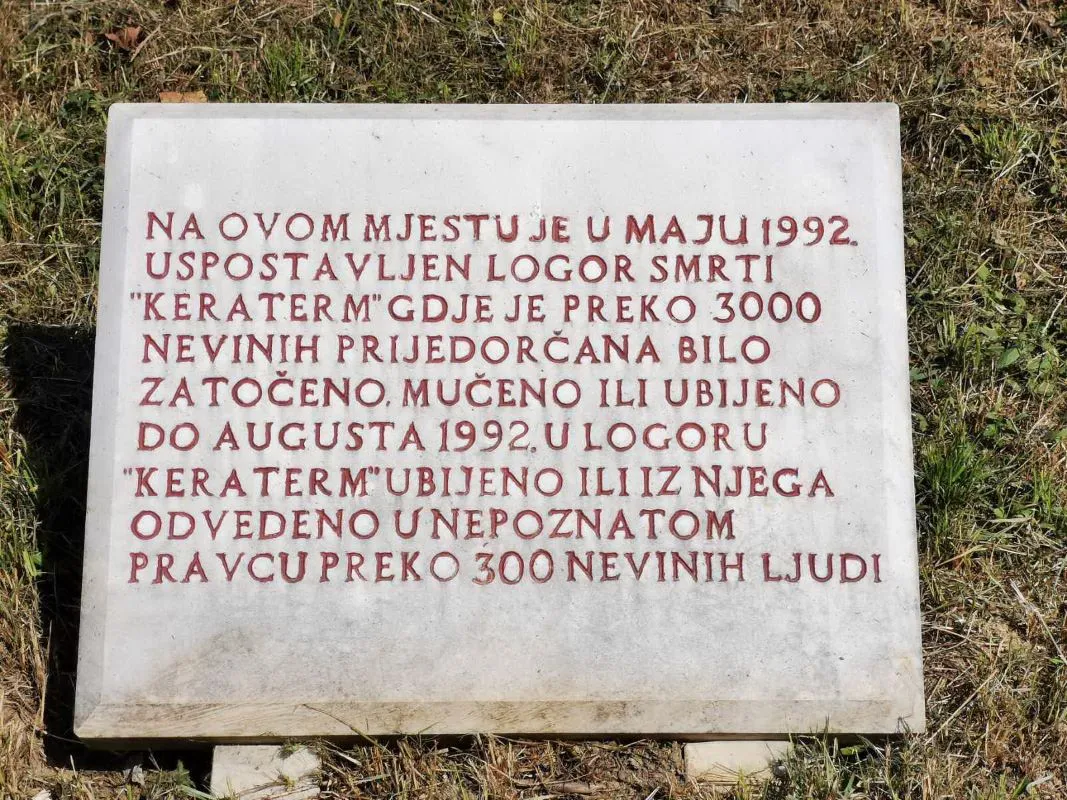
(Patria) - A play about wartime sexual violence and a commemorative program called "Night Roll Call" marked the "Night in Keraterm", an event during which visitors had the opportunity to tour the interior of the former camp in Prijedor and the rooms where detainees were interrogated and tortured for the first time.
The "Night in Keraterm" program, organized by the Youth Center "Kvart" from Prijedor, gathered former detainees, activists, artists, and citizens at the site of the former "Keraterm" camp, where a theatrical performance about the consequences of wartime sexual violence and a commemorative program paid tribute to the killed and missing detainees.
A special part of the program was the play "Doghouse", performed by the Zagreb-based Association for Cultural Action "Arterarij", which addresses the long-term consequences of wartime rape on survivors, their families, and communities.
"The theme of the play is rape in war, and 'Keraterm' is precisely the place where sexual abuse and rape of detained men were more frequent than anywhere else in the countries that emerged from the breakup of Yugoslavia. Art can help us better understand our reality after the severe traumatic experience of war, especially people who were exposed to that violence or were aware of it while it was ongoing in the camp," Edin Ramulić from the Youth Center "Kvart" told Detektor.
For Roman Nikolić, the director of the play and artistic director of "Arterarij", performing at the site of the former camp carries a special responsibility.
"I have never been to this location before, and my feelings are mixed. I feel an immense responsibility that the play we brought from Zagreb points out and raises awareness of everything that has been hushed up for years. We are trying to reach those memories and that truth that must be spoken," Nikolić told Detektor.
The play was created over six months through conversations with survivors, psychologists, psychiatrists, and organizations working with victims of war crimes across the region. It is inspired by real events and follows two families marked by wartime sexual violence.
"We tried in a credible way not to desecrate any story, any pain, sorrow, or emotion we heard during the research," Nikolić said.
Co-author of the play's text and co-founder of "Arterarij", Mario Mažić, told Detektor that performing the play in the space of the former camp gives special weight to the entire event.
"It is my first time entering inside, and my hope is that this will not cause retraumatization or bring back negative emotions for people, but rather let them know that there is an effort to tell their story, understand it, and for people to learn from it," Mažić said.
This year's "Night in Keraterm" was also special because interested citizens had the opportunity to tour the interior of the former camp complex for the first time, including the rooms where illegal interrogations and torture of detainees were carried out during the war.
Among those who walked through these rooms again was Nijaz Huremović, a former detainee of "Keraterm".
"Right in this room where we are now talking, I was interrogated, and it is my first time in it since then. I shudder at the thought," Huremović told Detektor.
He recalled how during the interrogation he was beaten and accused of participating in the fighting.
"When I came to the camp, they killed the god in me, they beat me, they did not spare me," he said.
Huremović says he was brought to the camp on the same day the famous bodybuilder from Kozarac, Fikret Hodžić, was killed, together with Ešaf Dženanović, about whom BIRN BiH recently made a documentary film due to his harrowing life story and the loss of his entire family during the war.
He spent the period from July 9 to August 6, 1992, in "Keraterm", after which he was transferred to the "Trnopolje" camp. He left Prijedor on August 22, in a convoy that transported civilians from this area via Travnik and Zenica, later finding salvation and a new life abroad.
Although many members of his extended family were killed during the war, he says he does not want to live in hatred today.
"A psychiatrist once told me that hatred is an introduction to madness, and I stick to that. Do not hate, but do not forget. I do not forget what I survived, but I am not inclined to any form of revenge or hatred," Huremović said.
The program ended with the "Night Roll Call", a commemorative act during which the names of 406 killed and missing detainees were read again in the space of the former camp.
"Through the 'Night Roll Call', we wanted to return the names of 406 killed people to the space of 'Keraterm', to fill every one of those rooms where these detainees spent their last days of life through a powerful sound system," Ramulić said.
He added that the organizers hope this approach to commemoration will contribute to the development of empathy and solidarity among citizens, and that the space of "Keraterm" will one day become a memorial center through which young people will pass and learn about the consequences of war.
The former "Keraterm" camp was located within the ceramics factory complex at the entrance to Prijedor. During the summer of 1992, according to judicially established facts, several thousand people were detained there, mostly Bosniaks and Croats, who were subjected to beatings, psychological abuse, rape, and other forms of violence. The Hague Tribunal designated "Keraterm", along with "Omarska", as a death camp.
According to data from the Association of Detainees of Bosnia and Herzegovina, 371 people were killed in the camp, while research by organizations documenting war crimes indicates at least 406 killed or missing detainees. For crimes committed in Prijedor, the Hague Tribunal sentenced 17 people to a total of 276 years in prison, while before the Court of Bosnia and Herzegovina, 28 people were sentenced to more than 430 years in prison. Several people have been prosecuted for crimes in Prijedor in district courts.
"Keraterm" remains one of the most well-known sites of civilian suffering during the war in Bosnia and Herzegovina, and the organizers believe that precisely because of this, this space must become a place of remembrance, learning, and warning for future generations.
Komentari (0)
Prijavite se za komentiranje
PrijavaJos nema komentara. Budite prvi!
Minuta
Sve →Iz drugih kategorija

High Representative Not Elected: Germans, French and British Sabotaged Americans, New Attempt at End of June

ČOVIĆ WITHOUT MERCY: How Those Who Brought Ademović to Office Created a Political Hell for Him



Sunny Saturday, quite warm



Tragedy in Albanian resort: Two minors drown












