
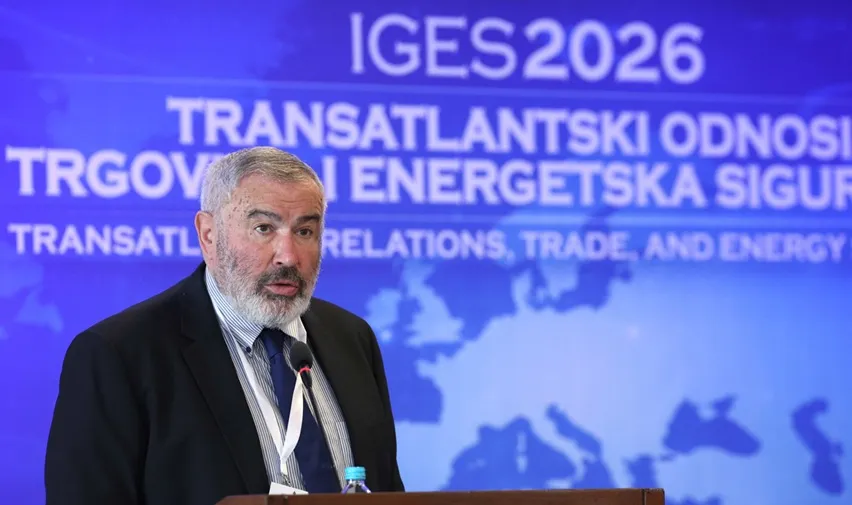
(Patria) - State property is not an unresolved issue; it constitutionally and legally belongs to the state, and as such, with the help of our allies and the mechanisms established by the Dayton Agreement, it should only be confirmed as state property. Most importantly, only as such can it serve all its citizens in every corner of our homeland, said the Ambassador of Bosnia and Herzegovina to Washington, Sven Alkalaj.
It is an exceptional honor for me to attend today's conference, whose title is very relevant: TRANSATLANTIC RELATIONS, TRADE, AND ENERGY SECURITY. Allow me to congratulate IGES, led by Director Adnan Kapo, on the successful organization of the conference at the very beginning. Thank you to everyone who supports the work of this important institute for Bosnia and Herzegovina and the region. In a world changing at a speed that is difficult to follow, institutes like IGES become key beacons for understanding the complex processes shaping our future.
Today, I stand here not only as the Ambassador of Bosnia and Herzegovina to Washington but as someone who has actively witnessed intense geopolitical changes in the world for decades, which have also been reflected in the Southeast wing of Europe where we live. In the period from the 1990s to the present, the evolution of the transatlantic partnership has occurred in parallel. My current duty on the other side of the Atlantic gives me direct insight into how important the Balkans are to that large puzzle we call the “Euro-Atlantic world.”
We are in 2026. The world is no longer what we knew just five or 10 years ago. Europe, in particular, is not the same as at the end of the 20th century when it underwent its own transformation through the accelerated expansion of the then European Community and NATO. That process took place in close cooperation with America, which had its own interests, but was also the key country that defended Europe in World War II.
After decades of European prosperity, expansion, and consolidation, certain changes have occurred, and today transatlantic relations have become more complex, with challenges undermining trust among allies. However, these relations are still here and have not been broken. It often appears very confusing in public, but the system of collective defense, as well as trade relations between North Atlantic allies, despite certain changes and disagreements on some issues, still functions.
From Washington's perspective, the Western Balkans remains an important area and, most importantly, a region with huge economic opportunities. This time, American involvement in the region is not solely tied to security issues and maintaining peace but also to strategic investments. Bosnia and Herzegovina has transformed from a passive recipient of aid into a proactive factor of stability. I believe that political actors, both in power and in opposition, have recognized this, which is a good sign to start. Bosnia and Herzegovina's priority interest is stability through partnership with all friendly countries, and we have them both in the East and the West.
At the same time, it is important to emphasize that large investments do not come where there is no security, and this includes legal certainty as a basis for capital investments. In this context, we cannot fail to mention the issue of state property, which is crucial for legal and political stability in BiH. State property is not an unresolved issue; it constitutionally and legally belongs to the state, and as such, with the help of our allies and the mechanisms established by the Dayton Agreement, it should only be confirmed as state property. Most importantly, only as such can it serve all its citizens in every corner of our homeland. According to the constitution and the law, representatives of these citizens are elected to state institutions, and in this way, everyone participates in the disposal and use of state property, both for the state and for every local community. Otherwise, if state property came under the control of local political potentates, then our partners in America and Europe must know that global rival geopolitical actors could use it in the future for further destabilization of Bosnia and Herzegovina and for economic and political influence in this region. Let us not underestimate this, and my colleagues from our friendly countries who are with us today understand what I am talking about.
Trade and Economic Cooperation
When we talk about trade, we cannot be blind to the fact that global supply chains are undergoing reconfiguration. This dynamic is primarily influenced by the trade relations of global powers such as America, China, the European Union, India, but also by regional actors who supply the world with energy, rare minerals, and other raw materials, thereby also influencing and dictating the pace of global economic exchange.
Regarding the relations between Bosnia and Herzegovina and the country where I am currently ambassador, I can speak about the discussions I am currently having with our partners in Washington, which increasingly focus on how their investors can help modernize our infrastructure, energy sector, and digital transformation. Although the narrower topic of the conference is trade, it is impossible to separate it from the overall economic relations between countries, which is why I am mentioning the US plans for investment. From the perspective of Bosnia and Herzegovina's interests, stronger economic ties with our Western partners directly contribute to strengthening the sovereignty and territorial integrity of our country, making us more resilient to external pressures that threaten BiH's stability.
Therefore, I must emphasize that we in Bosnia and Herzegovina are concerned about the continuation of secessionist rhetoric coming from Banja Luka, even after the lifting of sanctions on a group of politicians most responsible for our country's years of stagnation. Unfortunately, destabilizing policy has not stopped, and its rhetoric continues to resonate in the public sphere. We must not allow such a political establishment to jeopardize Bosnia and Herzegovina's relationship with friendly countries due to personal interests and corruption. These are political forces of destabilization and endangerment of all investments coming into BiH, as their actions are contrary to all the values of liberal democracy, democratic institutions, and the values that have been painstakingly built in Europe for decades.
This is another reason why today's IGES conference is the right place to send a message: Bosnia and Herzegovina is ready for serious capital investments, but it is equally important that these investments are secured through Bosnia and Herzegovina's membership in NATO and the European Union.
Energy Security as a Pillar of Stability
Allow me to touch upon the third pillar of this conference, energy security. This issue is no longer solely within the domain of economics but of pure national security. We have seen in many cases around the world how energy dependence can be used as a weapon. The answer to that is diversification. It is certainly good for Bosnia and Herzegovina to reduce its dependence on a single source, but at the same time, we must ensure that announced investments are not jeopardized by precisely those political forces that constantly undermine the country's sovereignty and territorial integrity and seek further complication of the political system. Such rhetoric reduces capital inflow into BiH and economic development, thus reducing the possibility of a quick return on capital investments.
Ladies and gentlemen,
Dear friends,
The dynamics in the world are such that they do not tolerate slowness and fragmented political systems that cannot integrate into global flows. Today's times often require quick decision-making. Key political actors in Bosnia and Herzegovina must finally understand that blocking BiH's integration into global flows will cause the most harm to those who have slowed down Bosnia and Herzegovina's development. It would be regrettable if such policies belatedly concluded that the world will not wait for us. Ultimately, those political actors, businessmen, and citizens of BiH who follow global dynamics and have the ability to integrate will have an insurmountable advantage over the obstructors. They will eventually be left behind by the train accelerating into the future. Thanks to such backward-thinkers, Bosnia and Herzegovina has so far lost hundreds of millions of Euros in aid from the EU, as well as billions of Euros in investments that did not materialize due to the insecure environment and the rule of law.
It is precisely through IGES that we are creating an intellectual and strategic framework for such a BiH, one that will be part of the modern world, not part of failed nations trapped in 19th-century ideas. My message today is a message of optimism based on knowledge, work, learning, networking, adopting modern technologies, and the ability to integrate into the modern era. The transatlantic connection remains functional, although with many challenges. This connection must be constantly maintained and be able to adapt to new situations. On the other hand, it is in the interest of the Balkan countries to have a stable world order, because every major change in order throughout history has brought great suffering to the states and peoples of this region. Therefore, let us stir, open our eyes, and try to understand what is happening in the world.
Thank you for your attention, and I wish us successful and fruitful work in the continuation of this extremely important conference. Sarajevo has always been a meeting place, so let today's conference be a place where we offer ideas that lead to a safer and more prosperous Bosnia and Herzegovina and the Balkans as a whole.
Komentari (0)
Prijavite se za komentiranje
PrijavaJos nema komentara. Budite prvi!
Minuta
Sve →Iz drugih kategorija

High Representative Not Elected: Germans, French and British Sabotaged Americans, New Attempt at End of June

ČOVIĆ WITHOUT MERCY: How Those Who Brought Ademović to Office Created a Political Hell for Him



Sunny Saturday, quite warm



Tragedy in Albanian resort: Two minors drown












