
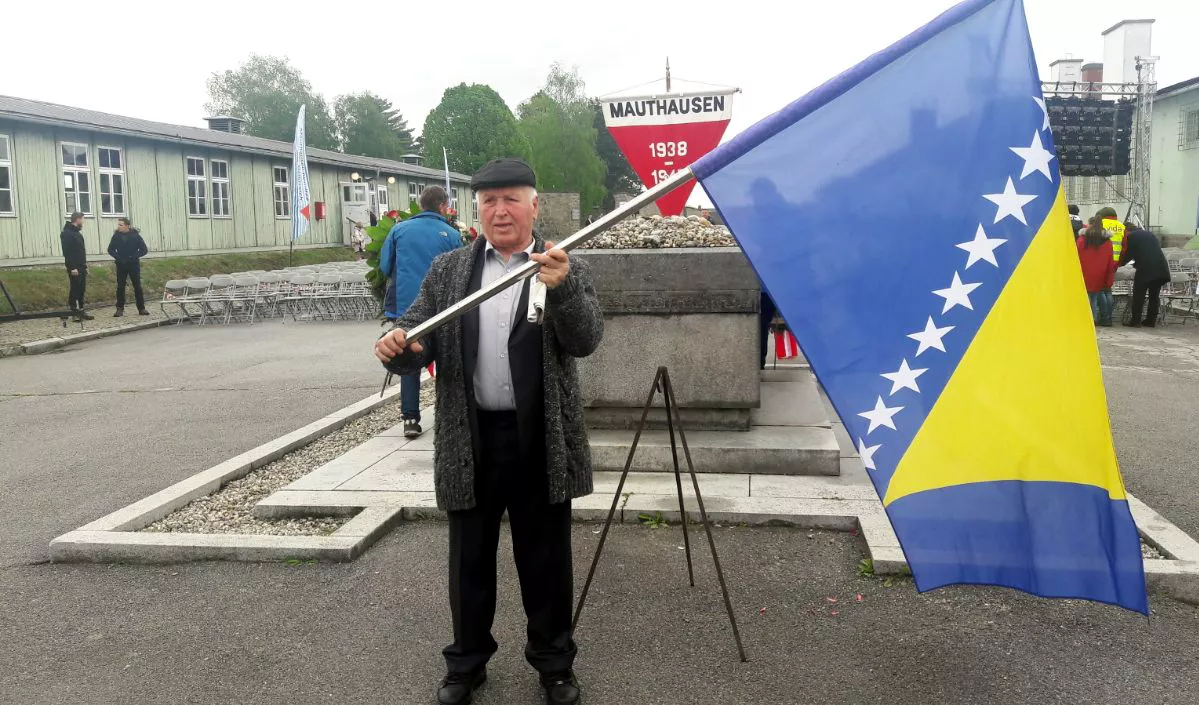
LINZ, (Patria) - A delegation of the Association of Camp Victims from BiH today attended the commemoration of the 74th anniversary of the closure of the Nazi camp Mauthausen in Austria.
The Mauthausen concentration camp was the largest Nazi camp during World War II in the territory of present-day Austria. It was located in Mauthausen, 15 km east of Linz, and existed from August 8, 1938, until its liberation by the US Army on May 5, 1945.
The delegation of the Association of Camp Victims from Bosnia and Herzegovina has been participating in the anniversary commemoration of Mauthausen's closure since 2016, when a memorial plaque for prisoners of war from World War II, originating from Bosnia and Herzegovina, was placed in this camp. It is estimated that several hundred prisoners originating from Bosnia and Herzegovina were held in Mauthausen. Some were killed, while some managed to return home.
The delegation of the Association of Camp Victims from BiH who attended the commemoration of Nazi crimes in Mauthausen this year included six former prisoners who were captured in various camps during the aggression against Bosnia and Herzegovina in the 1990s. They say that today they empathize with every victim, regardless of where they were or when the crime was committed against them, which is why they came to today's commemoration.
Osman Talić (68) spent two years in six camps controlled by the Serb army during the 1990s. He was a leader of the resistance in Sanski Most and one of the key figures in the defense organization of that part of Bosnia and Herzegovina after the attack by Serb forces. The last of the six camps where he was imprisoned was the Manjača camp on the mountain of the same name near Banja Luka. When asked how he views the period of captivity from this distance, Talić says it was his worst life experience. He can count on his fingers the camps where he witnessed death. He saw women killed before his eyes, and even an eight-month-old baby. Because of this, he says, he feels the pain of the victims of Mauthausen, even though those crimes were committed more than 70 years ago.
"Fascists built Mauthausen, but also camps in Bosnia and Herzegovina. I saw killings, torture," Talić told the Patria agency.
"In the camp, they put my hands in boiling water to get some kind of statement from me," says Talić, wanting to draw attention to the magnitude of the crimes committed against him and other prisoners.
Talić says that perhaps a greater defeat in his life was when, in May 1992, he had to mark his house in Sanski Most with a white sheet so that the Serb army would know which houses were inhabited by non-Serbs.
"I felt like I had betrayed my father and grandfather. Today, when I think about it, I would never do it again, even if they killed me."
After leaving the camp and the end of the war, Talić managed to go to the United States of America. He spoke about the suffering and horror he experienced in the camps to students at several American universities.
"America recognized my status as a camp victim, while in my Bosnia and Herzegovina, I do not have that status. I wonder why we were important then, and now we are not. I feel rejected," says Talić.
Nedim Mustačević was 19 years old when he was captured as a member of the Army of RBiH and taken to the Batković camp. He was already in a serious condition, having been wounded previously. His wound healed over months in the camp, during which time he was repeatedly beaten. Standing in front of the sarcophagus of Mauthausen victims, he recalls 9.5 months of suffering in the Batković camp.
"At one point, I weighed only 48 kilograms," Mustačević told a Patria reporter.
"Lice appeared, we had no hygiene conditions whatsoever. We slept on concrete. At one point, there were about 2,500 of us prisoners."
Mustačević is now 47 years old. He recovered for a long time after leaving the camp.
"I try not to think about the camp period," says Mustačević, his gaze lost in the distance. In front of him, numerous world delegations are sending a message that prisoners are not numbers, but people. The young Austrian Chancellor Sebastian Kurz also pays tribute to the victims.
The Association of Camp Victims in Bosnia and Herzegovina brings together 55,000 male and female camp victims who are trying to maintain a culture of remembrance of the horrors they endured in the camps during the war in Bosnia and Herzegovina in the 1990s.
Komentari (0)
Prijavite se za komentiranje
PrijavaJos nema komentara. Budite prvi!
Minuta
Sve →Iz drugih kategorija

High Representative Not Elected: Germans, French and British Against Americans, New Attempt at End of June

ČOVIĆ WITHOUT MERCY: How Those Who Brought Ademović to Office Created a Political Hell for Him



Sunny Saturday, quite warm



Tragedy in Albanian resort: Two minors drown












