
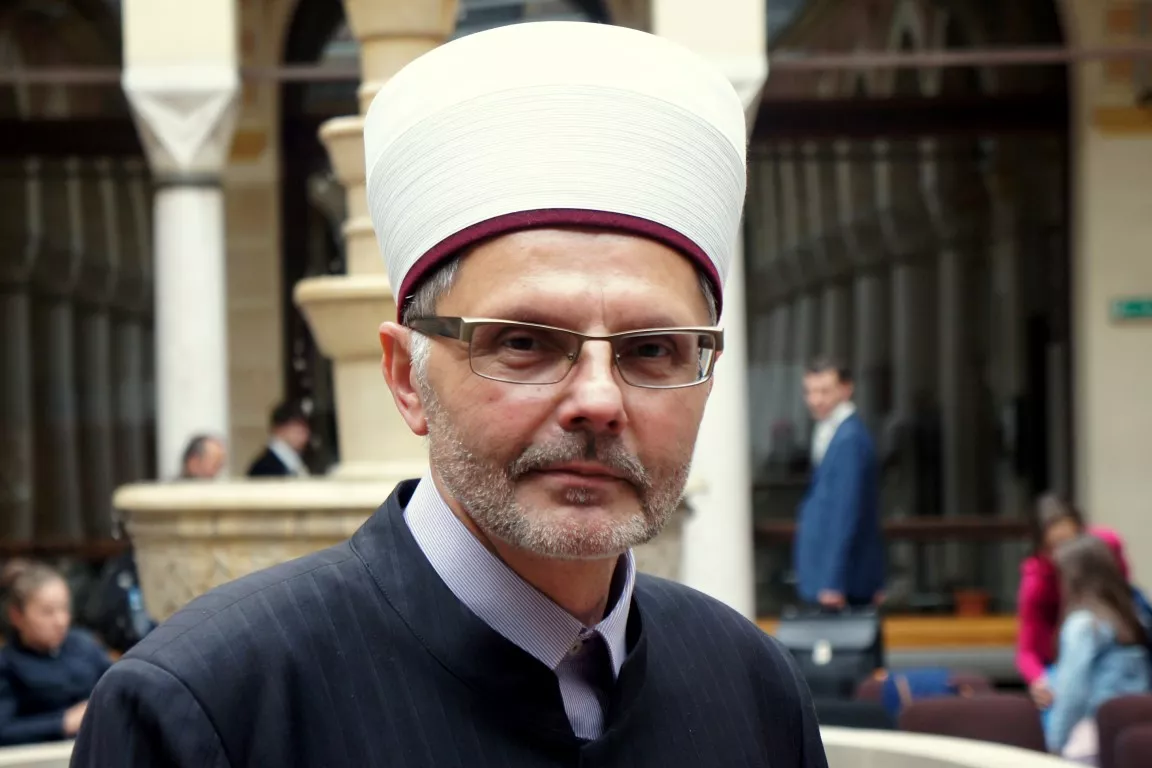
(Patria) - We are publishing the sermon of the Deputy Reis-ul-ulema, Dr. Enes ef. Ljevaković, from the Gazi Husrev-beg Mosque in its entirety.
Praise be to Allah, Lord of the worlds. To Him we give thanks and from Him we seek help and forgiveness. May peace and blessings be upon the last prophet Muhammad, peace be upon him, his noble family, and his esteemed companions.
Dear brothers and sisters!
The Almighty Creator has revealed to mankind in the Quran that He created death and life to test which of you is best in deed: "Exalted is He in whose hand is dominion, and He has power over all things. [He] who created death and life to test you and determine who is best in deed..." (Al-Mulk, 1-2) In Surah Al-Baqarah, Allah (SWT) says: "And We will surely test you with something of fear and hunger and a loss of wealth and lives and fruits, but give good tidings to the patient, who, when disaster strikes them, say, 'Indeed, we belong to Allah, and indeed, to Him we will return.' Those are the ones upon whom are blessings from their Lord and mercy, and it is those who are the guided."
The trials that individuals and societies face, both in good times and bad, are an integral part of life in this world. In light of the aforementioned Quranic verses, we understand the latest great trial that has befallen all of humanity in recent days in the form of the coronavirus pandemic, professionally known as COVID-19. This tiny, invisible creature of God has challenged the entire world: state authorities and all their services, especially medical workers on the front lines, it has challenged mighty armies and security services, scholars and ordinary people, the rich and the poor, forcing responsible factors in society to adopt rigorous measures and restrictions at various levels and intensities. This is a message and a lesson to man that the path of arrogance, violence, injustice, immoderate use of natural resources, the frenzied pursuit of profit, environmental pollution, and the endangerment of the Earth's ecosystem does not lead to good, and that it will eventually backfire on him in one way or another. The Almighty warns of such human behavior in Surah Al-Alaq:
"Indeed, man transgresses when he sees himself as self-sufficient. Indeed, to your Lord is the return." Some analysts predict that another pandemic could follow this virus pandemic, a pandemic of economic recession and the social problems it brings. This current pandemic, as well as the one announced as its consequence in the form of a global economic crisis and recession, vividly show how interconnected the world is, how intertwined and networked the interests and economies of states are, and how dependent they are on each other. The behavior of great and powerful nations after the virus pandemic will show whether the world has learned a lesson from this crisis and whether it will turn to true common values that make the world better, more moral, more just, more compassionate, or whether it will turn to new conflicts, polarizations, and rivalries, whose victims will be weaker states and their already poor and suffering peoples.
Brothers and sisters,
The isolation and restriction measures regarding direct social contact, adopted by the competent state authorities, are difficult but not unbearable. They are mainly undertaken to protect human life and health. It is up to all of us to adhere to them with utmost responsibility, wholeheartedly, and with discipline, thereby contributing to the suppression and prevention of the spread of infection and thus saving many lives. In times of infection, epidemic, and pandemic, an infected person, or one who suspects infection or has symptoms of infection, will show a high degree of responsibility, love, consideration, and care for others, especially for people in risk groups, for family, for the community, and for society as a whole, by self-isolating from them at a safe physical distance, in accordance with the adopted rules, instructions, and recommendations. Besides being a legal obligation, it is also our moral and religious duty. The Almighty Creator says: "...and whoever saves one [a life], it is as if he had saved mankind entirely..." (Al-Ma'idah, 32) It is very important that we persevere to the end in applying these self-protection and self-control measures, that we do not falter halfway and thus endanger the efforts and successes achieved so far in the fight against the infection.
In addition to suppressing and preventing infection, the aforementioned measures and restrictions have other benefits. It is an opportunity for us to dedicate more time to ourselves, our families, to re-evaluate our life priorities in the solitude and quiet of our homes, to reflect on the values that guide our actions. Let us illuminate our homes with prayer, recitation of the Quran, remembrance of God (dhikr), supplications (duas), and other good deeds and acts of kindness.
The adopted measures and restrictions have brought about changes not only in our individual, family, and social lives, but have also directly affected our religious life, the community (džemat), and society as a whole. It is certainly difficult for sincere believers not to pray in congregation at the mosque, especially the Friday prayer, but also the absence of other religious events, gatherings, and meetings. The measures, instructions, and recommendations issued by our Islamic Community regarding the organization of religious rites and activities are identical or very similar to the measures taken by competent Islamic institutions in Muslim countries and communities around the world. The common goal is to contribute to the fight against the spread of infection and to protect human lives and health. However, if the virus has separated our bodies from the mosque and the community by force of circumstance, it has not and must not separate our hearts and souls from them. In this time of forced physical distance from the mosque and the community, let us strengthen our spiritual and heartfelt connection to them. The Prophet of God, Muhammad (peace be upon him), in a famous hadith about the seven types of people whom Allah will shade on the Day when there is no shade but His, mentions a person whose heart is attached to the mosque. Among them is a just ruler, then a person who gives charity discreetly so that his left hand does not know what his right hand gives, and a person who remembers Allah in solitude and his eyes overflow with tears. The time of crisis and measures of isolation and self-isolation is a good opportunity to achieve the levels mentioned in the aforementioned hadith narrated by Abu Hurayrah. Therefore, even in times of forced physical separation from the mosque and the community, a believer, through their heartfelt connection to the mosque and worship in their home, can achieve closeness to God and His pleasure. Allah (SWT) in Surah At-Tawbah speaks about the deeds by which mosques are maintained: "Only he who believes in Allah and the Last Day and establishes prayer and gives zakah and does not fear except Allah has [truly] maintained Allah's mosques. Those, it is hoped, will be among the guided."
Brothers and sisters,
In this time of trial and hardship, we must not forget those in need, the poor and the helpless. Let us remember the words of the Prophet (peace be upon him) that Allah helps a person as long as he helps other people. We call upon responsible officials at all levels to work together on projects of interest to all citizens, to alleviate hardships and solve pressing problems in society, and to refrain from populist statements and seeking cheap political points.
Regardless of all the difficulties and trials, we welcome the month of Ramadan with joy and hope for better days. We hope that the light of this blessed month, the worship of fasting, prayer, recitation of the Quran, Sadaqat al-Fitr, and Zakat will bring a new atmosphere and joy to our hearts and homes. It will be a unique Ramadan experience in very specific circumstances. Let us always keep in mind the words of our Lord: "For indeed, with hardship [will be] ease. Indeed, with hardship [will be] ease."
We ask Almighty Allah to ease our burdens, to remove the affliction that has befallen us, to grant His forgiveness and mercy to the deceased, health to the sick, sustenance to the poor, ease of travel to travelers, and wisdom and prudence to those in responsible positions when making decisions.
Our Lord, let not our hearts deviate after You have guided them and grant us from Yourself mercy. Indeed, You are the Bestower. Our Lord, indeed You will gather the people for the Day about which there is no doubt. Indeed, Allah does not fail in [His] promise. (Ali 'Imran, 8-9.)
Grant us good in this world and good in the Hereafter and protect us from the punishment of the Fire. Our Lord, protect us from severe illness and great trials."
Komentari (0)
Prijavite se za komentiranje
PrijavaJos nema komentara. Budite prvi!
Minuta
Sve →Iz drugih kategorija

High Representative Not Elected: Germans, French and British Against Americans, New Attempt at End of June

ČOVIĆ WITHOUT MERCY: How Those Who Brought Ademović to Office Created a Political Hell for Him



Sunny Saturday, quite warm



Tragedy in Albanian resort: Two minors drown












