
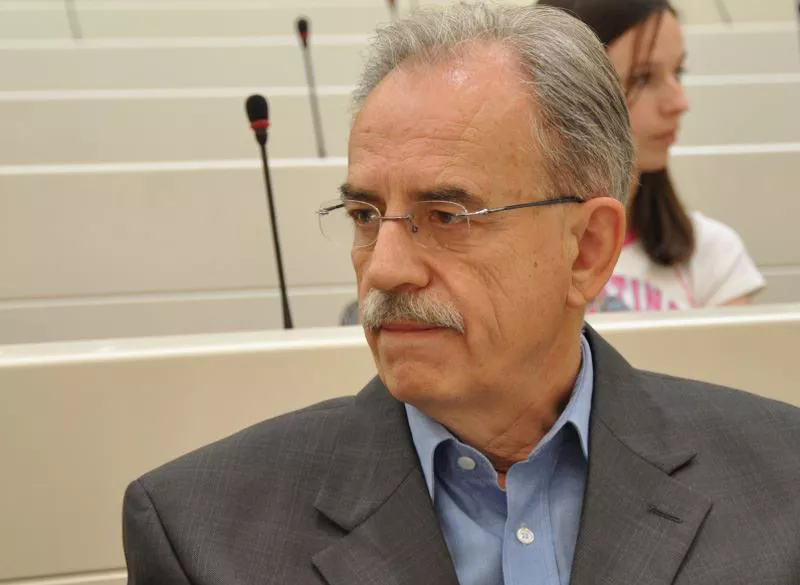
Mehmed Halilović, Deputy Ombudsman of the Federation of BiH for Media and an expert in media law and legislation, wrote a text titled "Čaušević, Špirić and Patria" which the Bosnian news agency Patria is publishing.
Kemal Čaušević could be the “star of court proceedings” this year, both criminal and civil, for defamation. What is the role of the media in this affair and what are the possible consequences for the media?
The man remembered for his statement “This is the happiest day of my life,” given at the moment when investigators arrested him and took him to pre-trial detention, will, by all accounts, pass on that “happiness” to many figures in our “high society.” During the months-long investigation, Kemal Čaušević revealed to prosecutors and investigators numerous accomplices in the criminal acts he is suspected of committing while he was director of the Indirect Taxation Authority of BiH.
But Kemal Čaušević could also bring upon himself and others additional court proceedings he probably did not count on. Not criminal ones this time. Civil ones. For defamation. As Slobodna Bosna reported on March 12, Nikola Špirić has already sued Kemal Čaušević over statements he made during the investigation and the news agency Patria, which published them. There may be more defamation lawsuits. Dragan Čović has announced in several interviews that his lawyers are also advising him to proceed in the same manner...
The subject of this analysis, however, is not the criminal proceedings that may eventually follow against Čaušević and others for alleged crimes worth several hundred million marks. It is not even the fact that transcripts of his interrogation reached the public before the investigation was completed. The subject of this analysis is the media side of the case. Thus, the role of the media in this affair and the consequences for the media.
As is known, the news agency Patria exclusively published the statements of the suspected former director of the Indirect Taxation Authority, which, of course with prominent headlines, was relayed by most traditional and online media. Some with their own comments.
Let us start with the defamation lawsuits filed by Nikola Špirić. What are his chances of winning a damages lawsuit against Kemal Čaušević and the agency Patria?
The shortest answer is – minimal. As a person with the status of a suspect in criminal proceedings, because the investigation is also part of the criminal/judicial process, Čaušević has the right to immunity like other participants in the proceedings. However, if his statements are based on false information and cause harm to other individuals, he could also be held liable for defamation. How and when? Of course, that would be in a civil proceeding, if one occurs. And, of course, after the conclusion of the criminal proceedings.
On the other hand, the Law on Protection against Defamation also protects media reporting on judicial (as well as legislative and administrative/executive) proceedings, Article 7(b). True, this law (ZZK) emphasizes that “there is no liability for defamation if the tortfeasor (the term refers to the media, author's note) is legally obliged to present or disseminate the expression...”. In the case of a defamation lawsuit, the agency Patria can therefore invoke the role of the media, the obligation to inform the public, and the fact that it published an authentic document.
So much for defamation. As the ZZK stipulates, in such a case there is no liability for defamation. Of course, this would not be an automatic release from liability, but a matter of proof in court proceedings.
A defamation trial, therefore, would not be an insurmountable problem for either Čaušević or Patria. For this news agency, a bigger problem could arise if the question of criminal liability is raised. Why?
Namely, investigation transcripts are marked as official secrets, whose protection is regulated by laws and protected in every country. However, publishing documents marked as official or other levels of secrecy in the media is not uncommon in the world. Just as cases of criminal liability and court proceedings against journalists and media are not uncommon.
How is this regulated in Bosnia and Herzegovina? The Criminal Codes in this country (BiH has a total of four – state, two entity, and a special law in Brčko District) prescribe the criminal offense of disclosing secret data by a person “authorized to determine the secrecy of data or to access secret data” (Article 164, paragraph 1 of the BiH Criminal Code). This therefore limits liability only to officials who have control over secret data.
But already in the next paragraph, the Criminal Code expands the circle of possible liability to any person who “discloses or delivers to another person, or mediates in the disclosure or delivery of data or a document for which they know it is a state secret, and which they have obtained unlawfully...”.
Such a definition can practically include any person who unlawfully obtains some data they know has been declared secret. For this criminal offense to exist, therefore, two conditions must be met: first, that the perpetrator knows the data or documents are secret, and second, that they obtained that data or documents unlawfully.
Such a formulation in principle excludes journalists, unless they obtained secret data unlawfully. Criminal laws around the world have similar standards. But in practice, even in democratic countries, affairs involving the publication of secret documents break over the backs of journalists. Namely, prosecutors often accuse journalists of obtaining them illegally. To defend themselves, journalists are forced to reveal their sources. This is, of course, contrary to the fundamental principle of criminal law regarding the presumption of innocence of the accused and contrary to the democratic standard of non-disclosure of sources. And this, of course, makes investigative journalism impossible.
The European Court of Human Rights has issued several judgments of this kind and in most cases has defended the media in cases where there is a public interest and where public debate is already underway. In the case „Bluf! v. The Netherlands,“ the European Court concluded that the Dutch authorities had no justified reason for seizing the newspaper (Bluf!) due to the publication of information relevant to national security, since that information was “already published and distributed” and the protection of that information “is no longer justified in a democratic society.”
The case (Weber v. Switzerland) has similarities with the case of the news agency Patria.
Namely, in 1990, the European Court ruled that a court in Switzerland violated Article 10 of the European Convention on Human Rights because “it was an interference with freedom of expression that was not necessary in a democratic society” to achieve a legitimate aim (protection of information about a judicial investigation). The European Court concluded that this information had already been disclosed and that, therefore, there was no longer an interest in keeping it secret. Can the same approach be applied in the case of the agency Patria?
Komentari (0)
Prijavite se za komentiranje
PrijavaJos nema komentara. Budite prvi!
Minuta
Sve →Iz drugih kategorija

High Representative Not Elected: Germans, French and British Against Americans, New Attempt at End of June

ČOVIĆ WITHOUT MERCY: How Those Who Brought Ademović to Office Created a Political Hell for Him



Sunny Saturday, quite warm



Tragedy in Albanian resort: Two minors drown












