
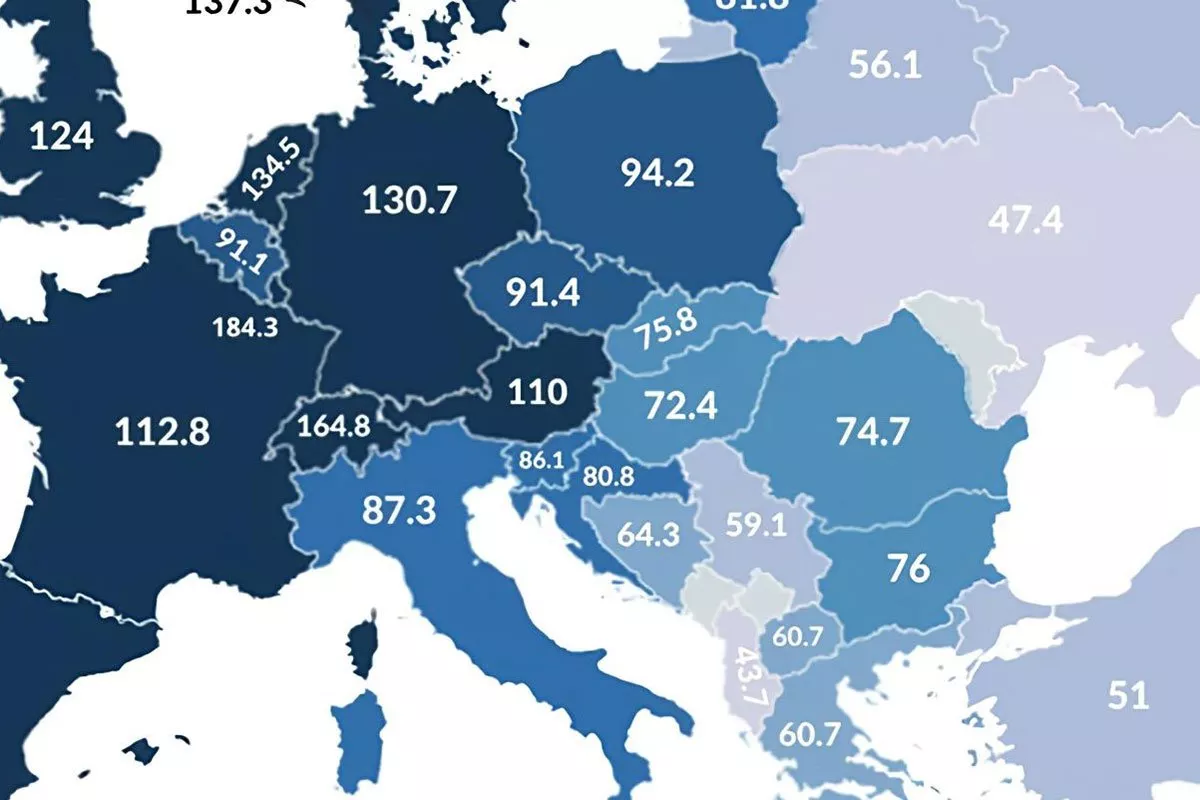
(Patria) - A map of Europe based on purchasing power parity (PPP) analyses has been published, showing where salaries cover basic costs.
The countries with the highest purchasing power index are:
Luxembourg – around 180
Switzerland – over 160
Denmark – over 130
Norway, Sweden, Finland – over 120
What does purchasing power mean?
Purchasing power is not just an economic indicator; it directly determines the quality of life.
According to the definition of the OECD and the World Bank, it shows how many goods and services citizens can afford with their income, taking into account domestic prices.
The difference between an index of 130 and 60 is not just a statistic; it is the difference between living with financial security and living where every expense is carefully measured.
This map was analyzed by the Statista platform and refers to the previous year.
Thus, the countries of Northern Europe continue to hold the top spot in purchasing power.
Norway, Sweden, and Finland have an index above 120, while Denmark exceeds even 130.
However, the absolute leaders are small but extremely wealthy economies like Luxembourg (180) and Switzerland (over 160).
According to analyses by the OECD and the World Bank, these countries have a standard far above the European average.
Economists point out that these countries have a key advantage: high productivity, strong institutions, and stable labor markets, which allow for real wage growth despite inflation.
Countries like France (around 112) and Great Britain (124), although still considered developed parts of Europe, are experiencing stagnation in purchasing power.
This is mainly due to Eurostat data, which indicates that inflation in these countries in recent years has "eaten away" at wage growth, particularly in the energy and food sectors.
Spain has an index just above 100, while Portugal, with around 60, shows how real standards can vary even within the European Union.
The Czech Republic and Poland are close to an index of 100, while Romania and Bulgaria, with an index slightly above 70, still lag behind, although the differences have narrowed in the last decade.
When it comes to the Balkans, the best indices are held by Slovenia (86) and Croatia (80.8).
Bosnia and Herzegovina has an index of 64.3, which is among the worst ratings in Europe.
However, Serbia is worse off with an index of 59.1, North Macedonia and Greece at 60.7, and Albania has by far the lowest index at 43.7.
Komentari (0)
Prijavite se za komentiranje
PrijavaJos nema komentara. Budite prvi!
Minuta
Sve →Iz drugih kategorija

High Representative Not Elected: Germans, French and British Against Americans, New Attempt at End of June

ČOVIĆ WITHOUT MERCY: How Those Who Brought Ademović to Office Created a Political Hell for Him



Sunny Saturday, quite warm



Tragedy in Albanian resort: Two minors drown












