
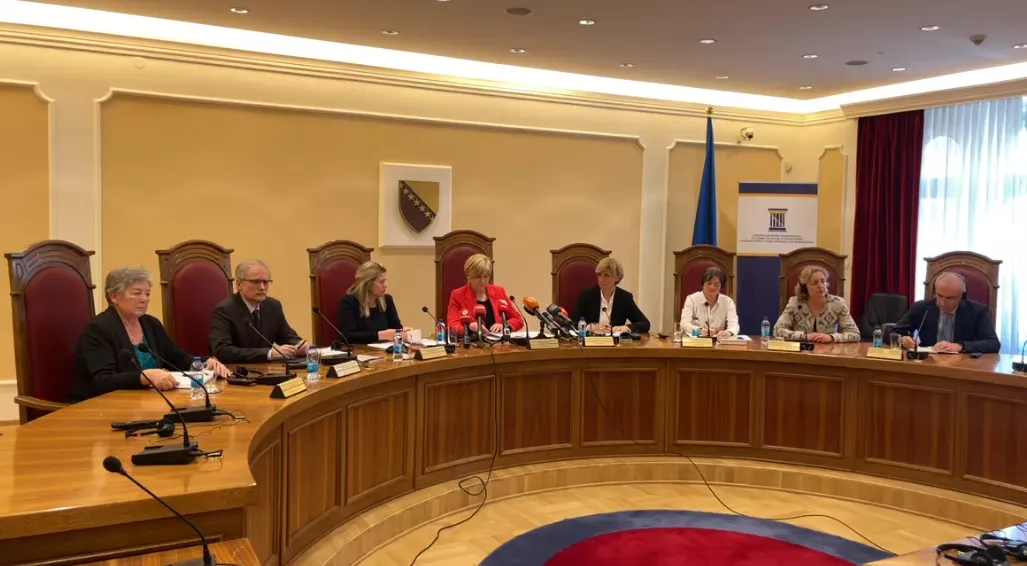
(Patria) - Valerija Galić, President of the Constitutional Court of Bosnia and Herzegovina, said at today's press conference that the Constitutional Court worked under specific circumstances during 2023.
She recalled that in November 2022, two judges' terms expired due to retirement.
"Both positions have not been filled, although the competent legislative bodies were notified in time. In the meantime, pressure was exerted on another colleague to leave the Constitutional Court, and he went into early retirement in January. The work of the Constitutional Court in the Grand Chamber, which consists of six domestic judges, has been made impossible, and a quorum requires five judges. The Grand Chamber decided on the largest number of cases within the Court's appellate jurisdiction. At plenary sessions, cases of constitutionality review and a very small number of appeals were resolved. For 17 months, the Court has been able to decide exclusively in plenary sessions, which consist of three domestic and three international judges," Galić said.
She pointed out that the most numerous cases are appellate cases in which legal and natural persons turn to the Court when they believe their rights have been violated in lower courts.
In 2023, 5,397 cases were received, and 8,188 cases remained unresolved. The Court issued 59 decisions on interim measures.
"The number of cases received in 2023 is 5,497 and remained at the average level of the previous five years. The number of completed cases is 1,510 and is lower than the five-year average. The number of unresolved cases is continuously increasing. Despite the difficulties, the Court continued to work and adapted its work organization to new needs. The Court has drafts for more than 4,000 cases. The pace of their submission to sessions depends on the pace of translation," Galić said.
Galić said that the Venice Commission adopted an opinion on March 15 expressing deep concern over the fact that the Constitutional Court is not functioning at full capacity.
"We must react very quickly and take measures we deem necessary," Galić said.
The Vice President of the Constitutional Court of Bosnia and Herzegovina, Mirsad Ćeman, said that the Constitutional Court is defined as a special, independent, and autonomous authority.
"As such, it is the guardian of the Constitution and a corrective to other branches of government within the framework of the competencies prescribed by the constitution. It is the obligation of institutions in Bosnia and Herzegovina to respect the principles of the constitution, including the independence and autonomy of the Constitutional Court. To a certain extent, there are behaviors, whether legislative or executive, that call into question the position of the Constitutional Court. This happens when certain bodies are given competencies that jeopardize the autonomy of this Court.
The Constitutional Court periodically monitors the execution of its decisions. Decisions not only of the Constitutional Court of Bosnia and Herzegovina but of any court should be respected. If this does not happen, then we have what is called in legal theory 'naked law.' It does not contribute to the rule of law if decisions of the Constitutional Court and other courts are not implemented," Ćeman said.
Judge Helen Keller said she speaks on behalf of her other colleagues.
"I speak in my capacity as one of the Vice Presidents of the Constitutional Court. The situation should concern us all. If the highest court in the country becomes non-functional, the rule of law will be endangered. The attack on the judiciary in Bosnia and Herzegovina follows a global trend, and it means that the law can no longer be enforced. If the Constitution of Bosnia and Herzegovina is protected by the Constitutional Court, only then can the citizens of this country be protected. Attacks on the judiciary always come from circles that want to destabilize the country. Destabilization always happens at the expense of weak and democratic forces. In December last year, the RS requested that the three of us judges step down from our positions. Had we done so, the Constitutional Court would have immediately become incapable of functioning. Our mandate is the mandate provided for in the Constitution of Bosnia and Herzegovina. Bosnia and Herzegovina is a constitutional democracy. We will continue to fulfill our mandate, and the Constitution will remain firm. We are loyal to the Constitution of Bosnia and Herzegovina.
The problem of not appointing judges means that we must be involved in all decisions, and that is an enormous workload. The Constitution clearly stipulates that two-thirds of the judges come from Bosnia and Herzegovina, and only one-third from international countries that are not neighboring.
Three domestic judges and three international judges bring the Constitutional Court far from the position that was envisaged by the Constitution. We are in an imbalance that brings the Court to the brink of being unable to work. The political blockade must stop," Keller said.
Seada Palavrić said that the Constitution is the key foundation of the state.
"The Constitutional Court is the guardian of that constitution, and that is a problem for someone. We have two problems that hinder the Constitutional Court from guarding that Constitution. One is the attack on international judges, and the other is the lack of will to elect domestic judges. When it comes to international judges, this Court is so fortunate that, according to the Constitution itself, it has international judges and that they have transferred to us the practice of the European Court of Human Rights. This is one of the best courts in its decisions, and the international judges have made a great contribution. They have accepted what few would accept. They were supposed to work on constitutionality reviews and the most complex appeals, but now they have to do everything every month," Palavrić said.
She recalled that her term expires in November because she turns 70, but that she will try to change the Rules so that she can remain in the Constitutional Court even after turning 70, because it must not be allowed for the Court to be left with five judges or not to work at all, which is also a recommendation of the Venice Commission.
"It is certain that the Constitutional Court will consider this issue," Galić said.
Speaking about the Božo Ljubić case, Galić said it is listed as unresolved.
"The Constitutional Court of Bosnia and Herzegovina concluded, given that the High Representative adopted amendments to the Constitution and the Election Law, that the Constitutional Court will conduct a detailed analysis of whether and in what form that decision has been implemented, and we will inform both the public and the Prosecutor's Office of Bosnia and Herzegovina. This requires time, but we now have priority activities and cases that we must resolve," Galić said.
President Galić said that the Parliamentary Assembly of Bosnia and Herzegovina can only change the method of appointing foreign judges to Bosnia and Herzegovina.
"The Constitutional Court does not decide territorially or by entity. We all act in our personal capacity, not as the entity that elected us. We must act professionally; we are the guardians of the Constitution and must act in the best possible way," Galić said.
Palavrić added that she will do her best to amend the Rules of the Constitutional Court so that a judge remains even after the age of 70 until his or her replacement is elected.
"Our constitution does not have a prohibition over 70. I would be happy if by November they elect all the missing judges and we can retire," Palavrić said.
Komentari (0)
Prijavite se za komentiranje
PrijavaJos nema komentara. Budite prvi!
Minuta
Sve →Iz drugih kategorija

High Representative Not Elected: Germans, French and British Against Americans, New Attempt at End of June

ČOVIĆ WITHOUT MERCY: How Those Who Brought Ademović to Office Created a Political Hell for Him



Sunny Saturday, quite warm



Tragedy in Albanian resort: Two minors drown












