
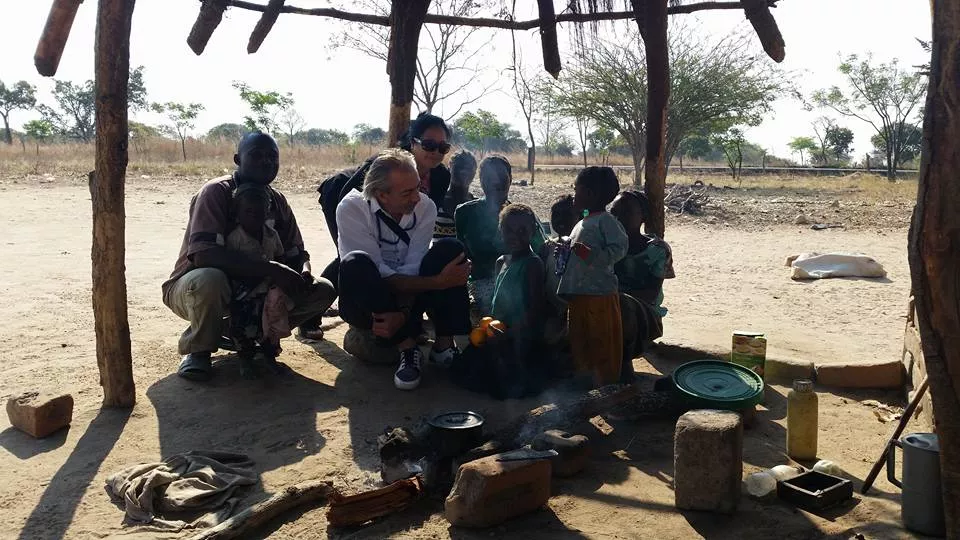
It's nice to return to one's homeland. Every new return reminds me that we are still part of the developed world – says Dr. Nihad Fejzić, Dean of the Faculty of Veterinary Medicine in Sarajevo, who returned to Bosnia and Herzegovina from Zambia a few days ago.
The Bosnian expert in veterinary medicine has been traveling to the African continent for several years, helping local countries elevate veterinary science to a higher level.
Professor Fejzić provided the Patria news agency with several photographs he took during his stay in Zambia, which more than anything else indicate that Bosnia and Herzegovina is a country with a thousand opportunities, but unfortunately we are not using the chance given to us.

- In the past few days, I met this one-and-a-half-year-old girl. She is the sixth child of an average farming family from southern Africa, from Zambia. Her father is only 28 years old and already has six daughters, the oldest of whom is 11. He is a day laborer on a nearby cattle farm, about twenty kilometers from the famous Victoria Falls. Their home is the open sky, only the bedroom has walls. It is the size of our bathrooms and has no electricity or water. In front is a rusty bucket where they store water for use.

Given that Zambia was an English colony until 1964, knowledge of English among the elderly is not uncommon. However, the children do not speak it yet. School is a dream for them, and I hope they will have the opportunity to attend. Still, they are happy, modest, and cordial. That day when we visited them, they were cooking corn porridge for lunch. There was enough left over for travelers passing through. And it was a wonderful, warm, and fulfilling day for me. I will return to them again next year.
Such families make up slightly less than two-thirds of Zambia, as many live from agriculture. It is a treasure trove of copper and cobalt, whose export has economically revived the country, with its GDP estimated at 1,700 US dollars over the last decade. Like neighboring Congo, they have no oil, nor access to the sea, but in southern Africa they are among the largest growers of tomatoes and meat. Still, their brand is tourism. The entire country lives off attractive safaris. While traveling, along the road, you will notice elephants, lions, giraffes…
Lusaka is the capital city, and more than 70 ethnic groups live there, most commonly speaking Bantu languages.
They have no national divisions, but they have major problems with unresolved infrastructure and electricity, with the things that make life easier.
Two-thirds of the population are Christians, mostly Catholics, and the rest are Muslims.
And as I return home, on the way I read the book "The First 50 Years of Zambia's Independence," a precious gift, and I notice a critical review of the former Yugoslavia, which through one of its companies tried to implement the TiKa program (Tito – Kaunda 'the president who, after independence, formed a one-party system and carried out nationalization and who failed') - says Professor Fejzić.
Perhaps, he adds, those little girls from the beginning of the story would be in a situation to have a dream, even under the open sky. Their parents might have it, they hope, they are not depressed or narrow-minded, they believe in a better tomorrow. Much more than we do in the developed world.
Komentari (0)
Prijavite se za komentiranje
PrijavaJos nema komentara. Budite prvi!
Minuta
Sve →Iz drugih kategorija

High Representative Not Elected: Germans, French and British Sabotaged Americans, New Attempt at End of June

ČOVIĆ WITHOUT MERCY: How Those Who Brought Ademović to Office Created a Political Hell for Him



Sunny Saturday, quite warm



Tragedy in Albanian resort: Two minors drown












