
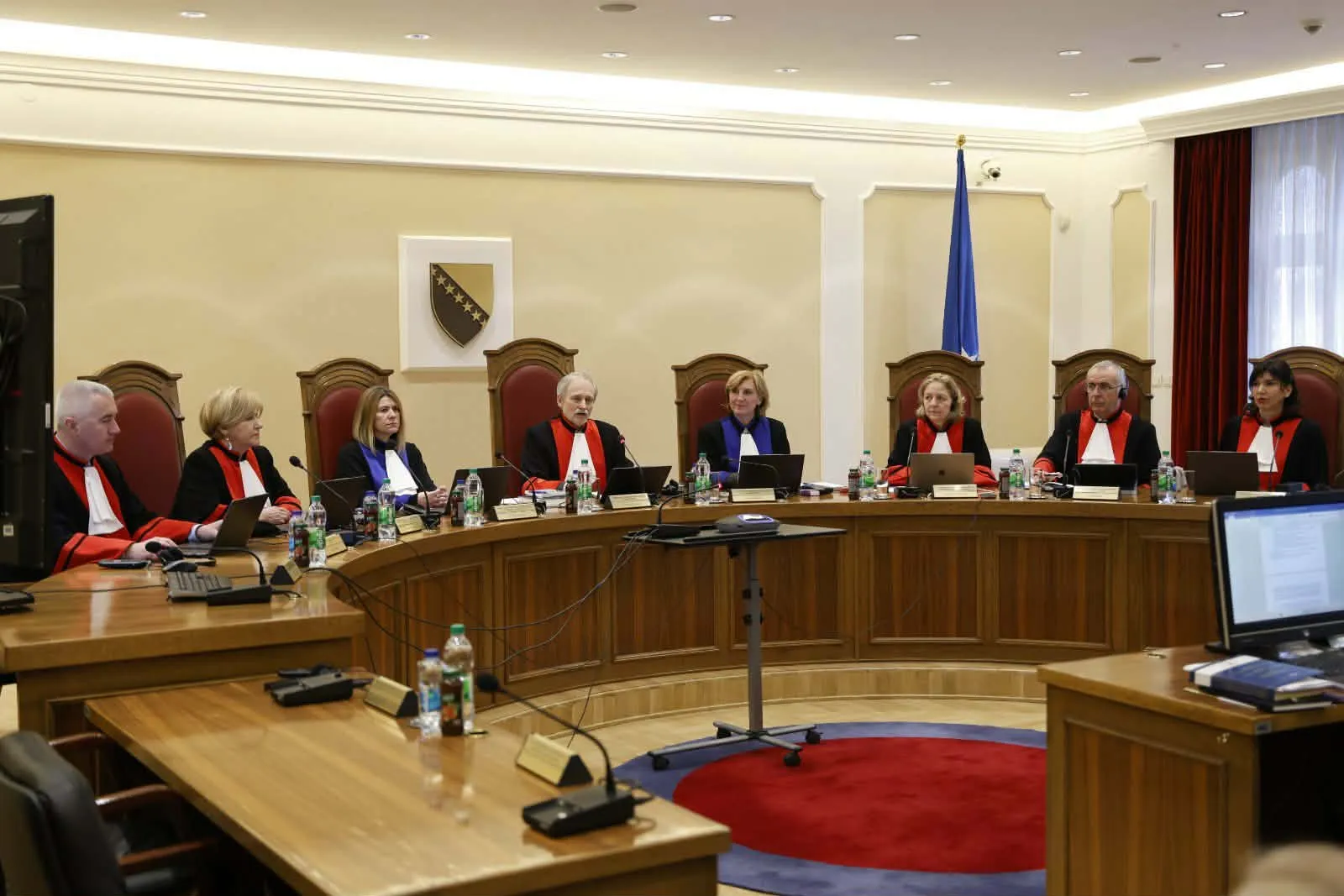
(Patria) - There is still no information on when the appointment of two judges of the Constitutional Court of BiH could be on the agenda of the House of Representatives of the Parliament of the Federation of BiH.
The working group for the selection of judges of the Constitutional Court of Bosnia and Herzegovina completed the evaluation of candidates on May 21. Representatives of the Troika and the HDZ placed Dženeta Omerdić and Katica Artuković in the first two positions on the candidate list. In third place is Ivan Matešić, while Faris Vehabović is in fourth.
The list was forwarded to the Commission for Elections and Appointments of the House of Representatives of the Parliament of the FBiH, chaired by Mladen Bošković from the HDZ, and Bošković is also the chairman of the Working Group that evaluates candidates. Besides him, the Working Group consists of members Senad Subašić (SDP), Irfan Durić (NES and PDA), Mustafa Šabić, and Joko Radić. Regarding the Commission for Elections and Appointments, out of 11 members, only one comes from the opposition, namely Asim Kamber (SDA).
At this moment, it is still unknown whether the Commission for Elections and Appointments will send the entire list of successful candidates or will forward only the two names agreed upon by the coalition partners. Given the fragile majority in the House of Representatives of the Parliament of the FBiH, which was also demonstrated at the emergency session where the vote was held on the Proposal of the Law on the Procedure of Extraordinary Administration in the company Nova Željezara Zenica d.o.o. Zenica of special systemic importance for the Federation of BiH, which was adopted with the help of votes from the opposition SDA and DF, it is possible that the entire process will be prolonged.
Omerdić is currently in the position of advisor to the Chairman of the Presidency of BiH, Denis Bećirović, while she has permanent employment as a full professor at the Faculty of Law of the University of Tuzla.
Artuković is the president of the Cantonal Court in Široki Brijeg, and before 2017 she was employed at the Municipal Court in Ljubuški.
Regarding Ivan Matešić, he has been a prosecutor at the Prosecutor's Office of BiH since 2013 and is the head of the War Crimes Department.
Vehabović is a long-time judge of the European Court of Human Rights in Strasbourg. Previously, he was a judge at the Constitutional Court of the Federation of BiH, and from 2001 to 2007 he worked as the registrar of the Constitutional Court of BiH.
We remind you that the process of selecting two judges was initiated because judge Mirsad Ćeman turned 70 last year, while judge Valerija Galić will turn 70 on October 13.
In 2024, the House of Representatives elected Marin Vukoja to the Constitutional Court of BiH, and his name was the only one sent by the Commission to the Parliament at the request of the HDZ. A year later, Larisa Velić was elected as a judge of the Constitutional Court of BiH.
State representative Šemsudin Mehhmedović sent a letter to federal deputies reminding them that the appointment of judges of the Constitutional Court of Bosnia and Herzegovina must be in accordance with the constitutional principle of proportional representation of officials in the institutions of Bosnia and Herzegovina.
The Constitution of Bosnia and Herzegovina, in Article IX, paragraph 3, clearly established the following: "Officials appointed to positions in the institutions of Bosnia and Herzegovina shall, as a rule, reflect the composition of the peoples of Bosnia and Herzegovina."
"Also, in the decision of the Constitutional Court of Bosnia and Herzegovina in case U-23-14-1058444, known as the 'Ljubić' case from December 2016, it is stated: 'From the aforementioned provisions of the Constitution of Bosnia and Herzegovina, it follows that the constituent authority established proportional representation of Bosniaks, Serbs, and Croats as constituent peoples in the institutions of Bosnia and Herzegovina' (p. 21). Respect for the Constitution of Bosnia and Herzegovina is an imperative from which there must be no deviation. I remind you that the Constitutional Court of Bosnia and Herzegovina has established that constitutiveness is the overarching principle of the Constitution of Bosnia and Herzegovina, to which the entities must fully comply. In this context, I wish to point out the fact that Bosniaks in the institutions of the Republika Srpska are employed at the level of a statistical error, although according to the last census, 14% of them live in the Republika Srpska. For comparison, 15% of Croats live in Bosnia and Herzegovina and practically govern the state and the Federation of Bosnia and Herzegovina, while 14% of Bosniaks in the RS are almost non-existent in the entity, city, and municipal institutions of the smaller entity.
Bosniaks are not in a much better position in the Federation of Bosnia and Herzegovina either, where brutal apartheid is being carried out against them in all municipalities where the HDZ has a majority, because proportionality is absolutely not applied in Stolac, Čapljina, Žepče, Livno, Kiseljak, etc. 22% of Croats live in the Federation, but many more than that percentage are employed in federal government bodies, holding ministerial and numerous director positions in institutions that manage huge budgets.
At the same time, 40% of Bosniaks live in Stolac, but only 4% are employed in the public sector. Not a single director or deputy director of a municipal service or institution in this city is a Bosniak.
At the state level, the representation of Bosniaks in the institutions of Bosnia and Herzegovina is significantly lower than the number established by law, because more than 800 Bosniaks are missing from institutions, and in managerial and higher-ranking positions, this representation is catastrophic.
Imagine what kind of majorization it is when Croats at the state level have twice as many director positions as Bosniaks, while Bosniaks finance the state budget three times more than Croats? 50% of Bosniaks and 15% of Croats live in Bosnia and Herzegovina, so such a proportional ratio of Bosniaks and Croats must be present in all official positions in the institutions of Bosnia and Herzegovina, including the Constitutional Court of Bosnia and Herzegovina.
No party agreement can or should be above the constitutional provisions on proportional representation of constituent peoples in the institutions of Bosnia and Herzegovina. Finally, I wish to call upon you, as deputies in the House of Representatives of the Parliament of the Federation, to strictly respect the constitutional provisions on proportional representation of officials in the institutions of Bosnia and Herzegovina when appointing two judges to the Constitutional Court of Bosnia and Herzegovina," the letter from Mehmedović states.
Mehmedović provided the deputies with an overview of appointed directors in the institutions of Bosnia and Herzegovina over the last three years, as a glaring example of discrimination against Bosniaks.
Komentari (0)
Prijavite se za komentiranje
PrijavaJos nema komentara. Budite prvi!
Minuta
Sve →Iz drugih kategorija

High Representative Not Elected: Germans, French and British Against Americans, New Attempt at End of June

ČOVIĆ WITHOUT MERCY: How Those Who Brought Ademović to Office Created a Political Hell for Him



Sunny Saturday, quite warm



Tragedy in Albanian resort: Two minors drown












