
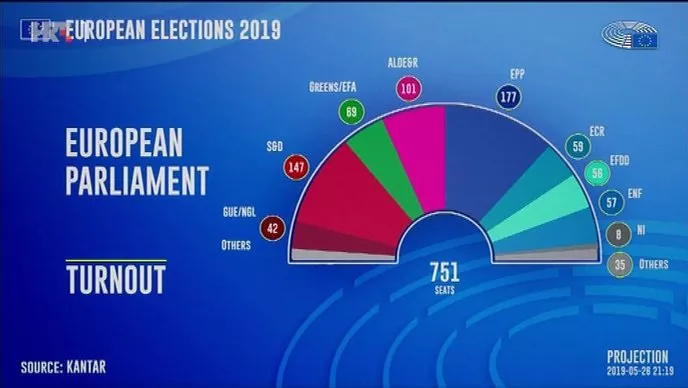
(Patria) - According to projections for the future composition of the European Parliament, right-wing and center-left parties have less support compared to the current composition, while the Greens, liberals, and far-right parties are showing significant growth.
The European People's Party remains the strongest with 170 seats, but with 46 fewer seats than before, and the Socialists are second with 147 seats, 40 fewer seats than in the current composition, according to polls in 11 countries.
Liberals, along with MEPs from French President Emmanuel Macron's list, are expected to have 103 seats, 34 more seats. Europe of Nations and Freedom, which includes Matteo Salvini's League, would have 71 seats, 35 more seats. European Conservatives and Reformists, which previously included the most MEPs from the British Conservative Party, would have 59 seats, 18 fewer seats. The current parliamentary group Europe of Freedom and Direct Democracy, which includes Italy's anti-establishment Five Star Movement and Nigel Farage's Brexit Party, would have 48 seats, six more than before.
The European United Left–Nordic Green Left (GUE) would get 46 seats, six fewer than before.
The National Rally (RN), Marine Le Pen's far-right party, won the most votes in France in the European Parliament elections, according to two exit polls. An Elabe agency poll published the results and predicts that Le Pen's party will get 24 MEPs, and Macron's 23.
As in Germany, where according to polls they won 22% of the votes, in France the surprise of the elections are the Greens, who according to IFOP won 13% of the votes. They are followed by the Republicans with 8%, the far-left La France Insoumise with 6.3%, and the Socialists with 6.5% of the votes, according to that poll.
Hungary's ruling Fidesz party could win 56% of the votes in the European Parliament elections, Hungarian state television reported, citing a poll by the pro-government Nezopont agency. According to the poll, Prime Minister Viktor Orbán's right-wing party is far ahead of the Socialists and the left-wing Democratic Coalition, both of which are expected to get around 10%.
Polls predict that the nationalist Jobbik party will get 9%, and the liberal Momentum party around 7%, state television reports.
The parties of the leading Christian-Social Democratic coalition in Germany, the CDU/CSU Union and the Social Democratic Party of Germany (SPD), have suffered heavy losses according to the first preliminary results in the European Parliament elections, while the Green Party achieved its best result ever in some federal elections.
According to the first preliminary incomplete results, the CDU/CSU Union won 21.7%, which is a loss of 8.3% compared to the last elections five years ago.
The Social Democrats suffered the most losses, with 11.9% fewer voters than in the last EU elections, resulting in a score of 15.4%, which is the weakest result for the SPD in any all-German elections. The Greens achieved the biggest increase in votes, achieving their best result in federal elections with 21.8% of the votes. 11.1% more voters chose the Greens than five years ago.
The right-wing populist Alternative for Germany (AfD) won 10.4% of the votes, which is 3.3% more than in the last EU elections, but about 2% less than in the 2017 parliamentary elections.
AfD leader Alexander Gauland blamed the chaos surrounding Brexit and the Ibiza affair in Austria with the right-wing populists there for the weaker election result.
According to preliminary incomplete results published shortly before 7 p.m., The Left party achieved 5.6% and the Liberals (FDP) 5.5%.
Voter turnout in these European Parliament elections was 59%, almost 12% higher than in the elections five years ago.
The significant rise of the far-right in the north of the country and the victory of the left in the south are the main features of the parliamentary elections in Belgium, which held triple elections today: for the federal parliament, for the regions, and for the European Parliament.
In Flanders, in the north of the country, according to the first partial results for the federal parliament, the far-right party Vlaams Belang (Flemish Interest) won 17% of the votes, becoming the second party behind the New Flemish Alliance (N-VA), a nationalist party that was the strongest party in the ruling coalition until December last year, which now won 25.5% of the votes. The third party in Flanders is the Christian Democrats CD&V with 12.7% of the votes.
Vlaams Belang had only 5.9% of the votes in the last elections in 2014, and polls before these elections gave them around 14%.
According to exit polls from Wallonia, the French-speaking region in the south of the country, the left remains the strongest. Due to problems in the IT system, there are no initial election results yet, only exit polls have been released. According to these polls, the Socialist Party (PS) is first with 27% of the votes, followed by the liberals of the Reformist Movement (MR), the current Prime Minister Charles Michel's party, with 19.5% of the votes, then the Greens with 13.5%, the Christian Democrats (CDH) with 12.5%, and the far-left Workers' Party of Belgium with 11% of the votes. The left has been the strongest political force in Wallonia since the end of World War I.
In the third region, the capital city of Brussels, the only bilingual region of Belgium but with a large French-speaking majority, PS is also the strongest party with 20.5% of the votes, followed by MR with 18%, Greens (Ecolo) with 18%, social liberals DeFI with 13%, and CDH with 10.5%.
The Eurosceptic anti-immigrant Danish People's Party has seen its support fall in the Danish European Parliament elections, according to exit polls by Danish television.
A poll by TV'2 shows the Danish People's Party with 14.5%, with almost half the support compared to the 26.6% it had in 2014. This would translate into two seats for the party, which won four out of 13 Danish seats in 2014. According to public broadcaster DR, the Danish People's Party received even less, 11.8%, which translates into one seat.
The Liberals, the center-right party of Prime Minister Lars Lokke Rasmussen, received 20.6%, an increase of almost four points compared to 2014, while the opposition Social Democrats received 23.6%, an increase of 4.5 points, according to the DR exit poll.
According to initial estimates, between 49% and 52% of voters turned out for the European Parliament elections, which represents a reversal of the trend, as turnout had been steadily declining since the first direct elections in 1979.
Komentari (0)
Prijavite se za komentiranje
PrijavaJos nema komentara. Budite prvi!
Minuta
Sve →Iz drugih kategorija

High Representative Not Elected: Germans, French and British Against Americans, New Attempt at End of June

ČOVIĆ WITHOUT MERCY: How Those Who Brought Ademović to Office Created a Political Hell for Him



Sunny Saturday, quite warm



Tragedy in Albanian resort: Two minors drown












