
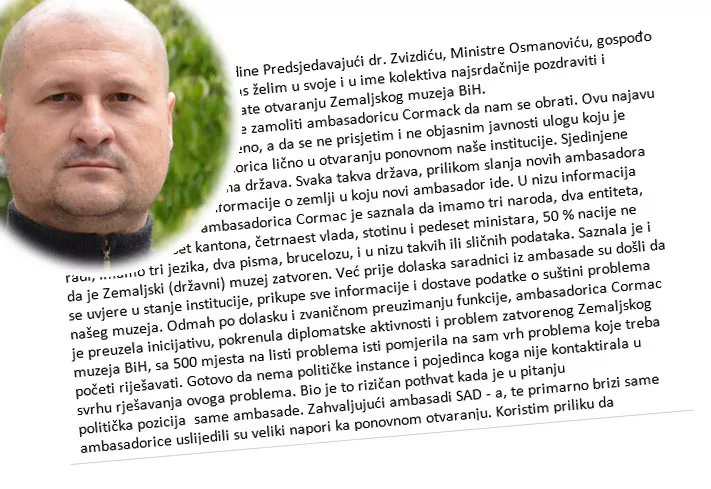
Director of the National Museum of Bosnia and Herzegovina, Professor Adnan Busuladžić, resigned from this position after the Museum reopened to visitors on Tuesday, three years after its doors were locked.
However, before resigning, which came like a bolt from the blue, Professor Busuladžić revealed the names of the people and institutions that helped in the reopening of the Museum. First and foremost, he highlighted the role of the U.S. Ambassador to Bosnia and Herzegovina, Maureen Cormack, who initiated the revival of one of the most significant institutions in Bosnia and Herzegovina.
Busuladžić also pointed out those who made life difficult for the Museum and him the entire time.
The news agency Patria transmits the integral speech of Professor Busuladžić in its entirety:
The opening of the Museum was initiated by Maureen Cormack
I cannot help but recall and explain to the public the role played in the opening of the Museum by the Embassy of the United States of America in Bosnia and Herzegovina and Ambassador Maureen Cormack personally.
The United States of America is a serious country. Every such country, when sending new ambassadors, also provides basic instructions and information about the country to which the new ambassador is going. Among the series of information that Ambassador Cormack must have received, she learned that we have three constituent peoples, two entities, one district, ten cantons, fourteen governments, one hundred and fifty ministers, 50% of the nation is unemployed, we have three languages, two scripts, brucellosis, and a series of such or similar data.
Cormack also learned that the National (State) Museum was closed.
Even before her arrival, associates from the embassy came to verify the condition of the institution, gather all information, and submit data on the essence of our museum's problem. Immediately upon her arrival and official assumption of duty, Ambassador Cormack took the initiative, launched diplomatic activities, and moved the problem of the closed National Museum of Bosnia and Herzegovina from 500th place on the list of problems to the very top of the problems that need to be addressed.
There is hardly a political instance or individual she did not contact for the purpose of solving this problem. It was a risky undertaking when it comes to the political position of the embassy itself. Thanks to the U.S. Embassy, and primarily the care of the Ambassador herself, great efforts towards reopening followed.
The person most deserving for initiating the resolution of the problem of the National Museum of Bosnia and Herzegovina is the Minister of Civil Affairs, Adil Osmanović. Through his immense effort, lobbying, and coordination of all municipalities, cantons, all the way to the state level, we have managed, I sincerely hope, to secure funds for the functioning of seven cultural institutions of national importance, and to initiate a legal battle and find solutions for the legal framework and operation of the National Museum of Bosnia and Herzegovina.
His direct contact, sincere attitude, permanent availability, expressed openness, and honest relationship truly surprised me and instilled faith in people, especially politicians. My life experience tells me that everything I condemned, I later did myself, and everything I praised turned out to be wrong. I hope and am convinced that in this regard there will be no mistake and that in Minister Osmanović we see a sincere straw of salvation.
Rešidat was attacked by those who do not understand culture
I also wish to thank the Minister of Culture and Sports of Sarajevo Canton, who also helped with the opening of the institution through his activities. Minister Samer Rešidat and Prime Minister Elmedin Konaković were the first to make their payments, thus helping the Museum to a significant extent. I must emphasize that thanks to Sarajevo Canton and its payments over the last three years, the institution was saved from complete collapse, because all the time we were settling obligations towards the power utility, maintaining the fire and burglar alarm systems, paying water and telephone bills, and buying chemicals for maintaining the collections.
Minister Rešidat has already stated on several occasions in the media about modalities for partial financing of the Museum, such as allocating part of the tourist tax. I am sorry that he was attacked because of these statements, apparently by those who do not know much about this issue.
I especially want to thank the numerous municipal mayors, prime ministers of the governments of Zenica-Doboj Canton, Bosnian-Podrinje Canton, and Tuzla Canton. I feel immense gratitude that these people are willing to allocate part of the funds from their budgets for our financing, and I thank them from the bottom of my heart most sincerely. In a normal situation, we from Sarajevo should be allocating for these regions, not the other way around.
I express gratitude to the association Akcija and their head Aida Kalender, BH Telecom, the company Grakop, Klas, Rad, Park, Bosnalijek, the Commission for the Preservation of National Monuments, UNESCO and their director Siniša Šešum, SIDA, CHWB, the Swedish Embassy, my dear professor Dr. Dubravko Lovrenović, Dr. Amra Hadžimuhamedović, the Federal Institute for the Protection of Monuments headed by director Lidija Mićić and Azer Aličić, attorney Emir Hasić who defended us from the brutal attacks of political bullies from the previous convocation of the Federal Government and the Council of Ministers (the Federal Minister of Culture and Sports in the previous convocation was Salmir Kaplan, and the state Minister of Civil Affairs was Sredoje Nović, editor's note).
Sidran, Seksan, Filipović...
I thank Prof. Dr. Mirko Pejanović who acted through amendments so that now the Government of the Federation of Bosnia and Herzegovina participates in partial financing. I also thank the Tax Administration of the Federation and its director, Mirsad Čolić, academician Abdulah Sidran, Nenad Veličković and Nenad Filipović, Vedrana Seksan, whose publicly spoken words were a true balm for my wounded soul. I thank the workers of Dita, the agencies DSC and Azkir, and many others.
For three years, I went to bed and woke up with the desire to make this known. I performed the duties of Director of the National Museum of Bosnia and Herzegovina completely free of charge. Namely, as a university professor, I did not want to receive two salaries. Finding myself in a moral dilemma to simply leave and walk away from the Museum, or to continue the legal battle, because at that moment I was the only legally fully authorized legal and legitimate person in the institution, I signed a service contract for 1 (one) convertible mark.
The idea for this information was given to me by the statement of the cantonal Prime Minister Konaković, that certain managers in public institutions of Sarajevo Canton have annual net incomes of up to 115,000 KM.
I admit that I am an incompetent manager
I admit that I am an incompetent manager, because unlike our social role models, in three years of struggle and hell, I received (and didn't even collect that) a total of 1 KM.
I also want to provide you with an analysis by my colleague Devleta Filipović, director of the Cinematheque of Bosnia and Herzegovina. Unfortunately, certain directors of institutions with unresolved status poured salt on my wounds with stories about alleged 'managerial operations and enthusiasm.' In these blatant lies, they forgot to mention that in 2014, they received, like the Historical Museum of Bosnia and Herzegovina, up to 55% more funds, and in 12 months they could distribute up to 18 salaries, unlike the National Museum of Bosnia and Herzegovina, and that is why they work, not because of infantile stories about 'commercial operations.'
After securing the monetary amounts for one year of operations, and the fact that all responsible parties now know that the Museum cannot survive without budget funds in the minimum amount for regular activities, I believe that I have largely achieved my goal. That goal implies that the Museum should be open, but that employees must receive a salary. Therefore, my mission as director ends here, and I submit a written resignation to the Minister of Civil Affairs, Mr. Adil Osmanović.
I want to say that I will remain during the transition period until new circumstances stabilize in the near future.
Finally, I want to ask my employees: have I in any way harmed them, curtailed their rights? Have I let them down, betrayed them, done anything wrong?
I pray to dear God that the dust of oblivion may fall upon my name, image, and work, because I love it most when I am anonymous.
I want to say at the very end that I worked as best I knew and could to save the institution, its treasure, and to stand in defense of the dignity of my employees. If in these efforts I have harmed anyone in any way, I ask friends and enemies, supporters and detractors, the media, politicians, the public, and especially my employees, to forgive me and grant me halal, and I forgive and grant halal to everyone for everything. The Museum is open, and the new Zoogeographic exhibition, welcome.
Komentari (0)
Prijavite se za komentiranje
PrijavaJos nema komentara. Budite prvi!
Minuta
Sve →Iz drugih kategorija

High Representative Not Elected: Germans, French and British Sabotaged Americans, New Attempt at End of June

ČOVIĆ WITHOUT MERCY: How Those Who Brought Ademović to Office Created a Political Hell for Him



Sunny Saturday, quite warm



Tragedy in Albanian resort: Two minors drown












